

On this page
A ball hitting a floor at an angle looks like a two-dimensional puzzle, but on a smooth surface it is two one-dimensional problems. Split the velocity the right way and the rebound angle and energy loss each take one line.
What happens when a ball hits a smooth floor at an angle?
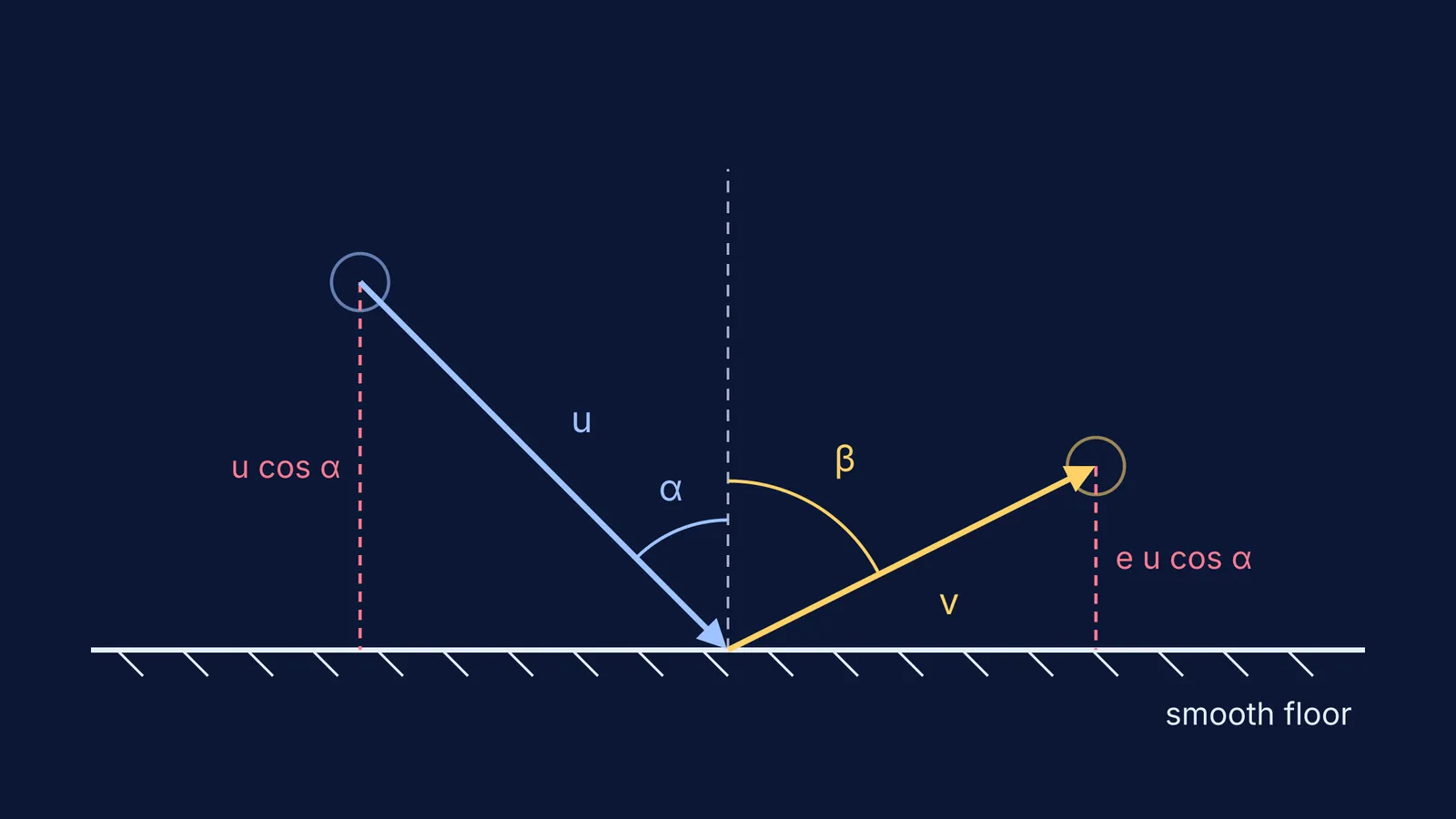
The University of Cambridge STEP mechanics notes give the rule for a smooth sphere striking a fixed surface in three parts: the impulse on the sphere acts perpendicular to the wall, Newton's experimental law applies to the velocity component perpendicular to the wall, and the component parallel to the wall is unchanged.
"Smooth" means no friction, so the floor can only push straight up.
The coefficient of restitution e is the ratio of the final to the initial magnitude of the relative velocity, as defined in this LibreTexts physics chapter_Conservation_of_Energy-_Kinetic_and_Gravitational/8.05%3A_Relative_Velocity_and_the_Coefficient_of_Restitution). The same source notes that e = 1 is elastic and e = 0 is totally inelastic. With a fixed floor, e applies only to the ball's normal component.
How do you find the rebound angle?
Let the ball arrive with speed u at angle α to the normal (the vertical, for a floor). Then:
Parallel component before: u sin α. After: u sin α, unchanged.
Normal component before: u cos α, towards the floor. After: e u cos α, away from the floor.
Rebound angle β to the normal: tan β = (u sin α) / (e u cos α) = tan α / e.
Rebound speed: v = u √(sin²α + e² cos²α).
Since e is less than 1, β is bigger than α: the ball leaves flatter than it arrived. For any slanted approach, the angles match only when e = 1.
How much kinetic energy is lost in an oblique bounce?
Under the smooth-surface rule only the normal component shrinks, so only its share of kinetic energy is lost. Before impact the kinetic energy is ½mu². After impact it is ½m(u² sin²α + e²u² cos²α). Subtracting gives the loss ½mu²(1 − e²)cos²α, so the fraction lost is (1 − e²)cos²α.
With e = 0.5, a straight-down bounce (α = 0°) loses 75% of the kinetic energy, a bounce at 60° to the normal loses about 19%, and a grazing hit at 80° loses about 2%.
Worked example: a 0.2 kg ball at 10 m/s, 45° to the normal, e = 0.5
Parallel component: 10 sin 45° = 7.07 m/s, unchanged on a smooth surface.
Normal component: 10 cos 45° = 7.07 m/s before; 0.5 × 7.07 = 3.54 m/s after.
Rebound angle: tan β = tan 45° / 0.5 = 2, so β = 63.4° from the normal.
Rebound speed: √(7.07² + 3.54²) = √62.5 = 7.91 m/s.
Kinetic energy: 10 J before, 6.25 J after, so 3.75 J is lost.
Check with the formula: (1 − 0.25) × cos²45° = 0.75 × 0.5 = 0.375, which is 37.5% of 10 J.
Impulse from the floor: m(1 + e)u cos α = 0.2 × 1.5 × 7.07 = 2.12 N s, straight up.
Step 6 is your self-check. If the two energy answers disagree, you applied e to the wrong component.
Which mistakes cost marks in oblique bounce problems?
Multiplying the whole speed by e instead of only the normal component.
Measuring α from the floor in one line and from the normal in the next.
Forgetting the sign flip: the normal component reverses direction.
Using momentum conservation for the ball alone; the floor's impulse changes the ball's momentum.
Applying the rule to an inclined plane without resolving along and perpendicular to the incline.
If you keep landing on the wrong component, the Fermi Problem Library has worked problems with a step-by-step solver that explains the reasoning rather than printing an answer. For the multi-bounce version, see our guide to total distance, time and nth height in bouncing ball problems, and for choosing a conservation law, when to use energy or momentum conservation in collisions.
When does the smooth-floor model break down?
Real floors have friction. In a 2002 American Journal of Physics study, Rod Cross measured the forces on obliquely bouncing balls and found that real balls do not roll when they bounce; instead the deformed contact region grips the surface. Friction changes the parallel component and makes the ball spin.
Even e is not fixed. In simulations of an elastic disk hitting an elastic wall, Hiroto Kuninaka and Hisao Hayakawa found that the coefficient of normal restitution can exceed one at oblique incidence and peaks at a particular angle. In JEE and board questions, "smooth" and a constant e are given assumptions: use them, but know they are a model.
To see how e changes what is lost, try our elastic vs inelastic collisions simulation. If restitution itself still feels shaky, the Fermi Concept Library gives every physics concept its own lesson and its place in the map.


