On this page
Stand under a tamarind tree at dusk and the feathery canopy seems to thin out. The National Tropical Botanical Garden describes tamarind as having pinnate leaves with 10 to 20 pairs of oblong leaflets which fold at night. The leaves are not wilting; they move on a schedule set by osmosis and a biological clock, two chapters you already study.
What is nyctinasty?
Nyctinasty is a daily swing in leaf position: by day the leaf blades sit roughly horizontal to catch sunlight, and at night they turn essentially vertical, according to a 2019 review in Biological Reviews by Peter Minorsky. A 2018 paper in Current Biology notes that the circadian leaf opening and closing of the legume family, Fabaceae, has interested scientists since Charles Darwin's time. Tamarind, Samanea saman and the touch-me-not Mimosa pudica are all legumes.
For exams, keep it apart from the touch-me-not's quick folding when poked, which is a separate response to touch.
How does a pulvinus fold a leaf?
The moving part is the pulvinus, a swollen motor organ at the base of each leaf and leaflet, as described in a 2012 New Phytologist study of the model legume Medicago truncatula. When a mutation turned those pulvini into stalk-like tissue, the leaflets stopped moving at night.
A classic 1974 study of Samanea saman put the mechanism in one line: leaflet movement results from differential changes in the turgor and shape of motor cells on opposite sides of the pulvinus. The two sides are called the extensor and the flexor. In the same study, white light switched on outward potassium pumps in the flexor cells.
The sequence to draw in your notebook:
Ion channels in the motor cells on one side open, and potassium ions and anions flow out.
With fewer solutes inside, those cells have a higher water potential than their surroundings, so water leaves by osmosis.
Those cells lose turgor and shrink, while motor cells on the opposite side take up ions and water and swell.
The pulvinus bends towards the shrinking side, like a hinge, and the leaflet swings up or down.
At dawn the ion traffic reverses and the leaflet opens again.
In 2018, Takaya Oikawa, Minoru Ueda and colleagues identified three ion channels in Samanea saman, the anion channels SsSLAH1 and SsSLAH3 and the potassium channel SPORK2, and showed that clock-timed, cell-specific production of SsSLAH1 plays a key role in opening the leaf, working with SsSLAH3 in the flexor cells.
Is it the light or an internal clock?
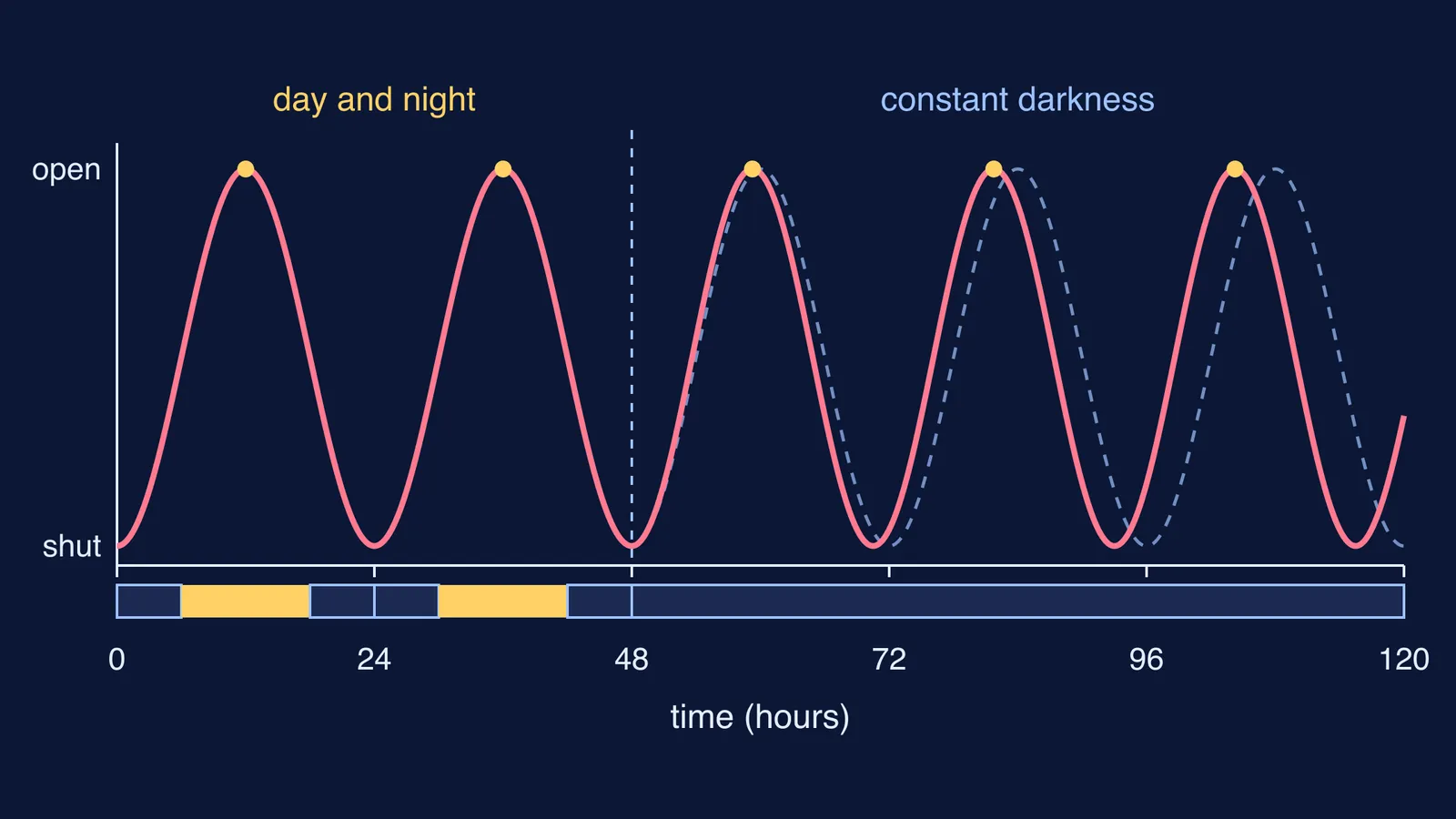
Both. In 1729 de Mairan reported that the daily leaf movements of a sensitive plant persisted in constant darkness; he had kept the plant in a cupboard. That pointed to a clock inside the plant.
A 2006 Plant Cell review by C. Robertson McClung records that in 1832 de Candolle measured the free-running period of Mimosa pudica at 22 to 23 hours, shorter than a day. Light acts as a time-giver (a zeitgeber) that resets the clock to the real 24-hour day. Samanea leaflets also keep their circadian rhythm in prolonged darkness.
Why would a leaf fold at night?
Nobody has settled this. Minorsky's review lists four older ideas: better temperature relations, shedding surface water, stopping moonlight from upsetting the plant's sense of day length, and deterring insects. It adds a fifth: with leaves folded, bats and owls may spot plant-eating insects more easily. All five remain hypotheses.
Try it: a six-day leaf-clock experiment
You can repeat de Mairan's test with a potted touch-me-not or a tamarind seedling.
Days 1 to 2: photograph the same leaf at 6 am, noon, 6 pm and 10 pm. Score each photo 0 (shut) to 3 (fully open).
Day 3, morning: once the leaves are open, move the pot into a dark cupboard. Water it first and do not touch it.
Days 3 to 5: open the cupboard only briefly, in dim light, at the same four times, and score the leaf again.
Day 6: return the plant to a sunny window.
How to read your results:
The leaves keep opening and closing in the dark: you are watching the clock.
The leaves stay shut in the dark: in your plant the light response is stronger than the clock, or your peeks reset it.
The opening drifts earlier (or later) each day: the clock is free-running. At 22.5 hours, the middle of de Candolle's 22-to-23-hour range, a leaf that opened at 6:00 would open near 4:30 the next day and near 3:00 the day after.
If osmosis, water potential or turgor still feel shaky, the Fermi Concept Library gives each concept its own lesson and its place in the map. Not sure where to start? Fermi's AI tutor can work out what you already know and build a plan for the session.
Tonight, look at a tamarind or touch-me-not after dark and work out which side of each pulvinus has just lost its water.