

On this page
A mango tree never eats, yet it grows every year, because it makes its own food. That is the Class 7 topic "nutrition in plants". Once you know the four things a leaf needs, the rest of the chapter falls into place.
What is nutrition in plants?
NCERT's Class 7 chapter Nutrition in Plants defines nutrition as the mode of taking food by an organism and its utilisation by the body.
Organisms that make their own food from simple substances are autotrophs, so plants are autotrophs. Animals and most other organisms take in food prepared by plants; they are heterotrophs.
Check which book your school uses. In the older NCERT science book, this topic is Chapter 1. The newer Curiosity textbook covers it in Chapter 10, Life Processes in Plants, along with transport and respiration. Photosynthesis is the same in both.
How do plants make food by photosynthesis?
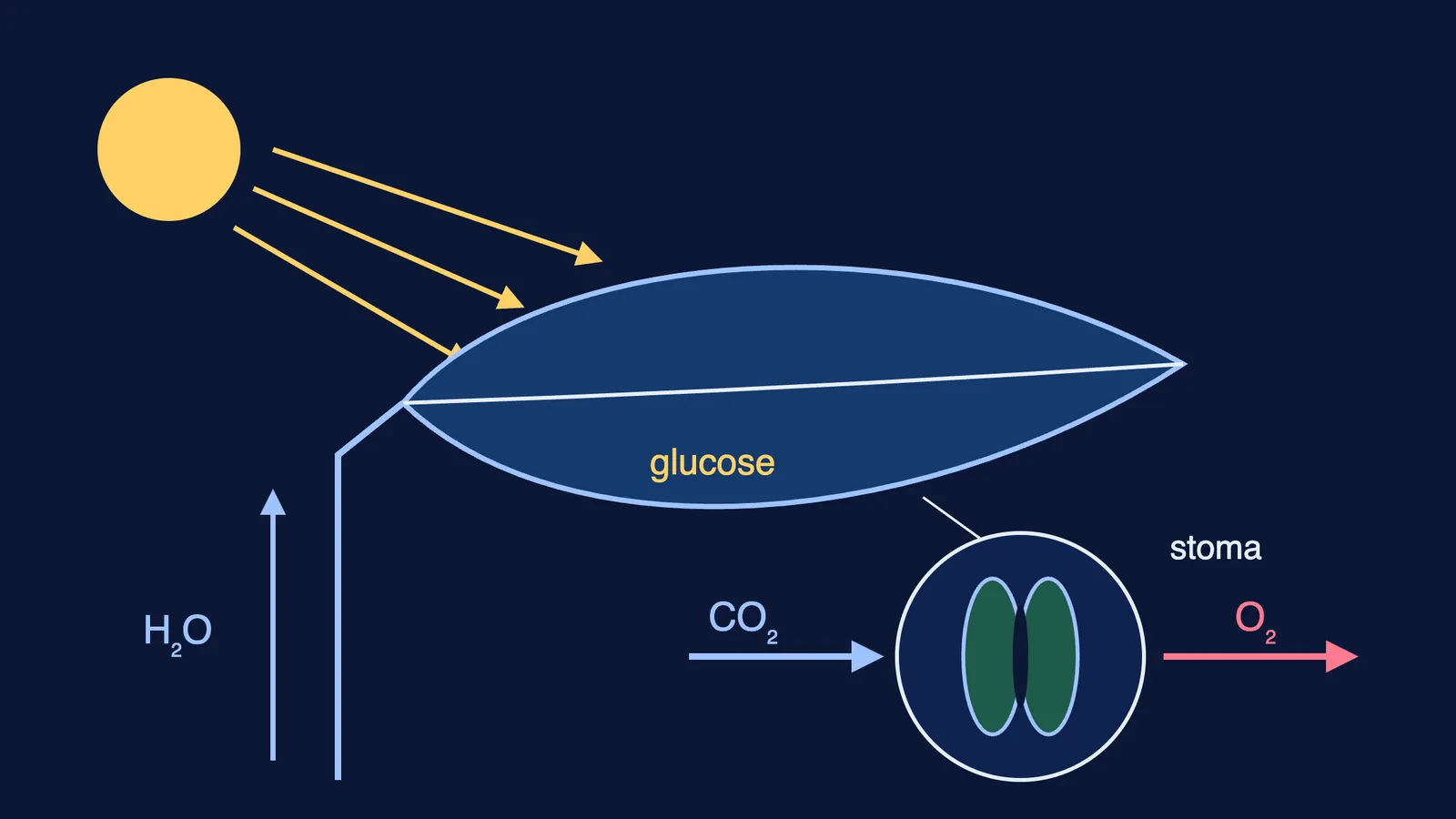
Leaves are the food factories of plants. The older chapter lists four things a plant needs to make food: chlorophyll, sunlight, carbon dioxide and water (NCERT, Chapter 1). Chlorophyll, the green pigment, captures the energy of sunlight. Water and minerals come up from the roots, and carbon dioxide enters from the air.
The Curiosity book writes the word equation like this (NCERT Curiosity, Chapter 10):
Carbon dioxide + water → (sunlight, chlorophyll) → glucose + oxygen
The older book writes "carbohydrate" where Curiosity writes "glucose". Both are right: the glucose gives the plant energy straight away and is later converted into starch for storage. Our explainer on why plants store starch instead of glucose takes this one step further.
Green stems make food too. Red or violet leaves also contain chlorophyll; other pigments hide the green.
To show that a leaf has made food, Curiosity's Activity 10.2 softens it in boiling water, removes its colour in alcohol and adds dilute iodine: blue-black means starch. In Activity 10.3, a plant kept in the dark for 36 hours makes no starch. In Activity 10.4, the half of a leaf sealed in a bottle with caustic soda (sodium hydroxide), which absorbs carbon dioxide, makes no starch, so carbon dioxide is needed too. Many labs use potassium hydroxide instead; we explain why KOH is used to show CO2 is needed for photosynthesis.
What are stomata and what do they do?
Stomata are tiny pores on the surface of leaves, surrounded by guard cells (NCERT, Chapter 1).
Carbon dioxide enters and oxygen leaves through them, and the Curiosity chapter adds that stomata also exchange gases during respiration (NCERT Curiosity, Chapter 10). To see stomata, as in Curiosity's Activity 10.6 (a teacher demonstration), peel a thin layer from the lower surface of a rhoeo leaf, add a drop of ink and look under a microscope.
Which plants do not make their own food?
The older chapter (NCERT, Chapter 1) gives these examples:
Parasite: Cuscuta (amarbel), a yellow, wiry plant with no chlorophyll, takes ready-made food from the plant it climbs on, called the host.
Insectivorous plant: the pitcher plant's leaf traps and digests insects, yet the plant is green and photosynthesises. Read why insectivorous plants eat insects but still photosynthesise.
Saprotrophs: fungi such as mushrooms and bread mould absorb nutrients from dead and decaying matter.
Symbiosis: in lichens, an alga makes food while a fungus gives it shelter, water and minerals. Rhizobium in the roots of gram, peas and moong gives the plant nitrogen it can use, in return for food and shelter.
The Curiosity chapter focuses on green plants, so if that is your book, ask your teacher whether these examples are in your test.
How do you write a full-marks answer?
Take Exercise question 4 from the older chapter: "Give a brief description of the process of synthesis of food in green plants." A strong answer covers five points:
Green plants make their own food by photosynthesis, so they are autotrophs.
Water and minerals reach the leaf from the roots; carbon dioxide enters through the stomata.
Chlorophyll in the leaf captures the energy of sunlight.
Carbon dioxide + water → (sunlight, chlorophyll) → carbohydrate (glucose) + oxygen.
Oxygen is released, and the food is stored as starch, which the iodine test shows.
If autotroph, heterotroph and saprotroph still blur together, the Fermi Concept Library gives each concept its own lesson and its place in the map. If you don't know where to start, Fermi's AI tutor can work out what you already know and build a plan for the session.
Before the test, draw the leaf once more and check that every arrow points the right way.


