

On this page
"How many spectral lines are possible?" is a common question in Class 11 and JEE practice. The formula is short. The marks go to students who know which version the question wants.
How many spectral lines when an electron falls from the nth level?
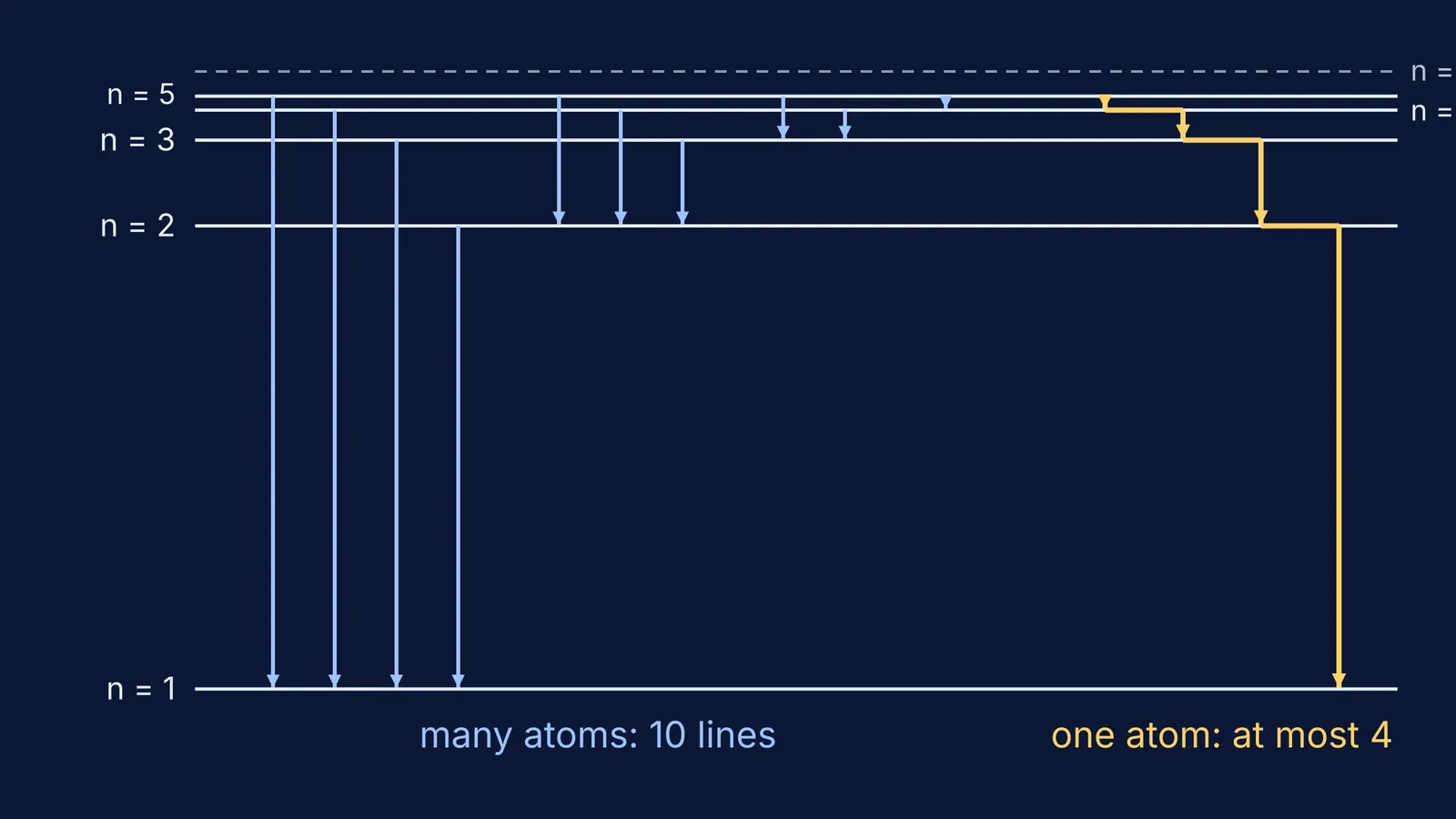
For a sample of hydrogen, the number of possible emission lines when electrons fall from level n down to n = 1 is n(n − 1)/2.
The physics behind this is in the NCERT Class 11 Chemistry chapter Structure of Atom. A photon is emitted when an electron drops from a higher orbit to a lower one, and its energy is the gap between the two levels, ΔE = 2.18 × 10⁻¹⁸ J (1/n_i² − 1/n_f²). The same chapter says each spectral line can be linked to one particular transition. It also says a large number of hydrogen atoms produces a large number of lines, because different atoms make different transitions.
So from n = 3 you get 3 lines, from n = 4 you get 6, from n = 5 you get 10 and from n = 6 you get 15.
Why is the formula n(n − 1)/2?
Every line comes from one pair of levels, an upper level and a lower one. With n levels in play, you pick 2 of them, and the number of ways to do that is nC2 = n(n − 1)/2. Order is fixed, because in emission the electron always goes down.
For n = 4 the pairs are 4→3, 4→2, 4→1, 3→2, 3→1 and 2→1. That makes six.
Why does a single atom give at most n − 1 lines?
The caption of Fig. 2.10 in the NCERT chapter states that a single atom can be in only one excited state at a time, while a whole sample contains all possible excited states.
One electron starting at level n takes one path down. It gives off the most photons when it stops at every level on the way: n → n − 1 → … → 1. That is n − 1 jumps, so at most n − 1 lines from one atom. If it skips a level, it gives fewer.
How do you count lines between any two levels?
Often the electron does not fall all the way to the ground state. If it falls from n₂ to n₁, only the levels from n₁ to n₂ take part. That is Δn + 1 levels, where Δn = n₂ − n₁. Put that in place of n:
Sample of atoms: Δn(Δn + 1)/2 lines
Single atom: at most Δn lines
Lines in one series only (all ending on level n₁): n₂ − n₁ lines
The NCERT table of spectral series names which lower level each series ends on: Lyman ends on n = 1 (ultraviolet), Balmer on n = 2 (visible) and Paschen on n = 3 (infrared), as given in Table 2.3 of the chapter.
Worked example: electrons fall from n = 6 to n = 2
Question: In a sample of hydrogen atoms, electrons fall from n = 6 and stop at n = 2. How many lines are possible? How many are in the Balmer series? What is the most one atom can give?
Levels involved: 2, 3, 4, 5, 6. So Δn = 6 − 2 = 4.
Sample: Δn(Δn + 1)/2 = 4 × 5/2 = 10 lines.
Check by listing: 6→5, 6→4, 6→3, 6→2, 5→4, 5→3, 5→2, 4→3, 4→2, 3→2. That makes ten.
Balmer lines are the ones ending on n = 2: 6→2, 5→2, 4→2, 3→2. That makes four, matching n₂ − n₁ = 4.
One atom: at most Δn = 4 lines, by stepping 6→5→4→3→2.
As a cross-check, NCERT's Problem 2.10 works out the 5→2 transition and gets a visible Balmer line at 434 nm (NCERT, Structure of Atom). That line is one of the four you just counted.
The count depends only on which levels are involved, so it works the same way for hydrogen-like ions such as He⁺. Our explainer on matching spectral lines of He⁺ and hydrogen shows how their lines line up. For the history of the formula behind every line, read our profile of Johannes Rydberg and his spectral formula.
Three checks before you write the answer
Sample or single atom? This decides between n(n − 1)/2 and n − 1.
Where does the fall stop? If it stops above n = 1, use Δn, not n.
All lines or one series? "How many Balmer lines" asks only for transitions ending on n = 2.
If you get the number right but keep picking the wrong version, work through a few mixed questions in the Fermi Problem Library, where a step-by-step solver explains the reasoning rather than printing an answer. If energy levels themselves still feel shaky, the Fermi Concept Library gives each concept its own lesson, and our post on watching the Bohr model build the hydrogen spectrum shows the transitions as they happen.


