On this page
Matrix-counting questions come down to one idea: each entry is a free choice unless a condition ties entries together. Every step is shown below, so you can reuse the method in JEE practice.
How many 2x2 matrices have entries 0 or 1?
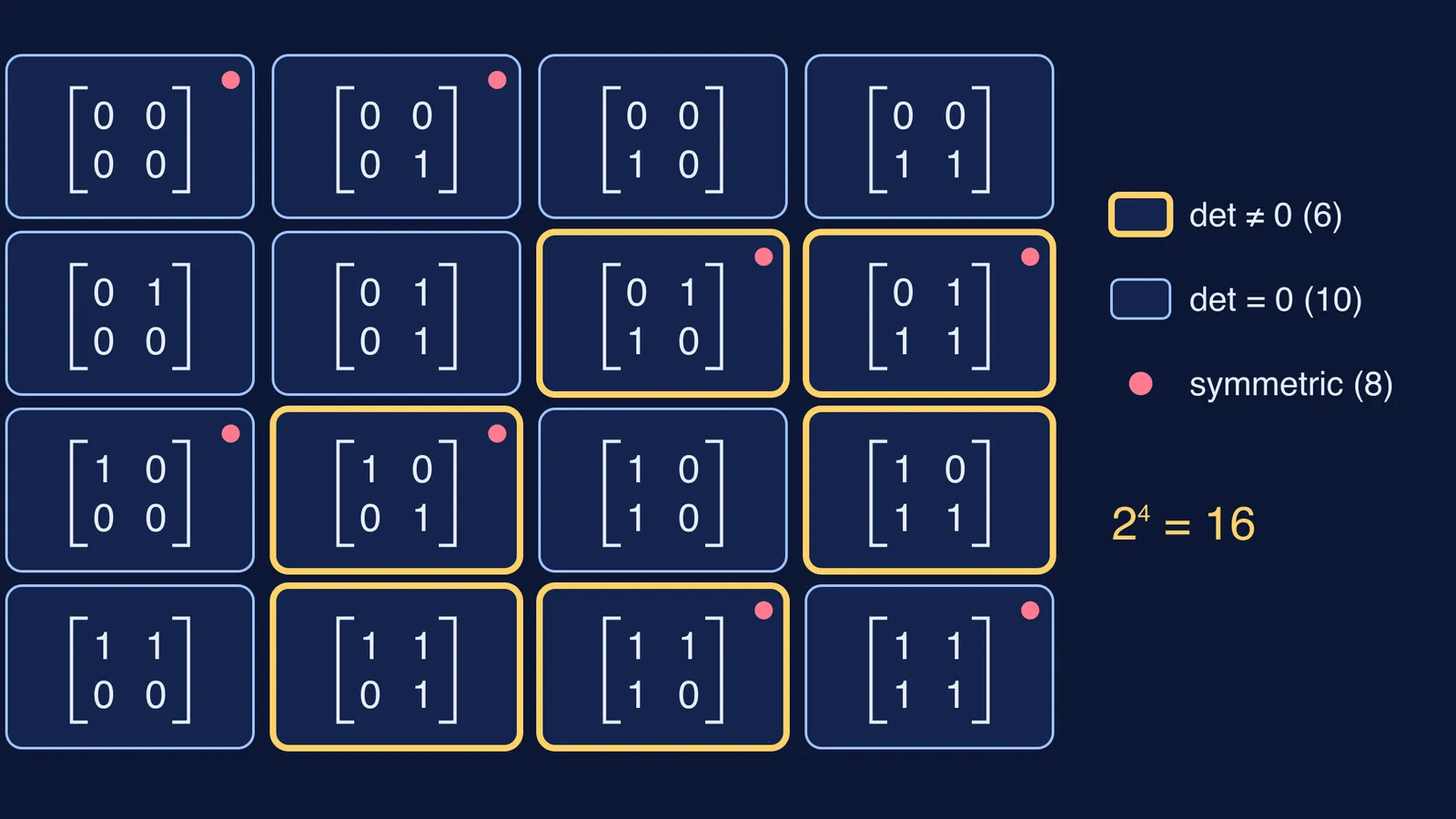
An m × n matrix has mn elements, as the NCERT Class 12 chapter on matrices states. A 2x2 matrix therefore has 4 entries, and each can be 0 or 1 independently of the others. By the multiplication principle, the count is 2 × 2 × 2 × 2 = 2^4 = 16.
The general rule: if each of the mn entries can take any of k values, there are k^(mn) matrices. The same NCERT chapter asks for the 3x3 case in Exercise 3.1, question 10, with options 27, 18, 81 and 512; the answer is 2^9 = 512. We walk through that version in counting 3x3 matrices with entries 0 or 1.
How many 2x2 matrices with entries 0 or 1 are symmetric?
A square matrix A is symmetric if A′ = A, that is, a_ij = a_ji for every i and j (NCERT, Definition 4).
Write the 2x2 matrix with rows (a, b) and (c, d). Symmetry only demands b = c. So a, b and d are free, and c is copied from b. That gives 2^3 = 8 symmetric matrices.
For an n × n matrix, the free entries are the diagonal and everything above it: n(n + 1)/2 of them. So there are k^(n(n+1)/2) symmetric matrices, which is 2^6 = 64 for a 3x3 matrix with entries 0 or 1. A skew-symmetric matrix needs every diagonal entry to be 0 and a_ji = −a_ij, so with entries only from {0, 1} the zero matrix is the only one. For more on both types, read symmetric and skew-symmetric matrices explained.
How many are singular, and how many have determinant 1?
A matrix is singular when its determinant is 0; for the matrix above, det = ad − bc. Split this into two products. The product ad equals 1 only when a = d = 1, which is 1 of the 4 choices for (a, d); in the other 3 it equals 0. The product bc behaves the same way.
Now match the products:
det = 1 needs ad = 1 and bc = 0: 1 × 3 = 3 matrices.
det = −1 needs ad = 0 and bc = 1: 3 × 1 = 3 matrices.
det = 0 needs ad = bc: 1 × 1 + 3 × 3 = 10 matrices.
Check: 3 + 3 + 10 = 16. So 10 matrices are singular and 6 are invertible. The On-Line Encyclopedia of Integer Sequences lists 10 singular {0, 1}-matrices of order 2 and 338 of order 3 (OEIS A046747). It lists 6 invertible ones of order 2 and 174 of order 3 (OEIS A055165). For the idea behind the word, read what a singular matrix means.
Questions often combine conditions. For symmetric and singular, set b = c, so you need ad = b^2. If b = 0, then ad = 0 gives 3 matrices; if b = 1, then a = d = 1 gives 1 more, the all-ones matrix. That makes 4, so the other 4 symmetric matrices are invertible.
What changes if the entries come from {−1, 0, 1}?
The same counting rule from the NCERT chapter applies with k = 3. There are 3^4 = 81 matrices and 3^3 = 27 symmetric ones. Of the 9 choices for (a, d), the product ad is 0 in 5, equals 1 in 2, namely (1, 1) and (−1, −1), and equals −1 in 2. The product bc behaves identically.
det = 0: 5 × 5 + 2 × 2 + 2 × 2 = 33 matrices.
det = 1: (ad, bc) = (1, 0) or (0, −1), so 2 × 5 + 5 × 2 = 20 matrices.
det = −1: likewise 20.
det = 2: ad = 1 and bc = −1, so 2 × 2 = 4.
det = −2: likewise 4.
The total is 33 + 20 + 20 + 4 + 4 = 81, so 48 of these matrices are invertible.
How do you solve any matrix-counting MCQ?
Write the matrix with letters and note the condition.
Count the free entries. Conditions such as symmetry remove choices; the rest multiply.
For a determinant condition, split the determinant into products and list how often each product value occurs.
Add the matching cases.
If your answer does not match, check step 3 first. The Fermi Problem Library has worked problems with a step-by-step solver that explains the reasoning rather than printing an answer, so you can see which case you dropped. For the definitions behind each step, the Fermi Concept Library gives every mathematics concept its own lesson.
Next, try counting the 2x2 matrices with entries from {0, 1, 2} that have determinant 0, using the same four steps.