

On this page
Protons in a nucleus repel each other electrically, yet the nucleus holds. The nuclear force is what wins. Class 12 board and entrance-exam questions on it usually come in three forms: a list of properties, one graph and true-or-false statements. Here is each, with the reasoning "explain why" questions want.
What are the properties of nuclear force?
The NCERT Class 12 Physics chapter on nuclei (Chapter 13, Section 13.5) lists the features, which it says were found from experiments carried out between 1930 and 1950.
Very strong. The nuclear force is much stronger than the Coulomb force and far stronger than gravity, strong enough to hold protons together.
Short range. The nuclear force between two nucleons falls rapidly to zero once they are more than a few femtometres apart (1 fm = 10⁻¹⁵ m).
Charge independent. The nuclear force between neutron-neutron, proton-neutron and proton-proton pairs is approximately the same.
Saturating. Because the range is short, a nucleon in a large nucleus feels only its near neighbours.
No simple formula. Unlike Coulomb's law or Newton's law of gravitation, the nuclear force has no simple mathematical form.
HyperPhysics notes that Hideki Yukawa judged the range of the nuclear force to be about a fermi and calculated that the exchange particle should be in the neighbourhood of 100 MeV in mass equivalent (HyperPhysics, exchange forces). In written answers, NCERT's own wording, "falls rapidly to zero beyond a few femtometres", is the phrase to use.
What does the potential energy curve between two nucleons show?
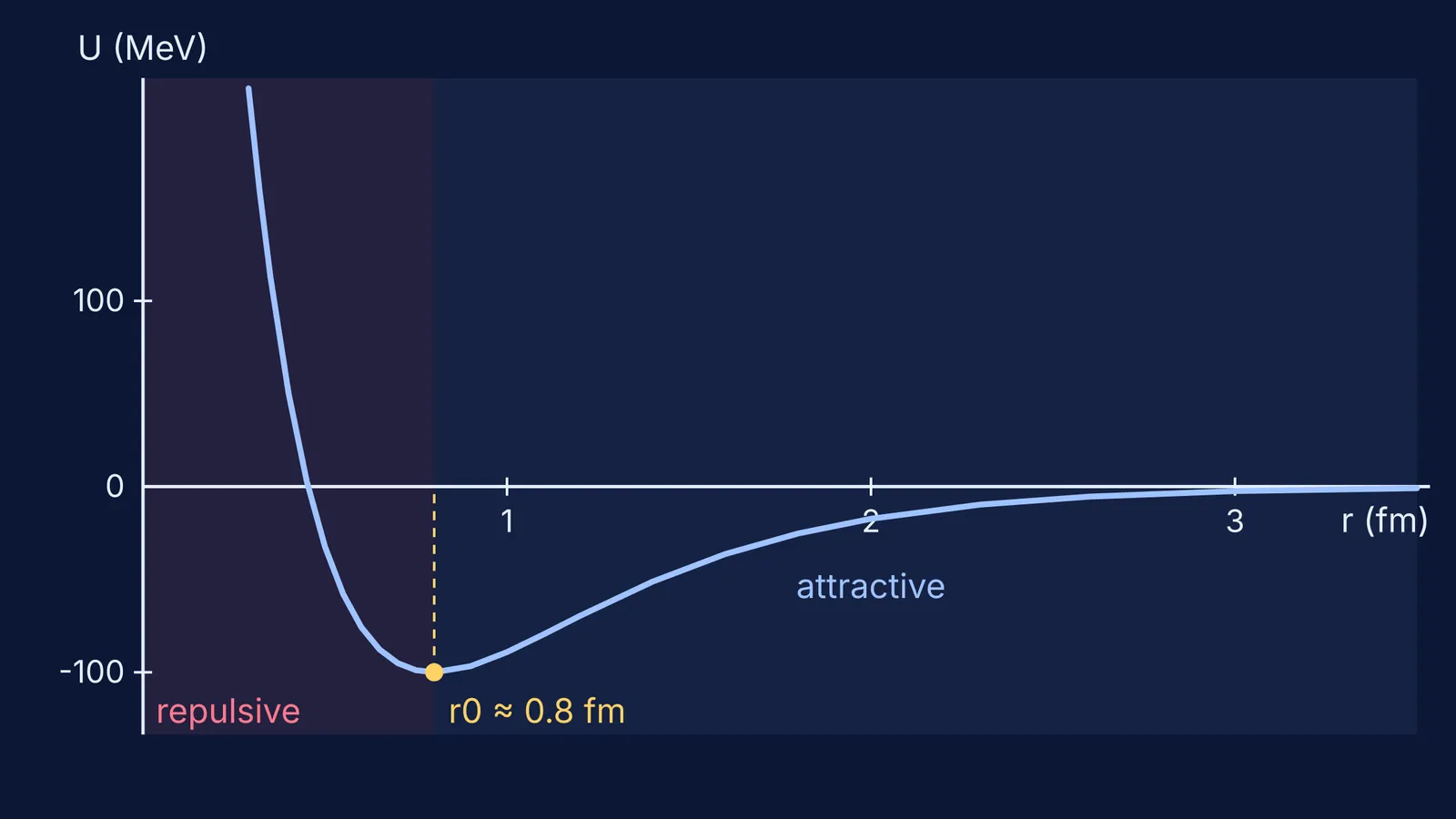
NCERT's Fig. 13.2, redrawn as the diagram at the top of this post, plots the potential energy U of a pair of nucleons against their separation r. The potential energy is a minimum at a distance r0 of about 0.8 fm (NCERT, Section 13.5). Read the curve in three zones:
r greater than about 0.8 fm: U rises as r grows, so the force (F = −dU/dr) pulls the nucleons together. Attractive.
r less than about 0.8 fm: the curve shoots up steeply, so the force is strongly repulsive and nucleons cannot crowd together.
r beyond about 3 fm: the curve flattens out close to zero, so the force is negligible. That flat tail is the short range.
How does saturation explain constant binding energy per nucleon?
NCERT's binding energy curve shows that binding energy per nucleon is practically constant for middle mass numbers (30 < A < 170), with a maximum of about 8.75 MeV at A = 56 and a value of 7.6 MeV at A = 238 (NCERT, Section 13.4.2). The chapter's reasoning: if a nucleon can have at most p neighbours within range, its binding energy is proportional to p, so adding more nucleons barely changes the binding of one deep inside.
Worked example: what if the force did not saturate? Suppose every nucleon attracted every other, the way gravity works. A nucleus of A nucleons has A(A − 1)/2 pairs. Going from A = 50 to A = 100 takes the pairs from 1,225 to 4,950, about four times as many, so binding energy per nucleon would roughly double. The real curve barely moves across that range: that mismatch is the evidence for saturation.
Saturation also explains constant density. NCERT gives R = R0A^(1/3) with R0 = 1.2 fm, so volume grows with A and nuclear density, about 2.3 × 10¹⁷ kg m⁻³, is the same for all nuclei (NCERT, Section 13.3). Copper-64 has 4/3 the radius of aluminium-27, since (64/27)^(1/3) = 4/3, but the same density. This liquid-drop picture is the one Bohr and Wheeler used to explain nuclear fission.
Which nuclear force statements do exams test?
Cover the answers, judge each statement, then write the one-line reason, which is where "explain" marks sit.
"Nuclear force is charge dependent." False: n-n, n-p and p-p forces are approximately the same.
"Nuclear force obeys an inverse square law." False: it has no simple mathematical form and dies out far faster than 1/r².
"Nuclear force is always attractive." False: it is strongly repulsive below about 0.8 fm.
"Each nucleon attracts every other nucleon in the nucleus." False: saturation means only near neighbours count.
"The nuclear force has to dominate over the Coulomb repulsion between protons inside the nucleus." True: NCERT says so directly, and it is why the nucleus holds together.
"Binding energy per nucleon is nearly constant for 30 < A < 170 because the nuclear force is short-ranged." True: this is NCERT's own argument.
If one property keeps slipping, the Fermi Concept Library gives each concept in physics its own lesson and its place in the map. For numericals, the Fermi Problem Library has worked problems with a step-by-step solver that explains the reasoning rather than printing an answer.
Next, put binding energy to work: learn how to calculate the Q value of a nuclear reaction and why mass number is conserved but mass is not.


