

On this page
You mix lead nitrate and potassium iodide in the lab, a bright yellow solid appears, and the question asks for the net ionic equation. Marks are often lost in four ways: splitting what should stay whole, keeping ions that should cancel, missing state symbols, or never checking charge. Here is a method that guards against all four.
What is a net ionic equation?
The same reaction can be written three ways. OpenStax Chemistry 2e calls the usual balanced equation a molecular equation because it "doesn’t explicitly represent the ionic species that are present in solution" (OpenStax Chemistry 2e, section 4.1). A complete ionic equation replaces every dissolved ionic compound with its separate ions. The net ionic equation then drops the ions that appear unchanged on both sides.
Spectator ions are ions that are needed for charge neutrality but are "neither chemically nor physically changed by the process", in the OpenStax definition. The LibreTexts introductory text puts it more simply: a spectator ion "is found in solution both before and after the reaction" (LibreTexts, Net Ionic Equations/16:_Solutions/16.18:_Net_Ionic_Equations)).
How do you write a net ionic equation step by step?
Write the balanced molecular equation with a state symbol on every species: (s), (l), (g) or (aq).
Split only dissolved strong electrolytes into ions: soluble salts, strong acids and strong bases. OpenStax lists six common strong acids: HCl, HBr, HI, HNO₃, HClO₄ and H₂SO₄ (OpenStax Chemistry 2e, section 4.2).
Keep whole: precipitates, gases, liquid water, weak acids and weak bases. Weak acids "only partially react with water, leaving a large majority of dissolved molecules in their original form" (OpenStax, section 4.2), so you write them as molecules.
Cancel every ion that appears with the same formula and the same state on both sides. If all the coefficients share a factor, divide it out.
Check atoms and charge. "Balancing by charge means making sure that the overall charge is the same on both sides of the equation" (LibreTexts/16:_Solutions/16.18:_Net_Ionic_Equations)).
If you are unsure which compounds count as strong electrolytes, our guide to strong, weak and non-electrolytes with examples sorts the common ones.
Worked example: how do you find the spectator ions in a precipitation reaction?
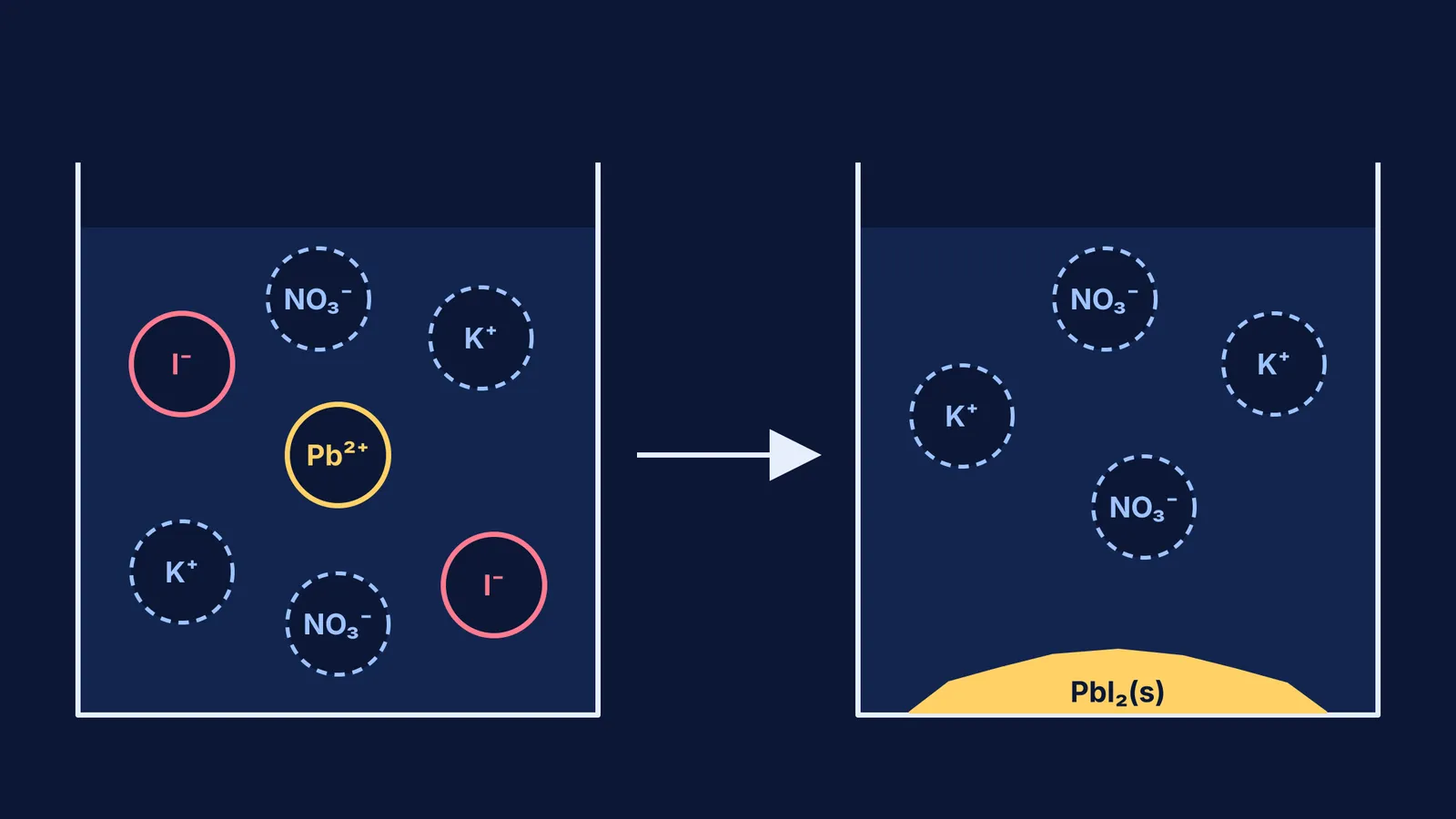
Take lead nitrate and potassium iodide.
Molecular: Pb(NO₃)₂(aq) + 2KI(aq) → PbI₂(s) + 2KNO₃(aq)
Complete ionic: Pb²⁺(aq) + 2NO₃⁻(aq) + 2K⁺(aq) + 2I⁻(aq) → PbI₂(s) + 2K⁺(aq) + 2NO₃⁻(aq)
Net ionic: Pb²⁺(aq) + 2I⁻(aq) → PbI₂(s)
K⁺ and NO₃⁻ are the spectators. PbI₂ stays whole because it is a solid. Charge check: +2 + 2(−1) = 0 on the left, 0 on the right. This is the same pattern as the OpenStax silver chloride example, whose net ionic equation is Cl⁻(aq) + Ag⁺(aq) → AgCl(s) (OpenStax, section 4.1). To decide whether a precipitate forms at all, see how to identify a precipitation reaction.
What about gases, water and weak acids?
Sodium carbonate with hydrochloric acid gives a gas:
Molecular: Na₂CO₃(aq) + 2HCl(aq) → 2NaCl(aq) + H₂O(l) + CO₂(g)
Net ionic: CO₃²⁻(aq) + 2H⁺(aq) → H₂O(l) + CO₂(g)
Na⁺ and Cl⁻ cancel; CO₂ and water stay whole. Charge: −2 + 2 = 0 on the left, 0 on the right. Many school books write H⁺(aq); OpenStax writes the same species as H₃O⁺(aq), giving the strong acid and strong base equation H₃O⁺(aq) + OH⁻(aq) → 2H₂O(l) (OpenStax, section 4.2). Pick one form and use it throughout an answer.
Now acetic acid with sodium hydroxide:
Molecular: CH₃COOH(aq) + NaOH(aq) → CH₃COONa(aq) + H₂O(l)
Net ionic: CH₃COOH(aq) + OH⁻(aq) → CH₃COO⁻(aq) + H₂O(l)
Only Na⁺ is a spectator. Writing H⁺ + OH⁻ → H₂O here is a common slip: acetic acid is weak, so it stays as a molecule.
If one type of reaction keeps tripping you up, the Fermi Problem Library has worked problems with a step-by-step solver that explains the reasoning rather than printing an answer, so you can see which step went wrong.
How do you check charge balance?
Atoms can balance while charge does not. Try copper in silver nitrate: Cu(s) + Ag⁺(aq) → Cu²⁺(aq) + Ag(s). There is one Cu and one Ag on each side, but the charge is +1 on the left and +2 on the right. Put a 2 in front of both silver species: Cu(s) + 2Ag⁺(aq) → Cu²⁺(aq) + 2Ag(s). Now both sides are +2.
Run this checklist on every answer before you move on:
Every (aq) strong electrolyte is split, and nothing else is
No ion appears unchanged on both sides
Every species has a state symbol
Atoms match, element by element
Total charge matches
Coefficients are the lowest whole numbers
The same check works on an answer from a chatbot; see how to check if an AI balanced your chemical equation. If the gap is earlier, in what an electrolyte is, the Fermi Concept Library has a lesson for every concept in chemistry. Then take five reactions from your textbook and write all three equations for each.


