

On this page
Generative AI can be a helpful study partner for chemistry, but it is not a flawless calculator. When you ask a language model to balance a complex chemical reaction, it does not "do the math" the way a traditional algebraic solver does. Instead, it predicts the next most likely text token based on its training data.
Because balancing equations relies on a rigid sequence of logical and mathematical dependencies, this probabilistic text generation often falls short. The model might start balancing oxygen correctly, but forget to update the carbon count in a subsequent step, leading to a mathematically impossible final answer.
A 2024 study published in the *Journal of Chemical Education* evaluated ChatGPT-4.0 on chemistry questions from Spanish university entrance exams. The researchers found that while the AI outperformed average students conceptually, it still committed errors in approximately 20% of its responses, frequently stumbling during logical development or numerical calculations (DOI: 10.1021/acs.jchemed.4c00231).
Because models often present incorrect coefficients with absolute confidence, you cannot simply copy the final answer. You must verify the conservation of mass and the conservation of charge yourself.
Is the AI chemical equation balanced?
To verify an AI's output, you must perform a manual audit of the final equation. Language models often suffer from compounding errors, where a small mistake in counting atoms in the first step invalidates the entire balanced equation.
Here is a practical checklist to run through every time an AI balances a reaction for you:
Write down the AI's final equation: Ignore the intermediate explanatory text and look only at the final reaction it provides.
Check the chemical formulas: A common AI hallucination is changing a subscript to force the math to work (for example, changing H₂O to H₂O₂). Ensure that the identity of the reactants and products has not been altered.
Count the atoms: Create a T-chart. List every element present. Multiply the coefficient by the subscript for each element on the reactant side, and compare it to the product side. They must be perfectly equal.
Check the net charge: If the equation contains ions, add up the total electrical charge on the left side and compare it to the right side. This is where AI models fail most frequently.
Why is charge conservation essential in redox reactions?
When dealing with simple combustion or precipitation reactions, counting the atoms is usually enough. However, in redox (reduction-oxidation) reactions, electrons are transferred between species.
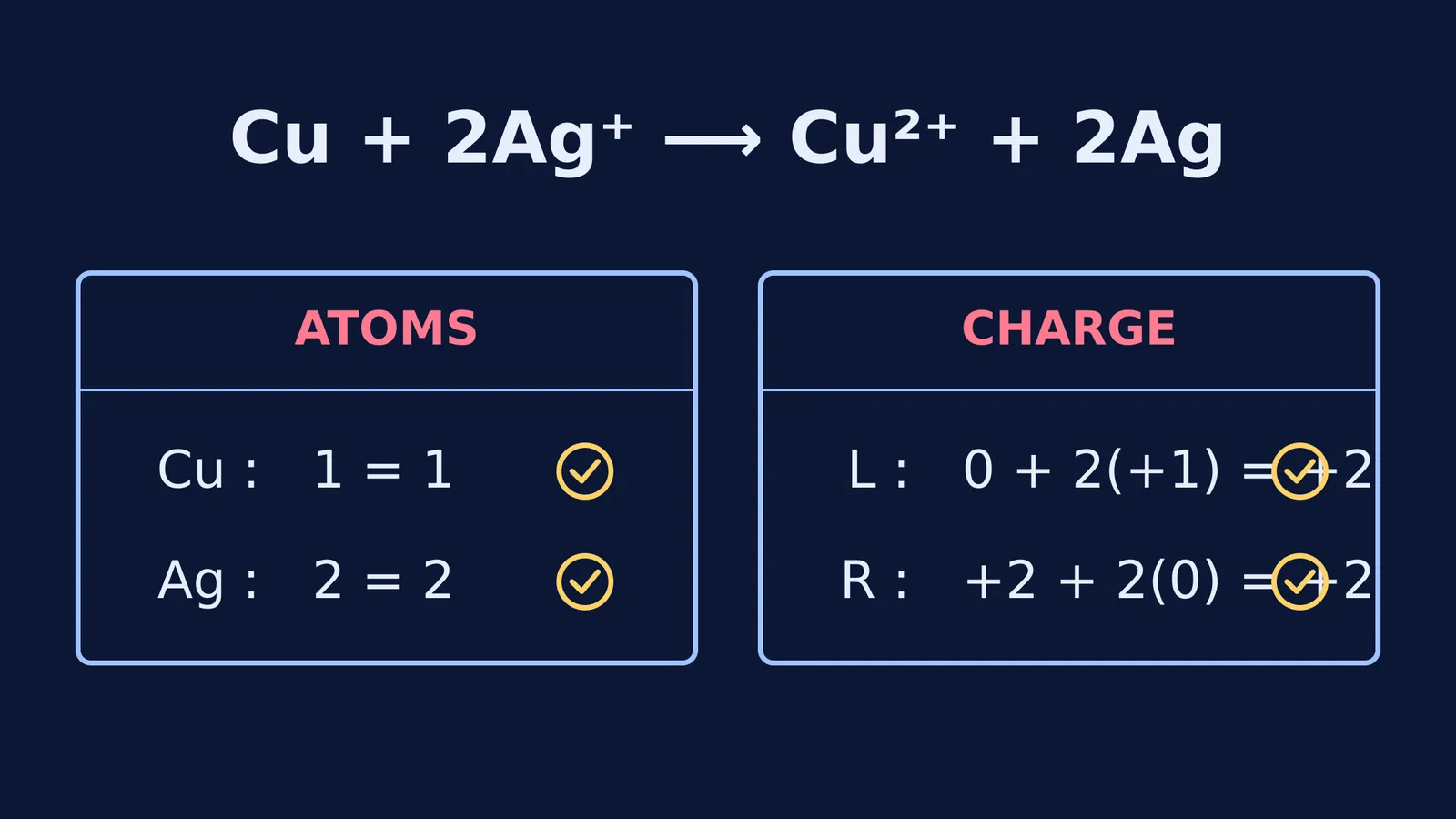
AI models often balance the atoms correctly but completely ignore the electrons. For example, if an AI gives you the equation Cu + Ag⁺ ⟶ Cu²⁺ + Ag, it might claim it is balanced because there is exactly one copper atom and one silver atom on each side. But the net electrical charge on the left is +1, and the net charge on the right is +2. The correctly balanced equation is Cu + 2Ag⁺ ⟶ Cu²⁺ + 2Ag, which ensures a +2 charge on both sides.
In a laboratory setting, failing to account for these electrons means you will miscalculate the stoichiometry of the entire reaction, leading to incorrect yields and wasted reagents. In an exam, it means losing full marks for the question.
To understand how these electron transfers work, you can review the rules for Balancing redox reactions: oxidation numbers and half-reactions. You might also need to determine the Oxidation numbers from structure: Fe3O4, S4O6²⁻ and CrO5 to ensure the half-reactions are set up correctly before relying on an AI's output.
How can you get better results from AI?
If you want to use AI to help you learn, you have to guide it. Instead of asking a model to simply balance an equation, ask it to explain the steps, but wait for you to do the math.
Another strategy is to ask the AI to perform a "conservation check" after it gives you an answer. Prompting the model with, "Review your previous answer and check if the Law of Conservation of Mass and Charge is satisfied," forces it to explicitly list the atoms and charges on both sides, which often catches its own mistakes.
This interactive approach forces you to do the heavy cognitive lifting. When you use Fermi's AI tutor, it holds a line of reasoning across a session and checks your understanding as it goes, rather than just printing an answer. It will guide you through complex problems like calculating the n-factor and the equivalent concept in redox titrations, ensuring you master the underlying chemistry. By using the AI to verify your steps rather than outsourcing the calculation entirely, you build a much stronger foundation for your exams.


