

On this page
When you mix two completely clear solutions in a test tube and suddenly a cloudy white or yellow solid appears, you are witnessing one of the most visually striking processes in chemistry. For students preparing for Class 10 CBSE exams, mastering these reactions is essential. Not only do they frequently appear in board exams, but they also form the foundation for understanding solubility and ionic bonds.
What is a precipitation reaction?
A precipitation reaction is a chemical process where two aqueous solutions react to form an insoluble solid, known as a precipitate). This solid separates from the surrounding liquid, eventually settling at the bottom of the container.
Most of these reactions are examples of double displacement. In a double displacement reaction, the positively charged ions (cations) and negatively charged ions (anions) of the two reacting compounds switch places. If one of the newly formed compounds cannot dissolve in water, it crashes out of the solution as a solid.
What are the most important Class 10 precipitation reactions?
The NCERT Class 10 science syllabus highlights three classic examples that you should commit to memory. Each has a distinct visual observation that makes it a favourite for practical-based exam questions.
Sodium sulphate and barium chloride
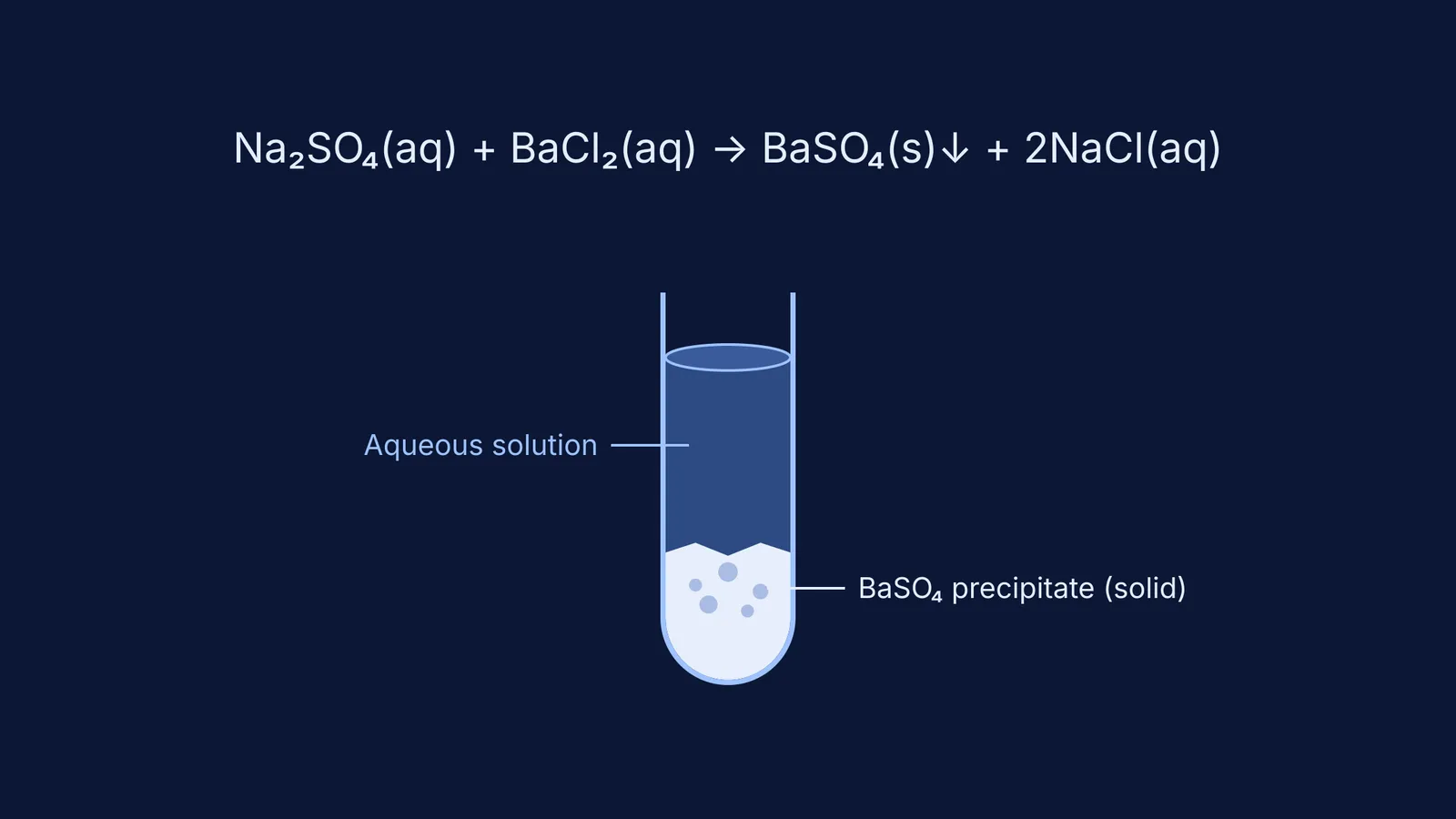
When you mix colourless sodium sulphate and barium chloride solutions, a white solid forms immediately. The reaction is: Na₂SO₄(aq) + BaCl₂(aq) → BaSO₄(s)↓ + 2NaCl(aq) The white solid is barium sulphate. It is highly insoluble; the solubility of barium sulphate is extremely low, at approximately 0.0024 grams per litre in water at 20 °C. This insolubility drives the reaction forward.
Lead nitrate and potassium iodide
Adding clear lead nitrate solution to clear potassium iodide solution yields a bright yellow solid. Pb(NO₃)₂(aq) + 2KI(aq) → PbI₂(s)↓ + 2KNO₃(aq) The yellow precipitate is lead iodide. Because of its colour change, this is often used in both classroom demonstrations and multiple-choice questions.
Silver nitrate and sodium chloride
Mixing these two solutions produces a curdy white precipitate. AgNO₃(aq) + NaCl(aq) → AgCl(s)↓ + NaNO₃(aq) The resulting white solid, silver chloride, is also sensitive to light and will eventually turn grey if left in sunlight—a phenomenon tied to photolytic decomposition.
How do you identify a precipitation reaction in the lab?
If you are facing a practical exam or just trying to understand the process, identifying these reactions is straightforward.
First, check the reactants. They should both be completely transparent aqueous solutions, meaning the salts are fully dissolved in water without any residual cloudiness. When you mix them together, the liquid will immediately turn cloudy or opaque. This sudden cloudiness is actually thousands of microscopic solid particles suspended in the water, blocking the light from passing through.
If you leave the test tube in a stand for several minutes, gravity will do the rest. The heavier solid particles of the precipitate will slowly settle at the very bottom of the glass. The liquid left resting above it will become clear again—this remaining liquid is scientifically referred to as the supernatant. In a chemistry lab, you might carefully pour off this supernatant if you need to isolate and weigh the dry precipitate for an experiment.
How do you predict the products on paper?
You don't need a lab to figure out if a precipitation reaction will happen. You can predict the outcome by following a simple framework for double displacement:
Identify the ions: Break your two reactant compounds into their respective cations (positive ions) and anions (negative ions).
Swap the partners: Pair the cation of the first reactant with the anion of the second, and vice versa. Always ensure you balance the positive and negative charges to find the correct formula for the new compounds.
Check solubility rules: Determine if either of the new compounds is insoluble in water. If one is insoluble, it will form a precipitate. If both are soluble, no reaction takes place, and you just have a mixture of dissolved ions.
If you struggle to remember the valencies of these ions or how to balance the resulting equations, you are not alone. This is exactly where the Fermi Concept Library can help, offering every concept in physics, chemistry, biology, mathematics and computing, each with its own lesson and its place in the map. Alternatively, if you need practice working through the balancing math step-by-step, the Fermi Problem Library provides worked problems with a step-by-step solver that explains the reasoning rather than printing an answer.
By breaking down the ions and looking for that characteristic insoluble solid, you can confidently identify and predict precipitation reactions in both the laboratory and your final exams.