

On this page
The NCERT Class 11 chapters Plant Kingdom and Animal Kingdom name dozens of genera. A bare list gives your memory nothing to hold on to, and multiple-choice questions can flip the task and ask which name does not belong. The fix has three parts: group examples into feature tables, test yourself on blank copies, and handle odd-one-out questions in four steps.
Why do lists of biology examples slip away?
Rereading a list feels like learning because the names look familiar on the page. In a 2006 study in Psychological Science, Henry Roediger and Jeffrey Karpicke had students either reread prose passages or take free-recall tests on them. Rereading did better on a test given 5 minutes later. On tests given 2 days or 1 week later, the students who had tested themselves remembered substantially more, even though rereading had made the other group more confident.
A 2013 review of 10 study techniques by John Dunlosky and colleagues rated practice testing and spaced (distributed) practice as high utility, and rereading and highlighting as low utility.
In a 2008 experiment, Nate Kornell and Robert Bjork found that people who saw different artists' paintings mixed together were better at naming the artist of new paintings than people who saw each artist's work in one block, though they rated the block method as more effective. Seeing groups side by side may help you notice what separates them, which is what an odd-one-out question tests.
How do you turn NCERT examples into a feature table?
NCERT has already done half the work. Table 3.1 in Plant Kingdom compares the three algal classes by pigment, stored food, cell wall, flagella and habitat, and Table 4.2 in Animal Kingdom compares the phyla by symmetry, coelom, segmentation and more. Your job is to attach the named examples to those features.
Pick one group, such as algae, and copy NCERT's feature columns into your notebook.
Under each class, write every genus NCERT names for it, in NCERT's own order.
Add rows for features that cut across classes, the ones NCERT ties to particular genera.
Here is the algae version, built from Plant Kingdom:
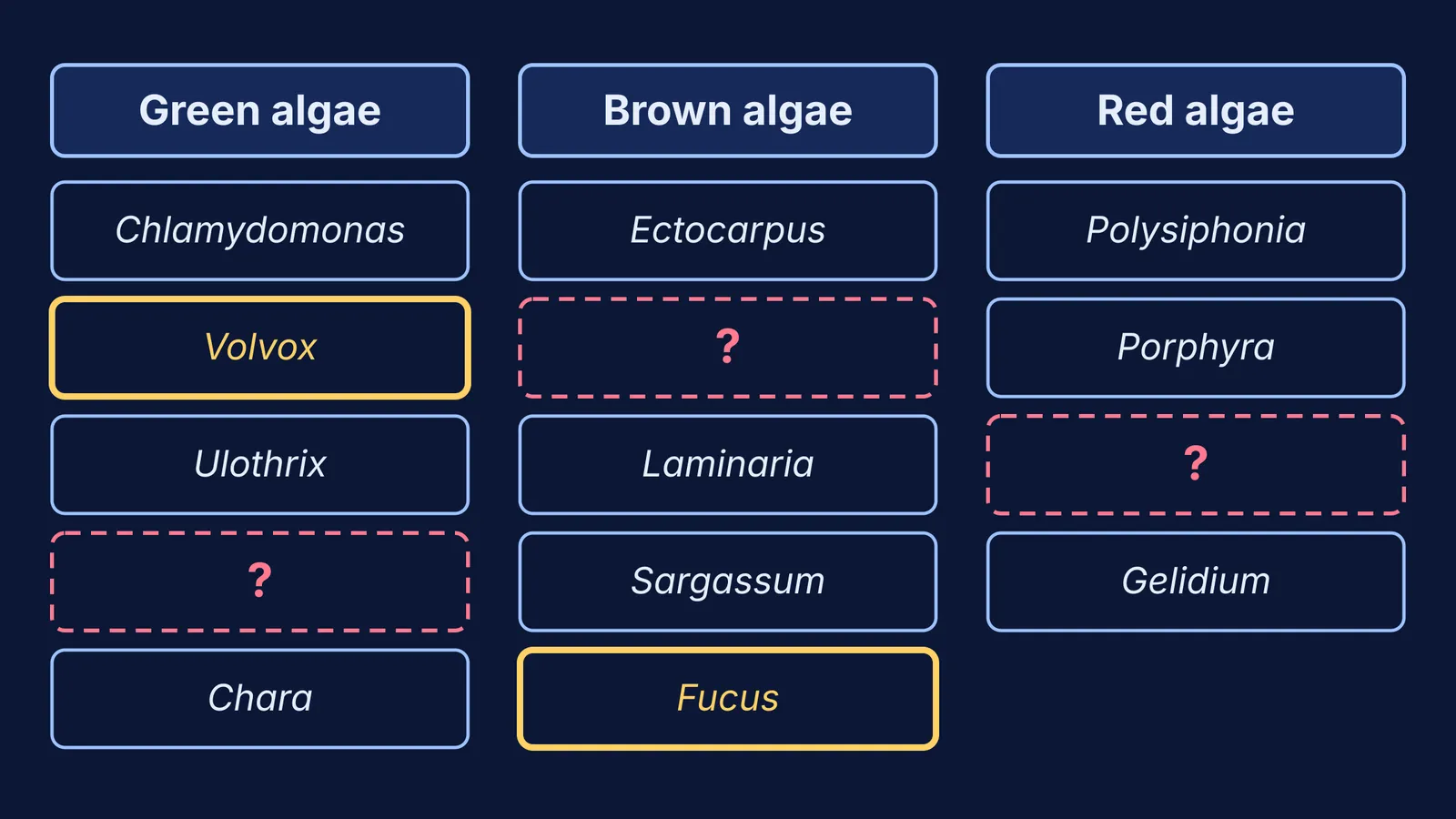
Green algae (chlorophyll a and b; stores starch): *Chlamydomonas, Volvox, Ulothrix, Spirogyra, Chara*
Brown algae (chlorophyll a and c, fucoxanthin; stores mannitol and laminarin): *Ectocarpus, Dictyota, Laminaria, Sargassum, Fucus*
Red algae (chlorophyll a and d, phycoerythrin; stores floridean starch): *Polysiphonia, Porphyra, Gracilaria, Gelidium*
Oogamous examples: *Volvox* (green) and *Fucus* (brown)
Used as food: *Porphyra, Laminaria, Sargassum*
Agar sources: *Gelidium* and *Gracilaria*
The cross-cutting rows are where questions catch people out, because they pair genera from different classes.
If a column heading is fuzzy, for example you cannot say what floridean starch or a pseudocoelom is, fix the idea before you memorise the names. The Fermi Concept Library covers every concept in biology, each with its own lesson and its place in the map.
How do you test yourself with a blank table?
Draw the same table with only the headings filled in. Then:
Fill in every genus and feature you can from memory, without looking.
Check against the NCERT page in a different coloured pen.
Copy every coloured-pen correction to the top of tomorrow's blank table.
Repeat the table a few days later, then a week later, until a whole sheet comes back clean.
That last step uses spacing, the other technique the Dunlosky review rated highly. Keep each sheet small, such as the algae or the mammals.
How do you solve odd-one-out questions on plants and animals?
An odd-one-out question is really asking which feature to sort on. Use four steps:
Say each option's group and two of its features out loud.
List every feature on which the options could differ.
Find the feature on which exactly one option differs.
If two features each give a different answer, choose the one NCERT uses to group the examples, not one you inferred from a name missing from a list.
Worked example 1: *Porphyra, Laminaria, Sargassum, Fucus*. By class, *Porphyra* is red algae and the rest are brown, so *Porphyra* is the odd one. You might be tempted to pick *Fucus* because it is missing from NCERT's food list, but the textbook never says *Fucus* is inedible. Class is the safe feature.
Worked example 2: *Macropus, Pteropus, Ornithorhynchus, Balaenoptera*. *Pteropus* flies and *Balaenoptera* lives in water, but those are habitat features. Animal Kingdom itself splits its mammal examples into oviparous (*Ornithorhynchus*, the platypus) and viviparous (the others). So *Ornithorhynchus* is the answer.
When you practise mixed MCQs and want to see why an option fails, the Fermi Problem Library has worked problems with a step-by-step solver that explains the reasoning rather than printing an answer.
For the exceptions scattered through these chapters, see odd-one-out exceptions from algae to gymnosperms, animal classification exceptions that appear in MCQs and our guide to remembering NCERT biology examples for NEET. Start tonight with one blank table for algae.


