

On this page
This chapter asks one question: how did a democracy hand power to a dictator and lose its freedoms within months? Answer it as a chain of causes and most exam questions become easy. Here is the chain, with dates checked against the United States Holocaust Memorial Museum's encyclopedia, and a plan for writing it up.
What was the Weimar Republic and why was it weak?
The Weimar Republic was Germany's democratic government from the end of the empire in 1918 until 1933, according to the USHMM entry on the Weimar Republic. Three problems wore it down.
A humiliating peace. Under the Treaty of Versailles, Germany lost 13 percent of its territory and 10 percent of its population. Article 231, the “War Guilt Clause”, blamed Germany for the war, and the treaty demanded heavy reparations. Nationalists, the Nazis among them, blamed the republic whose leaders had signed it.
Money that stopped meaning anything. In January 1920 a dollar bought 64.8 marks; by November 1923 it bought 4,200,000,000,000 marks, as the Weimar Republic entry records. Savings were wiped out.
A weak constitution. Article 48 let the president assume emergency powers, suspend civil rights and govern without parliament for a time (USHMM). Once the Great Depression hit, Chancellor Heinrich Brüning, backed by President Hindenburg, repeatedly used Article 48 from 1930 to govern by emergency decree instead of through the Reichstag (USHMM).
How did Hitler come to power in Germany?
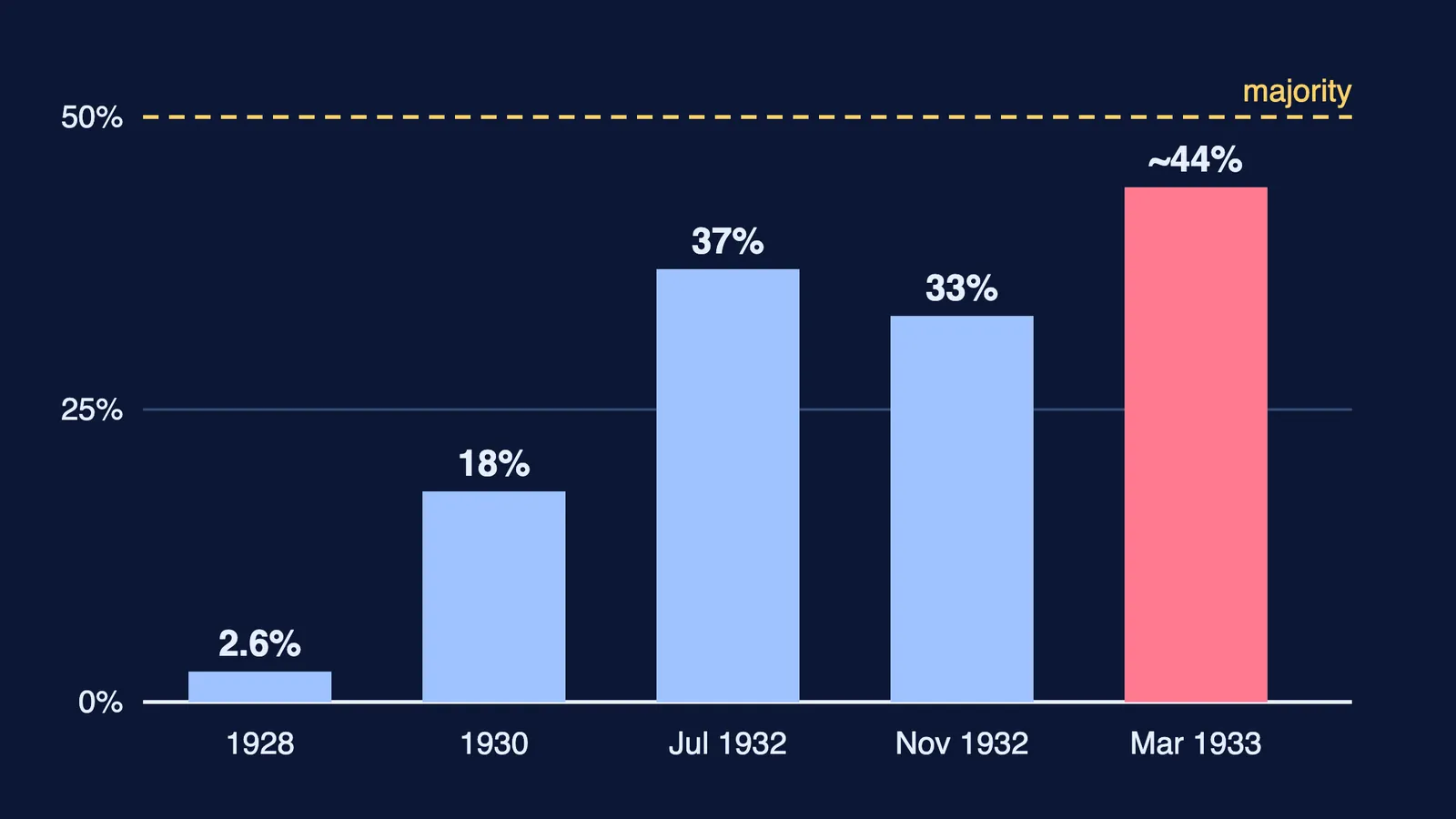
Hitler did not seize power in a coup in 1933. He was appointed, after years of rising votes. The USHMM account of the Nazi rise to power gives these steps:
20 May 1928: the Nazis win only 2.6 percent of the vote.
September 1930: with the Depression biting, they win 18 percent.
31 July 1932: they win 37 percent and become the largest party in parliament.
6 November 1932: their share falls to 33 percent, but they remain the largest party.
30 January 1933: pressed by Franz von Papen and other conservative politicians, President Hindenburg appoints Hitler chancellor.
27 February 1933: the Reichstag building burns; the next day's Reichstag Fire Decree suspends freedom of speech, the press and assembly, and lets the regime arrest political opponents without specific charges.
5 March 1933: in the last multi-party election, the Nazis win almost 44 percent (USHMM).
23 March 1933: the Enabling Act lets the government make laws without parliament's consent.
August 1934: President Hindenburg dies, and the Nazis' grab for power is complete (USHMM).
Notice the pattern examiners look for: crisis gave the Nazis votes, but decrees and laws gave them total power.
What did Nazi rule mean for people in Germany?
Once parliament no longer mattered, the regime turned its racial ideas into law. On 15 September 1935, Hitler announced the Nuremberg Laws, which stripped Jews of German citizenship and banned marriages between Jews and other Germans. Persecution grew into genocide: the USHMM records that six million Jewish men, women and children were murdered by the Nazi regime and its allies and collaborators.
When you write about this, use the precise words: persecution, exclusion, genocide, the Holocaust. Then link each law back to the timeline: from July 1933 the Nazi Party was the only legal party in Germany (USHMM), so no opposition in parliament was left to stop these laws.
How do you write a 5-mark answer on the rise of Hitler?
Use a cause, link, effect frame: one point per cause, each tied to a date or fact, each ending with why it helped the Nazis.
Worked example: “Explain any five reasons for the rise of Hitler.”
Versailles: losing 13 percent of its territory and accepting the War Guilt Clause made Germans resent the republic that signed it (USHMM).
Hyperinflation, 1923: savings vanished, so the middle class lost faith in Weimar.
Great Depression: unemployment and bank failures made people want a strong leader with simple promises.
Article 48: rule by emergency decree had already weakened parliament before Hitler arrived.
Votes and a deal: Nazi votes rose from 2.6 to 37 percent between 1928 and July 1932, and conservatives brought Hitler in as chancellor (USHMM).
End with one line on what followed: the Reichstag Fire Decree and the Enabling Act turned a chancellor into a dictator.
Draw it as a chart first; our guide to making a cause-and-effect chart for a history chapter shows the layout. If a chatbot gives you a date that looks off, check AI-given history dates against NCERT. Then add the timeline to a six-week revision calendar with 1-3-7-14 day gaps.
If a whole term of subjects leaves you unsure where to begin, Fermi's AI tutor can work out what you already know and build a plan for the session, so you sit down to a clear next step.


