

On this page
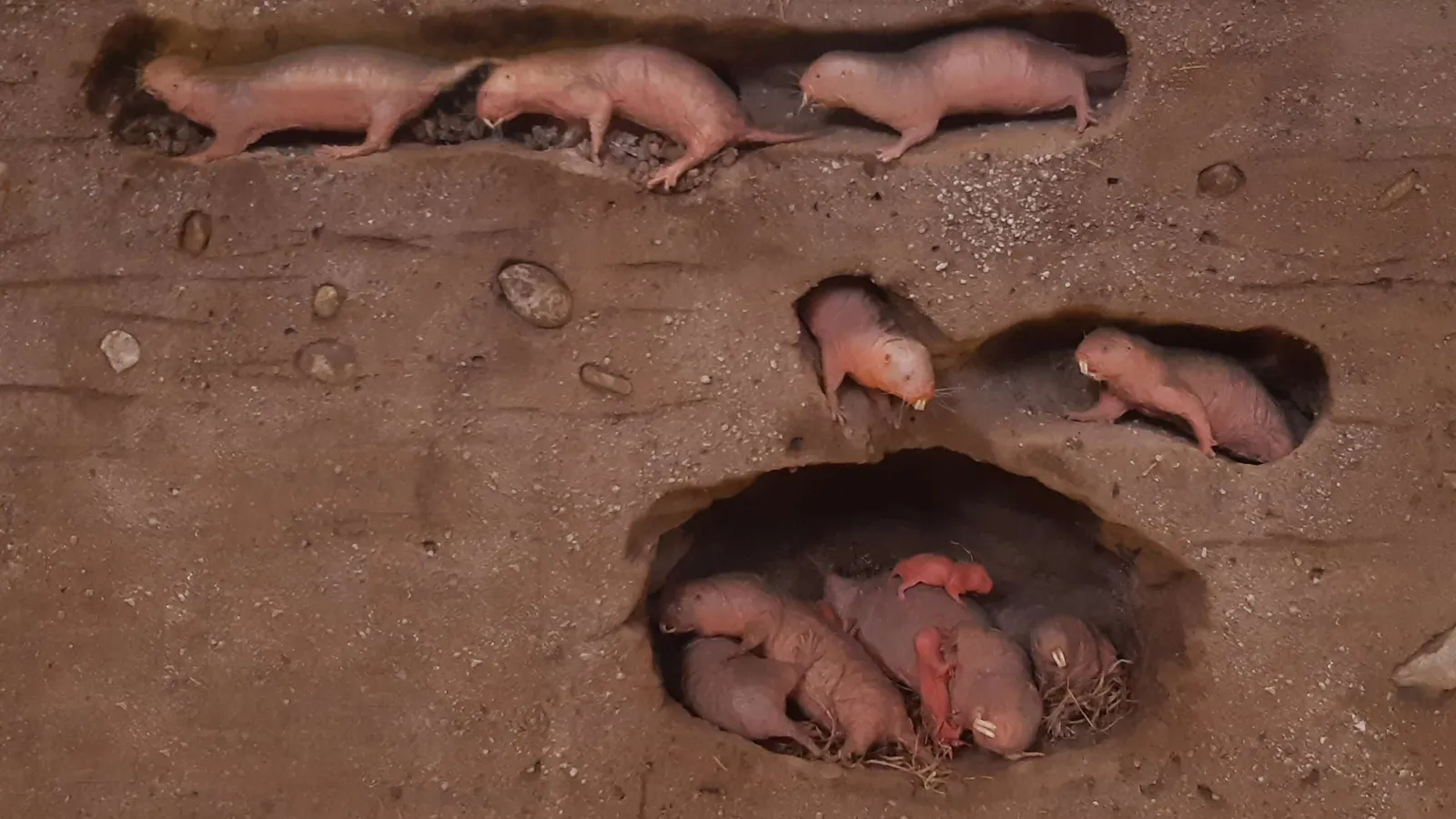
Naked mole-rats are small, nearly hairless rodents that live in underground colonies in the semi-arid eastern Horn of Africa (Delaney et al., Veterinary Pathology, 2013). Biologists study them for three unusual traits: a colony organised like a beehive, survival with no oxygen, and very little cancer over a long life. Here is what the research found and where scientists still disagree.
How do naked mole-rats live like bees?
In a 1981 paper in Science, J. U. M. Jarvis studied a field-collected colony of 40 naked mole-rats in the laboratory and found that only a single female breeds (Jarvis, Science, 1981). The rest formed two or three castes, each with both males and females, told apart by body size and by the jobs they did.
Jarvis also listed long lifespans, overlapping generations and shared care of the young as parallels with social insects. Biologists call this eusociality. Like the kangaroo rat that survives the desert without drinking, the naked mole-rat shows a body and a society shaped by where the animal lives.
How do naked mole-rats survive without oxygen?
Living packed together underground gives naked mole-rats a low-oxygen home. In laboratory tests, they tolerated hours of extreme hypoxia and survived 18 minutes of total oxygen deprivation without apparent injury (Park et al., Science, 2017).
Without oxygen, they switch to anaerobic metabolism fuelled by fructose, which the brain builds up and breaks down to lactate. Their tissues carry the fructose transporter GLUT5 and high levels of the enzyme ketohexokinase, and this fructose route avoids the feedback brake at phosphofructokinase, the same study found.
Do naked mole-rats really not get cancer?
Rarely, not never. A 2013 Nature study reported that years of watching large colonies had not detected a single cancer (Tian et al., Nature, 2013). The team found that naked mole-rat fibroblasts, the cells of connective tissue, make hyaluronan, a sugar polymer between cells, more than five times larger than the human or mouse version. With it removed, the cells became open to turning cancerous and formed tumours in mice.
A 15-year review of 138 adult naked mole-rats at a zoo found no malignant tumours (Delaney et al., 2013). In 2016 a team led by the same author reported the species' first two cancers, in zoo males aged about 20 and 22 (Delaney et al., Veterinary Pathology, 2016). The authors said this did not overturn the animal's long-observed cancer resistance but raised questions about its scope.
The mechanism is still debated. In 2020 a Cambridge group reported that naked mole-rat cells transform as easily as mouse cells (Hadi et al., Nature, 2020); the Rochester team replied that this happened only with much higher levels of the cancer gene Ras (Zhao et al., Nature, 2020). A 2024 study found that naked mole-rats lack natural killer cells but carry many circulating gamma-delta T cells, a type that attacks cancer cells in mice and humans (Lin et al., Nature Communications, 2024).
How long do naked mole-rats live?
A naked mole-rat can live more than 30 years, while a house mouse of similar size has a maximum lifespan of 4 years (Tian et al., 2013). An analysis of more than 3,000 lifespan records found that their risk of dying did not rise with age, unlike all other mammals studied to that point (Ruby, Smith and Buffenstein, eLife, 2018). Other researchers replied in the same journal that calling them a non-ageing mammal was premature (Dammann et al., eLife, 2019).
How can you use naked mole-rats in a biology answer?
Here is a worked answer to a classic question: how can an animal keep making ATP with no oxygen?
Name the pathway: glycolysis, which runs in the cytoplasm and needs no oxygen.
Name the control point: phosphofructokinase, the enzyme that commits sugar to glycolysis and slows it when the cell has enough energy.
Give the example: naked mole-rats run glycolysis on fructose in a way that avoids that brake, and survive 18 minutes without oxygen (Park et al., 2017).
Close the loop: pyruvate becomes lactate, which recycles NAD+ so glycolysis can continue. The Krebs cycle depends on oxygen indirectly, so it stops; glycolysis does not.
If step 2 is where you lose the thread, the Fermi Concept Library gives every biology concept its own lesson and its place in the map, so you can revise glycolysis first.
When a headline says an animal "doesn't get cancer" or "doesn't age", check four things:
Was it cells in a dish, animals in a lab or zoo, or animals in the wild?
How many animals, watched over how many years?
Has another lab tested it, and did they agree?
Does the article jump from an animal result to a human cure?
Comparing animals also cracks questions like why aquatic animals breathe faster. If you want help building that habit, Fermi's AI tutor works out what you already know and builds a plan for the session, so you start with the gap that matters.


