

On this page
You can multiply any two-digit number by 11 in a couple of seconds: split the digits, add them, and put the sum in the middle. When the sum reaches 10, you add one extra step.
How do you multiply a two-digit number by 11 in your head?
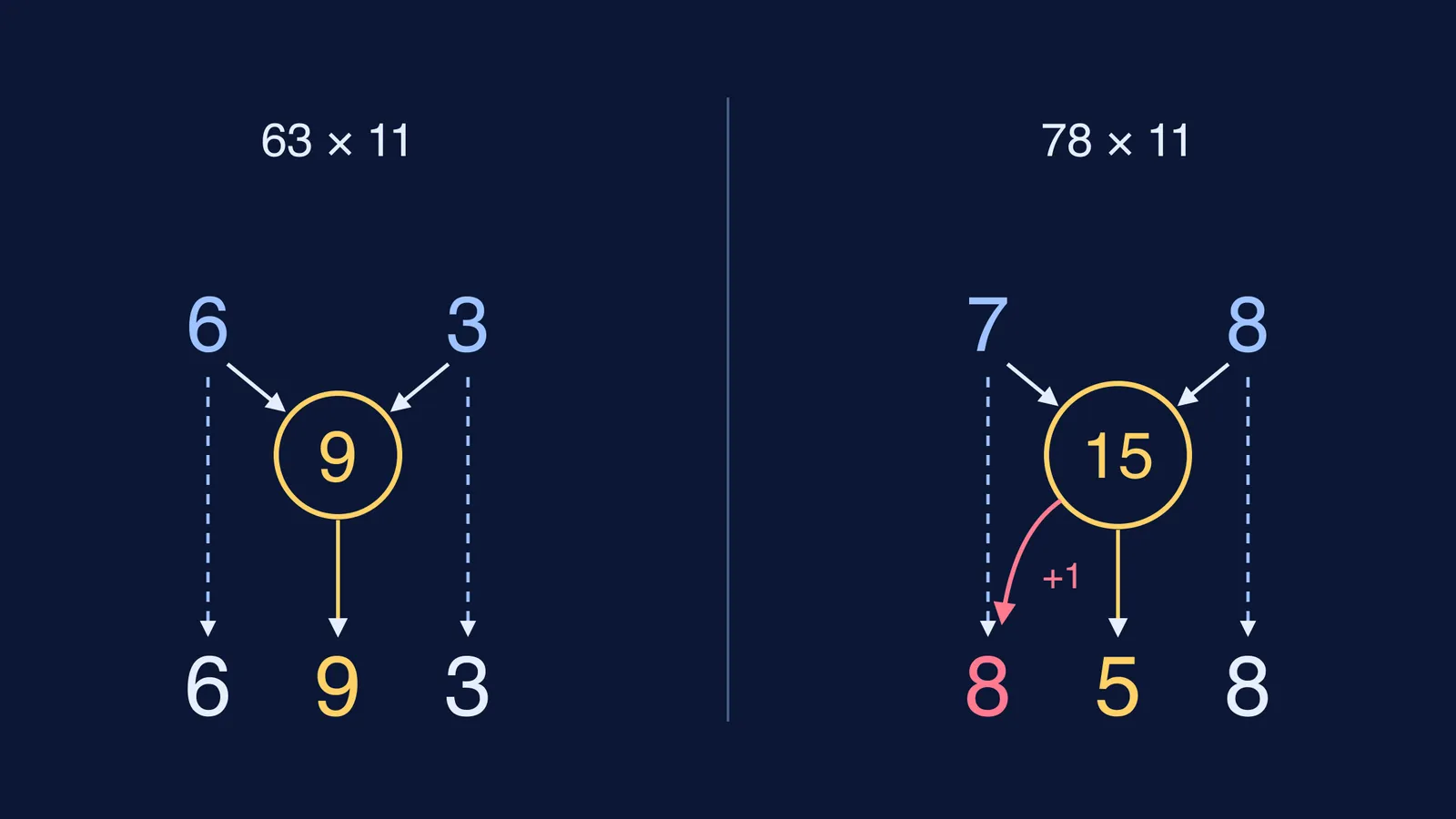
Take 63 × 11.
Split the number: 6 _ 3.
Add the two digits: 6 + 3 = 9.
Put the sum in the gap: 693.
A few more: 35 × 11 = 385 (3 + 5 = 8), 52 × 11 = 572 (5 + 2 = 7), 81 × 11 = 891 (8 + 1 = 9). Whenever the two digits add to 9 or less, that is the whole method.
This is a special case of a rule in the Trachtenberg speed system, which the engineer Jakow Trachtenberg developed to keep his mind occupied while he was held prisoner in a Nazi concentration camp. His rule for 11 is "add the digit to its neighbor", where the neighbour is the digit on the right, and it works for numbers of any length: 3,425 × 11 = 37,675. The book of his system was published in English by Doubleday in 1960.
What if the digits add up to 10 or more?
This is the carry case, and it is the step that is easiest to get wrong. Take 78 × 11.
Split: 7 _ 8.
Add: 7 + 8 = 15.
Write only the 5 in the middle and carry the 1 to the front: 7 + 1 = 8.
Answer: 858.
A common slip is to write the whole sum in the middle and get 7,158. The largest two-digit product is 99 × 11 = 1,089, so any answer bigger than that is wrong before you check anything else.
More carry examples: 47 × 11 = 517 (4 + 7 = 11), 28 × 11 = 308 (2 + 8 = 10), and 99 × 11 = 1,089 (9 + 9 = 18, then 9 + 1 = 10 at the front).
Why does the 11 trick work?
Write the number as 10a + b, where a is the tens digit and b is the units digit. So 63 is 10 × 6 + 3.
Multiplying by 11 means multiplying by 10 and adding the number once more:
11 × (10a + b) = 110a + 11b
= 100a + 10a + 10b + b
= 100a + 10(a + b) + b
Read the last line as place values. The hundreds digit is a, the tens digit is a + b, and the units digit is b. That is exactly "split and put the sum in the middle".
The carry case falls out of the same line. If a + b is 10 or more, write it as 10 + c, where c is the units digit of the sum. Then 10(a + b) = 100 + 10c, and the product becomes 100(a + 1) + 10c + b. The front digit grows by 1 and c sits in the middle. For 78: a = 7, b = 8, a + b = 15, so c = 5 and the answer is 100 × 8 + 10 × 5 + 8 = 858.
Seen this way, the trick is just the column addition 630 + 63 (or 780 + 78) done without writing the columns.
Is it worth learning the reason, not only the rule?
Yes. In two experiments with 5th- and 6th-grade students learning decimal fractions, Bethany Rittle-Johnson, Robert Siegler and Martha Alibali found that conceptual understanding and procedural skill develop iteratively; in the first experiment, children's initial conceptual knowledge predicted their gains in procedural knowledge (Journal of Educational Psychology, 2001). In everyday terms: a rule you can derive is a rule you can repair when you forget whether the carry goes left or right.
The algebra also connects the trick to place value, expanding brackets and the divisibility rule for 11 and its alternating sum. If you want more place-value ideas explained from the ground up, the Fermi Concept Library gives each concept in mathematics its own lesson, and the Fermi Problem Library has worked problems with a step-by-step solver that explains the reasoning rather than printing an answer.
How should you practise the 11 trick?
Day 1: ten numbers with no carry, such as 12, 26, 34 and 52. Say each answer aloud before writing it.
Day 2: ten carry numbers, such as 29, 57, 83 and 99. Run the two-second check on each.
Day 3: mix both kinds, then prove one answer on paper with 100a + 10(a + b) + b.
Day 4: try three-digit numbers with the add-the-neighbour rule, for example 243 × 11 = 2,673.
Parents can turn this into a two-minute game at dinner: you call out a number, your child gives the product and explains why.
Once this feels automatic, the same place-value thinking makes it easy to multiply by 99 or 999 in your head, and our guide to calculation shortcuts for JEE when there is no calculator collects more of them.


