

On this page
Why is multiplying by 99 hard for the brain?
Mental calculation is heavily limited by our working memory. Cognitive psychology defines "intrinsic cognitive load" as the mental effort required by the task itself. When you try to multiply 47 × 99 using the traditional school method in your head, you have to hold multiple intermediate products in your working memory at the same time. For most people, this overloads the brain, leading to mistakes.
To solve this quickly, you need a strategy that changes the structure of the problem, reducing the number of steps you have to remember.
Why does lowering cognitive load matter for exams?
During high-stakes exams, stress and time pressure already consume a significant portion of your working memory. When you rely on standard column multiplication for large numbers, you force your brain to juggle arithmetic facts, carrying numbers, and positional alignment simultaneously.
By applying algebraic properties to turn multiplication into subtraction, you break the process into smaller, more manageable steps. According to cognitive load theory, simplifying element interactivity allows your working memory to process the steps sequentially rather than simultaneously. This frees up mental resources, helping you stay focused on the broader problem rather than getting bogged down in arithmetic, which in turn reduces careless errors.
How does the distributive property work?
The trick relies on the distributive property of multiplication over addition and subtraction. This fundamental rule of elementary algebra states that multiplying a sum or difference by a number gives the same result as multiplying each term separately and then adding or subtracting the products: x(y - z) = xy - xz.
Instead of viewing 99 as an arbitrary two-digit number, you can view it as 100 minus 1. Multiplying by 100 is effortless because you only need to add two zeros to the end of the number.
If your fundamentals in algebra feel shaky, the Fermi Concept Library can help you review these core properties interactively at your own pace.
How to multiply by 99 or 999 mentally?
To multiply any number by 99, follow these two steps:
Multiply the number by 100 (just add two zeros).
Subtract the original number from that result.
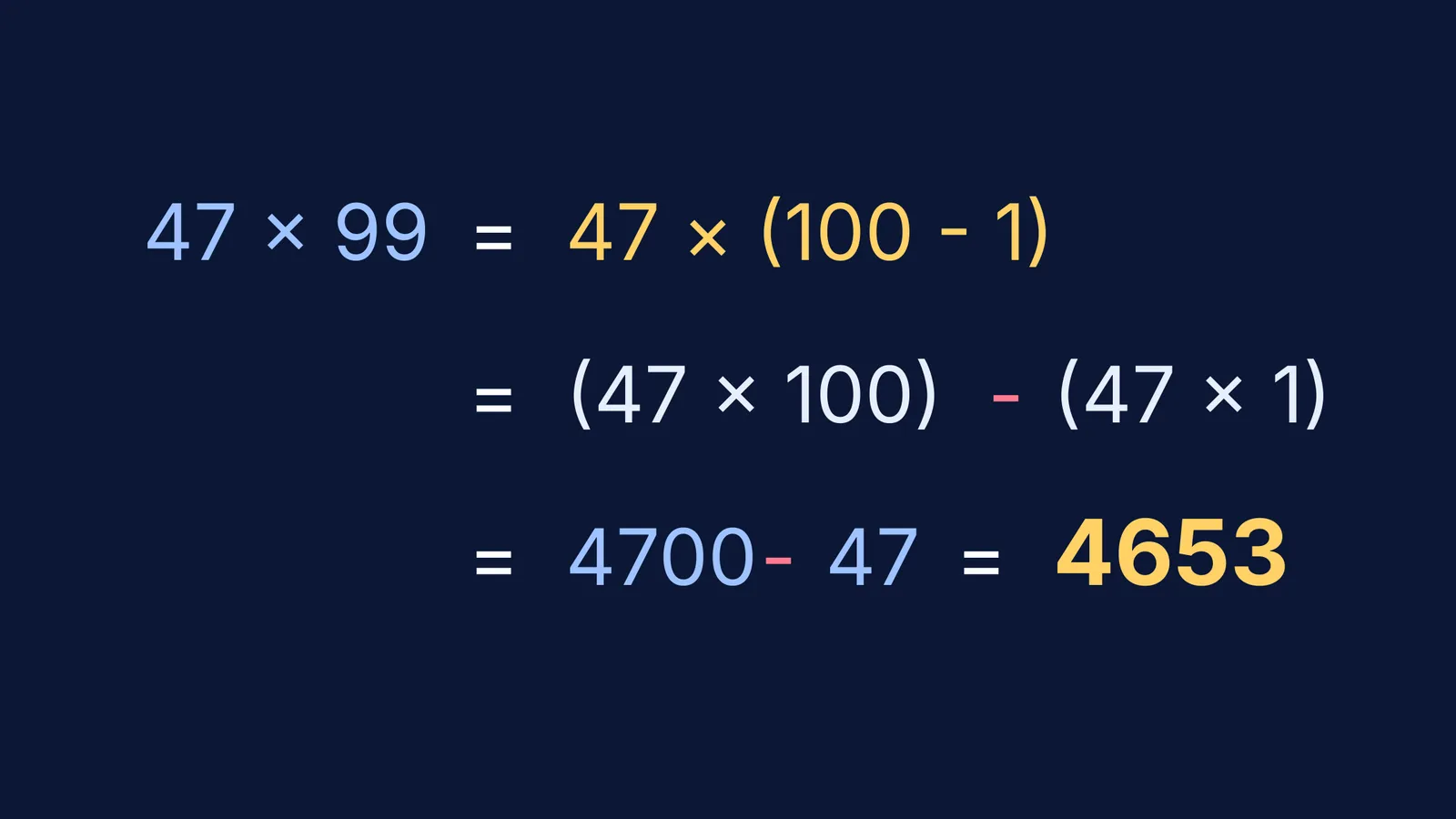
Let us look at a worked example for 47 × 99:
Rewrite the problem: 47 × (100 - 1)
Distribute the 47: (47 × 100) - (47 × 1)
Multiply: 4700 - 47
Subtract: 4653
The exact same logic applies to 999, but this time you rewrite it as 1000 - 1. To multiply a number by 999, you multiply the number by 1000 (add three zeros) and subtract the original number.
Let us try 345 × 999:
Rewrite: 345 × (1000 - 1)
Add three zeros: 345000
Subtract 345: 345000 - 345 = 344655
Can this trick work for numbers like 98, 101 or decimals?
Yes. Once you master the base trick, you can apply it to any number close to a power of 10.
To multiply by 98, multiply by 100 and subtract the original number twice (since 98 = 100 - 2). For example, 15 × 98 = 1500 - 30 = 1470.
To multiply by 101, multiply by 100 and add the original number (since 101 = 100 + 1). For example, 42 × 101 = 4200 + 42 = 4242.
You can also use this algebraic method when working with decimal numbers. If you need to multiply a quantity by 0.99, you can rewrite the multiplier as (1 - 0.01). To multiply 400 by 0.99, you multiply the number by 1 (400), multiply the number by 0.01 (4), and subtract the second result from the first: 400 - 4 = 396. This approach is highly useful in subjects like physics and chemistry when dealing with percentage changes or minor deductions.
Learning mental maths strategies like this one, or the trick for squaring numbers ending in 5, shifts the burden away from rote memorisation. By understanding the underlying algebra, you build a toolkit that makes exam calculations faster and more reliable.


