

On this page
You already know the two hard parts. Multiplying by 10, 100 or 1000 means adding zeros, and halving is something you do every day. The numbers in this post are just those two moves put together. Once you see that, 46 × 125 is no longer a long multiplication. It is a halving exercise you can do in your head.
Why does multiplying by 5, 25 and 125 work?
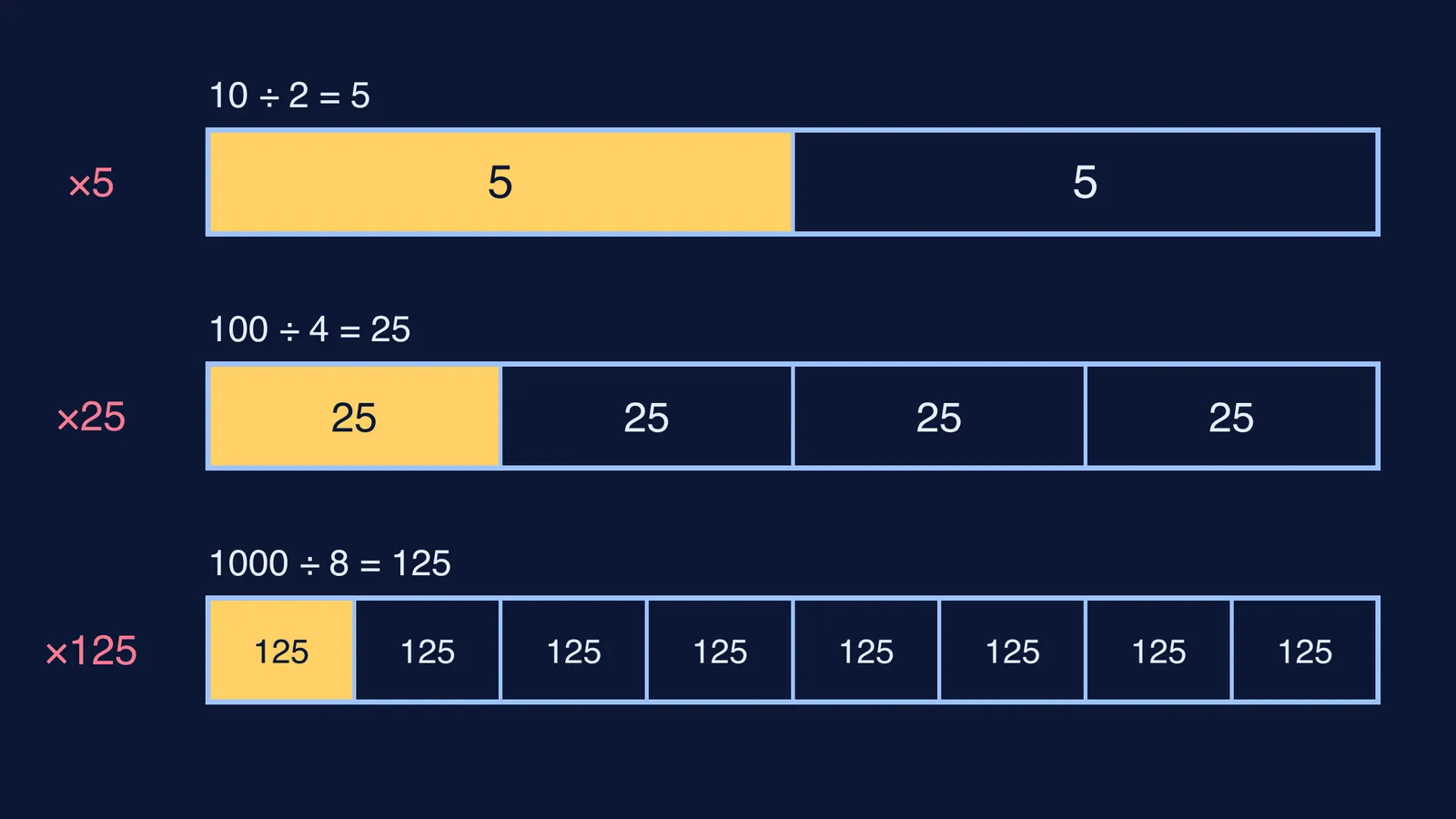
Each number is a power of 10 cut into equal pieces:
5 × 2 = 10, so × 5 is the same as × 10 ÷ 2
25 × 4 = 100, so × 25 is the same as × 100 ÷ 4
125 × 8 = 1000, so × 125 is the same as × 1000 ÷ 8
Dividing by 4 means halving twice, and dividing by 8 means halving three times. So the whole method is: add one, two or three zeros, then halve one, two or three times. The number of zeros always matches the number of halvings.
How do you multiply by 5, 25 or 125 in your head?
Pick whichever order keeps the numbers small.
Times 5, add a zero and halve once: 37 × 5 is 370, halved, which is 185. For 124 × 5, halve first to get 62, then add a zero to get 620.
Times 25, add two zeros and halve twice: 38 × 25 is 3800, then 1900, then 950. For 36 × 25, 36 ÷ 4 = 9, so the answer is 900.
Times 125, add three zeros and halve three times: 46 × 125 is 46,000, then 23,000, then 11,500, then 5,750. For 72 × 125, 72 ÷ 8 = 9, so the answer is 9,000.
If the number divides exactly by 2, 4 or 8, divide first and add the zeros last. Our post on the last-digit tests for divisibility by 4 and 8 shows how to spot that quickly.
What if the number does not halve neatly?
Odd numbers still work. You just end up with a 5 at the end. 13 × 25 is 1300 ÷ 4: half is 650, and half again is 325. 7 × 125 is 7000 ÷ 8: 3500, 1750, 875.
Decimals work too. 4.8 × 25 is 480 ÷ 4, which is 120.
The same idea works backwards for division. Dividing by 5 is × 2 ÷ 10, dividing by 25 is × 4 ÷ 100, and dividing by 125 is × 8 ÷ 1000:
340 ÷ 5: 680, then 68
675 ÷ 25: 2700, then 27
3000 ÷ 125: 24,000, then 24
This is where the shortcut pays off in physics and chemistry numericals. 0.25 is one quarter and 0.125 is one eighth, so 0.125 × 48 is just 48 ÷ 8 = 6. It helps to know the eighths by heart: 1/8 = 0.125, 3/8 = 0.375, 5/8 = 0.625 and 7/8 = 0.875.
Why learn these as one idea, not three tricks?
Shortcuts that share a principle seem to help each other. In a 2014 study in Frontiers in Psychology, Claudia Godau and colleagues gave primary school children addition problems built around commutativity, the rule that the order of adding does not matter (a + b = b + a). In the second experiment, 153 second graders and 140 third graders took part. Second graders who first worked on problems allowing one commutativity shortcut later did better on problems allowing a different shortcut based on the same principle. A control group, who first worked on a shortcut based on a different principle, did not show that benefit. The authors link this to adaptive expertise, which connects knowing why a method works with knowing how to do it. The study used addition, so treat it as a hint for these shortcuts, not proof.
For you, the lesson is to keep the reason in view. If you remember that 125 is 1000 cut into 8 pieces, you can rebuild the method under exam pressure, and you will spot related moves yourself, such as × 50 being × 100 ÷ 2. The same thinking is behind multiplying by 9, 99 and 999 with a nearby power of 10.
If a longer calculation keeps going wrong because you picked the wrong method, the Fermi Problem Library has worked problems with a step-by-step solver that explains the reasoning rather than just printing an answer.
A 10-minute practice plan
Minutes 1 to 2: say the three facts aloud: 5 is 10 ÷ 2, 25 is 100 ÷ 4, 125 is 1000 ÷ 8.
Minutes 3 to 6: work through the set below in your head, writing down only the answers.
Minutes 7 to 8: check each answer with the last-digit test.
Minutes 9 to 10: redo any you got wrong, saying each halving step aloud.
Practice set: 18 × 5, 86 × 5, 28 × 25, 15 × 25, 56 × 125, 9 × 125, 4.8 × 25, 625 ÷ 25.
Answers: 90, 430, 700, 375, 7000, 1125, 120, 25.
Repeat with new numbers for a week, then mix these in with other shortcuts. For timed rounds, see our guide to using AI for mental maths speed practice.


