

On this page
In competitive entrance exams, speed is often as decisive as conceptual clarity. Under National Testing Agency guidelines, JEE Main candidates answer 75 questions in 180 minutes, averaging 144 seconds per question. In the NEET-UG examination format, candidates face 180 compulsory questions in 180 minutes, allowing 60 seconds per question. With calculators strictly prohibited in both exams, every arithmetic step must be solved on scratch paper.
When students struggle to complete physics numericals or chemistry stoichiometry within the time limit, the obstacle is rarely a missing formula. The bottleneck is arithmetic friction: long division, squaring decimals, or converting units by hand. As shown in our practice routine for JEE Main physics numericals, students who understand underlying physics principles regularly forfeit marks when calculation fatigue causes numerical slips.
How does mental math free your working memory?
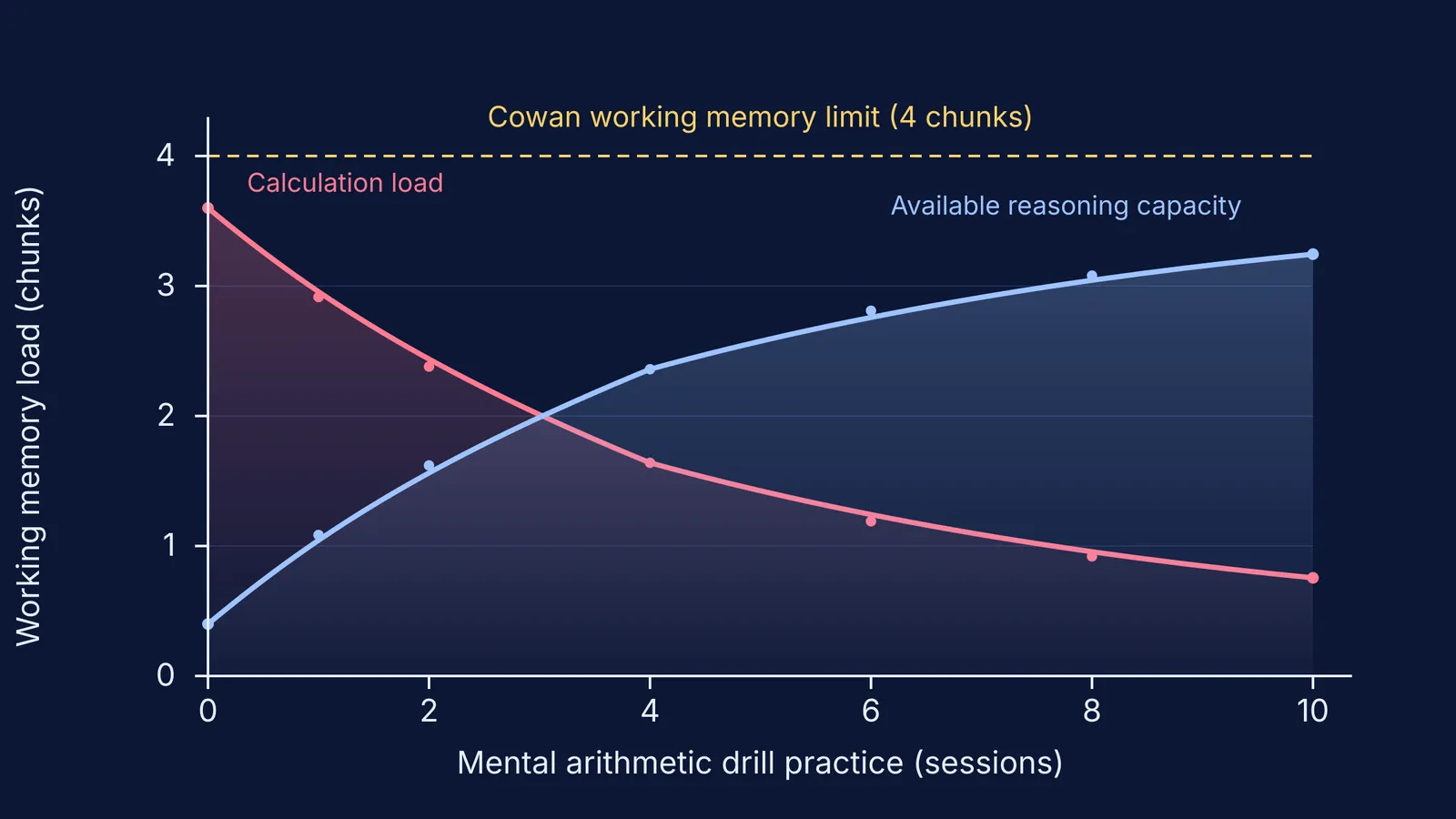
The primary toll of manual calculation is cognitive overload. In foundational research on Cognitive Load Theory, John Sweller (1988) demonstrated that problem-solving performance collapses when working memory is saturated by routine search and procedural arithmetic instead of schema processing. Human working memory is strictly bounded; experimental reviews by Nelson Cowan (2001) establish that short-term mental storage holds an average of only 4 informational chunks at any given moment.
A cognitive review by Diana DeStefano and Jo-Anne LeFevre (2004) confirmed that multi-digit mental arithmetic heavily taxes the central executive. Evaluating expressions like 1 / (4 × π × 8.85 × 10⁻¹²) consumes almost all available mental chunks, leaving little bandwidth to check boundary conditions or physical units. Automating arithmetic facts transforms active computation into fast memory retrieval, preserving working memory for conceptual reasoning.
Many students turn to AI chatbots simply to print solutions for difficult problems, but research confirms that passive copying bypasses skill formation. As discussed in our analysis of how cognitive offloading onto AI affects long-term retention, outsourcing effort reduces retention. Instead of serving as a shortcut, Fermi's AI tutor holds a line of reasoning across a whole session, notices where a student is stuck, and decides whether to explain, ask, or show.
How to turn an AI chatbot into a mental math coach?
To build speed without cognitive offloading, you can prompt conversational AI to act as a drill trainer. A classroom study by Fieke Ophuis-Cox and colleagues (2023) in *Applied Cognitive Psychology* confirmed that active retrieval practice produces significantly higher arithmetic fact fluency than passive review. This outcome reinforces lessons from decades of calculator research: digital tools assist learning best when they challenge your internal recall rather than replacing it.
You can configure an AI model as an interactive drill partner using a precise prompt template:
"Act as a mental arithmetic speed trainer for JEE and NEET calculations. Present one calculation at a time involving constants, reciprocals, square roots, or powers of 10. Do not provide the answer. Wait for my response. Once I submit an answer, tell me if I was within 5 percent of the true value, state the exact result, explain a 10-second approximation shortcut, and immediately present the next problem."
What approximation shortcuts should your drills focus on?
The National Testing Agency syllabi for JEE and NEET require calculations with standard physical constants without reference tables. Your drills should focus on recurring arithmetic patterns:
Gas constant fractions: substitute R ≈ 25/3 ≈ 8.33 J/(mol·K) instead of 8.314, and R ≈ 1/12 ≈ 0.0833 L·atm/(mol·K) instead of 0.0821. The value 25/3 cancels instantly with temperatures like 300 K or 600 K.
Reciprocals: memorize 1/7 ≈ 0.143, 1/8 = 0.125, 1/12 ≈ 0.0833, 1/16 = 0.0625, and 1/22.4 ≈ 0.0446 mol/L for gas volumes at STP.
Photon energy shortcut: use hc ≈ 1240 eV·nm so that E = 1240/λ in electron-volts when wavelength λ is in nanometres, bypassing Planck's constant and the speed of light.
Gravity and circular motion: use π² ≈ 9.87 ≈ g to simplify pendulum frequencies and centripetal accelerations.
Logarithms for pH and kinetics: memorize log₁₀(2) ≈ 0.301, log₁₀(3) ≈ 0.477, and log₁₀(7) ≈ 0.845. Adding these values estimates any single-digit logarithm in seconds, such as log₁₀(6) ≈ 0.778.
Consider an example: finding the pressure of 2 moles of an ideal gas in a 5.0 L container at 300 K. Traditional decimal multiplication requires (2 × 0.0821 × 300) ÷ 5.0 = 49.26 ÷ 5.0 = 9.85 atm. Substituting R ≈ 1/12 simplifies the calculation to (2 × 300) ÷ (12 × 5.0) = 600 ÷ 60 = 10 atm. The mental calculation takes 5 seconds with an error under 2 percent, identifying the correct option without scratch work.
How should you structure a 10-minute daily AI drill routine?
Building automaticity requires brief, consistent retrieval rather than marathon cramming. Research by Matthew Burns and colleagues (2015) in *School Psychology Quarterly* shows that targeted repetition across distributed sessions cements math fact retention. A 10-minute daily AI drill routine divides into three stages:
Minutes 1 to 3 (Roots and reciprocals): Drill rapid-fire approximations for square roots (such as √2 ≈ 1.414, √3 ≈ 1.732, √5 ≈ 2.236) and standard unit fractions.
Minutes 4 to 7 (Exam constant arithmetic): Solve expressions combining physical constants, such as (25/3) × 273 or (1.6 × 10⁻¹⁹) ÷ (9.1 × 10⁻³¹).
Minutes 8 to 10 (Order-of-magnitude checks): Estimate powers of 10 for multi-step equations before touching individual coefficients.
For students who want to verify multi-stage questions without getting bogged down by intermediate math errors, the Fermi Problem Library has worked problems with a step-by-step solver that explains the reasoning rather than printing an answer. Integrating rapid mental drills into daily study protects your working memory, ensuring that exam time is spent on physics and chemistry insight rather than arithmetic friction.


