

On this page
A stack of metal plates looks like one capacitor, but physics problems treat it as several. The trick is not a new formula. It is a way of reading the wiring, so you know which of two familiar formulas to use.
How many capacitors do n plates make?
Each pair of neighbouring plates facing each other across a gap is one capacitor. So n plates in a stack make n − 1 capacitors, one per gap. Plates that are not neighbours do not form a capacitor with each other, because the plate between them blocks the field.
For plates of area A with an air gap d, each gap has capacitance C = ε₀A/d, where ε₀ = 8.85 × 10⁻¹² F/m, as given in OpenStax University Physics Volume 2, section 8.1. We assume thin plates, equal gaps and no fringing, as most textbook problems do.
How do you tell whether the plates are in series or parallel?
Stop looking at the plates and think in nodes. A node is everything joined together by wire. Then use the label method:
Number the plates 1 to n from left to right.
Label each plate with its node: A for one terminal, B for the other, and a new letter (X, Y, Z) for any plate that is left on its own.
Write each gap as a capacitor between two labels: gap 1–2, gap 2–3 and so on.
Cross out any gap whose two plates have the same label. Both plates are at the same potential, so that gap stores no charge.
Redraw what is left between its labels and combine.
Capacitors connected across the same two nodes have the same voltage and are in parallel, so Cp = C₁ + C₂ + …; capacitors in a chain have the same charge and are in series, so 1/Cs = 1/C₁ + 1/C₂ + …, as set out in OpenStax section 8.2 on series and parallel capacitors. A chain only counts as series if the node in the middle connects to nothing else.
For the numbers below, take five plates with A = 100 cm² = 0.01 m² and d = 1 mm. Using ε₀ from OpenStax, each gap gives C = (8.85 × 10⁻¹²)(0.01)/(0.001) F = 88.5 pF.
What is the capacitance of n plates connected alternately?
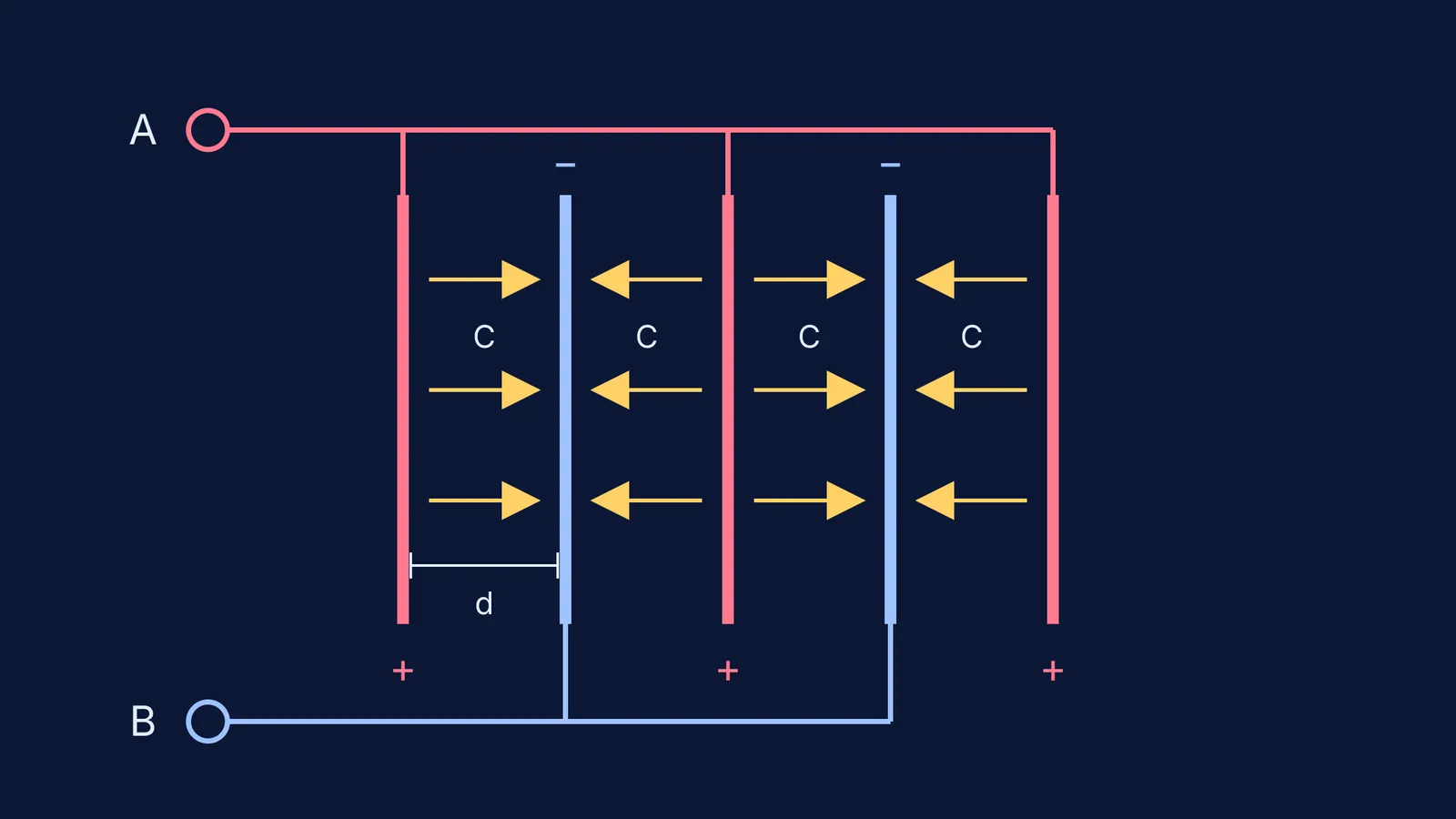
Arrangement 1: alternate plates joined. Plates 1, 3 and 5 go to A; plates 2 and 4 go to B. Every gap now has an A plate on one side and a B plate on the other, so all four capacitors sit between the same two nodes. They are in parallel, so their capacitances add:
C_eq = (n − 1)ε₀A/d = 4 × 88.5 pF = 354 pF.
The inner plates carry charge on both faces, which is how each one serves two gaps at once. The variable air capacitor used to tune radios is built this way, with interleaved fixed and rotating plates, as described in OpenStax section 8.1.
Arrangement 2: only the end plates connected. Plate 1 goes to A, plate 5 goes to B, and plates 2, 3 and 4 float as X, Y and Z. The chain A–X–Y–Z–B is four equal capacitors in series:
C_eq = C/(n − 1) = 88.5/4 pF ≈ 22.1 pF.
Check it: this is the same as one capacitor with a gap of 4d. That makes sense, because thin floating plates do not change the field between the two end plates.
Arrangement 3: a mixed stack. Plates 1 and 5 go to A, plate 3 goes to B, and plates 2 and 4 float as X and Y. The gaps are A–X, X–B, B–Y and Y–A. The path A–X–B is two capacitors in series, giving C/2. The path B–Y–A is two more in series, another C/2. Both paths join A to B, so they are in parallel:
C_eq = C/2 + C/2 = C = 88.5 pF.
Which mistakes cost marks on multi-plate questions?
Counting n capacitors instead of n − 1.
Keeping a gap whose two plates share a label.
Calling a chain series when a third wire leaves the middle node.
Mixing units: 100 cm² is 0.01 m², not 1 m².
Skipping the sanity check. With equal gaps, parallel answers must be larger than one gap's C and series answers smaller.
When the redrawn network does not reduce to simple series and parallel, use node potentials, as in solving unbalanced capacitor bridges with node potentials. If the same-charge rule feels like magic, read why capacitors in series have the same charge. To watch the two rules play out, try capacitors in series and parallel in a simulation.
If you set up a stack and your answer does not match the key, the Fermi Problem Library has worked problems with a step-by-step solver that explains the reasoning rather than printing an answer, so you can see which gap you labelled wrongly.
Next time you see a stack of plates, label the plates before you write a single formula.


