

On this page
A song on a CD is a long list of numbers. MP3 keeps the numbers your ear will use and rounds away the rest. Here is the physics, step by step.
How is a song turned into numbers in the first place?
A microphone turns a pressure wave into a voltage, and a converter measures that voltage thousands of times a second. Each measurement is a sample.
CD audio takes 44,100 samples per second per channel, stores each as a 16-bit number, and has two channels, which comes to 1,411,200 bits every second (Compact Disc Digital Audio).
Why 44,100? A sampled signal can only represent frequencies up to half its sample rate, the Nyquist frequency, so a CD can represent sounds up to 22.05 kHz (Compact Disc Digital Audio). Normal human hearing covers 20 to 20,000 Hz (OpenStax College Physics, Hearing/17%3A_Physics_of_Hearing/17.06%3A_Hearing)), so the CD rate covers the whole range of normal hearing.
Nothing is lost yet. A complex sound is a sum of sine waves (see how adding sine waves makes a square wave), and MP3 works on those frequencies.
How does MP3 compression work?
MP3 is the everyday name for MPEG-1 Layer III, part of an ISO/MPEG audio standard adopted in 1992 (Painter and Spanias, Proceedings of the IEEE, 2000). It is lossy: the decoded file differs from the original but is designed to sound the same. According to that review, the encoder works on short frames:
Split the sound into frequencies. A 32-band filter bank plus a transform called the MDCT turns each frame into narrow frequency lines, 41.67 Hz apart at a 48 kHz sample rate.
Ask a model of the ear what is audible. A psychoacoustic model estimates how loud each frequency must be to be heard at that moment.
Spend bits only where the ear will notice. Within the bit budget, each band is rounded as coarsely as it can be while aiming to keep the rounding error (quantisation noise) below that line.
Pack the result tightly. Huffman coding, a lossless step (compare how ZIP, GIF and PNG shrink files), squeezes out leftover repetition.
Steps 2 and 3 are where sound is discarded, using two facts about hearing.
What sounds does MP3 throw away?
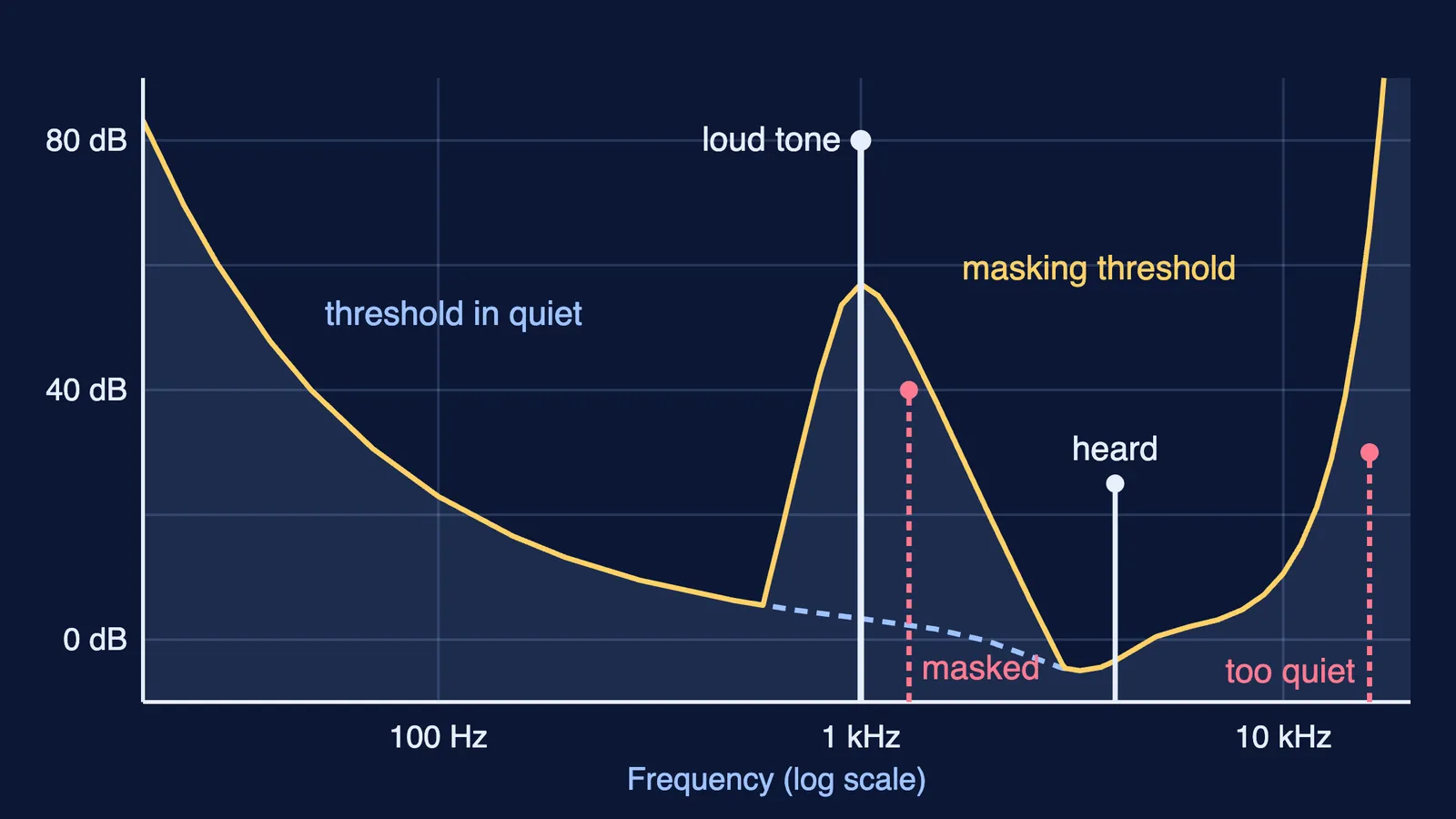
Sounds below the threshold of hearing. The quietest tone you can detect depends on its frequency. The ear is most sensitive between 2,000 and 5,000 Hz (OpenStax College Physics, Hearing/17%3A_Physics_of_Hearing/17.06%3A_Hearing)) and far less so at the extremes, so a faint high hiss can simply be dropped.
Sounds hidden by louder sounds. Masking is the process by which one sound is made inaudible by the presence of another (Painter and Spanias, 2000). In one experiment they summarise, an 80 dB tone at 1 kHz hid a narrow band of noise centred on 1 kHz as long as that noise stayed at or below about 56 dB. A loud sound hides quieter ones close to it in frequency.
Masking also works in time: a loud sound can hide quieter ones for 50 to 300 ms after it stops, depending on how strong and long it was, but only about 1 to 2 ms before it starts (same review). So at a sudden drum hit, MP3 switches to short blocks of about 4 ms, keeping rounding noise from leaking ahead of the beat as an audible “pre-echo”.
The frequency sorting happens in the inner ear: see how the cochlea detects different frequencies.
What does bit rate mean, and is 128 kbps enough?
Bit rate is the number of bits spent on each second of sound. CD stereo uses about 1.41 Mbit/s, and MPEG-1 allows 64 to 384 kbit/s for stereo (Painter and Spanias, 2000).
Worked example, a 180-second song:
CD: 1,411,200 bits/s × 180 s = 254,016,000 bits, or about 31.75 MB.
MP3 at 128 kbit/s: 128,000 × 180 = 23,040,000 bits, or 2.88 MB.
Ratio: 1,411,200 ÷ 128,000 ≈ 11, so the MP3 is about one-eleventh the size.
Per sample: 128,000 bits ÷ 88,200 samples a second (two channels) ≈ 1.45 bits per sample, against the CD's 16.
Can 1.45 bits do the job of 16? The review (Painter and Spanias, 2000) reports “perceptual entropy” estimates that a wide range of CD-quality music can be compressed transparently at about 2.1 bits per sample, with several coders approaching transparency near 1 bit. So 128 kbps leans hard on the ear model; a higher bit rate gives more headroom.
Try it yourself: a blind listening test
Export a song you know well as MP3 at three bit rates, say 320, 128 and 64 kbps.
Predict each file size with the formula above.
Have someone play the versions in random order on headphones. Guess which is which and note where you first hear a difference.
Match it to the two rules: quiet high frequencies, and quiet sounds next to loud ones.
If turning bit rates into sizes trips you up, Fermi's AI tutor works out what you already know and builds a plan for the session. For ideas easier to see than read, try the Fermi Simulation Lab.


