

On this page
The Class 6 chapter on the motions of the Earth comes down to two movements and one tilt. Picture all three together and everything else follows. Here it is in plain words, with real dates and a ten-minute home model.
What are the two motions of the Earth?
Rotation is the Earth spinning on its axis, an imaginary line through the North and South Poles. NASA's Earth facts page gives one rotation as 23.9 hours. The half facing the Sun has day and the other half has night; as the Earth turns, India moves into sunlight and out again.
Revolution is the Earth travelling around the Sun along a path called its orbit. The same NASA page says one trip takes 365.25 days. A calendar year has 365 days, so the leftover quarter days add up to one extra day every four years: 29 February in a leap year.
How much is the Earth's axis tilted?
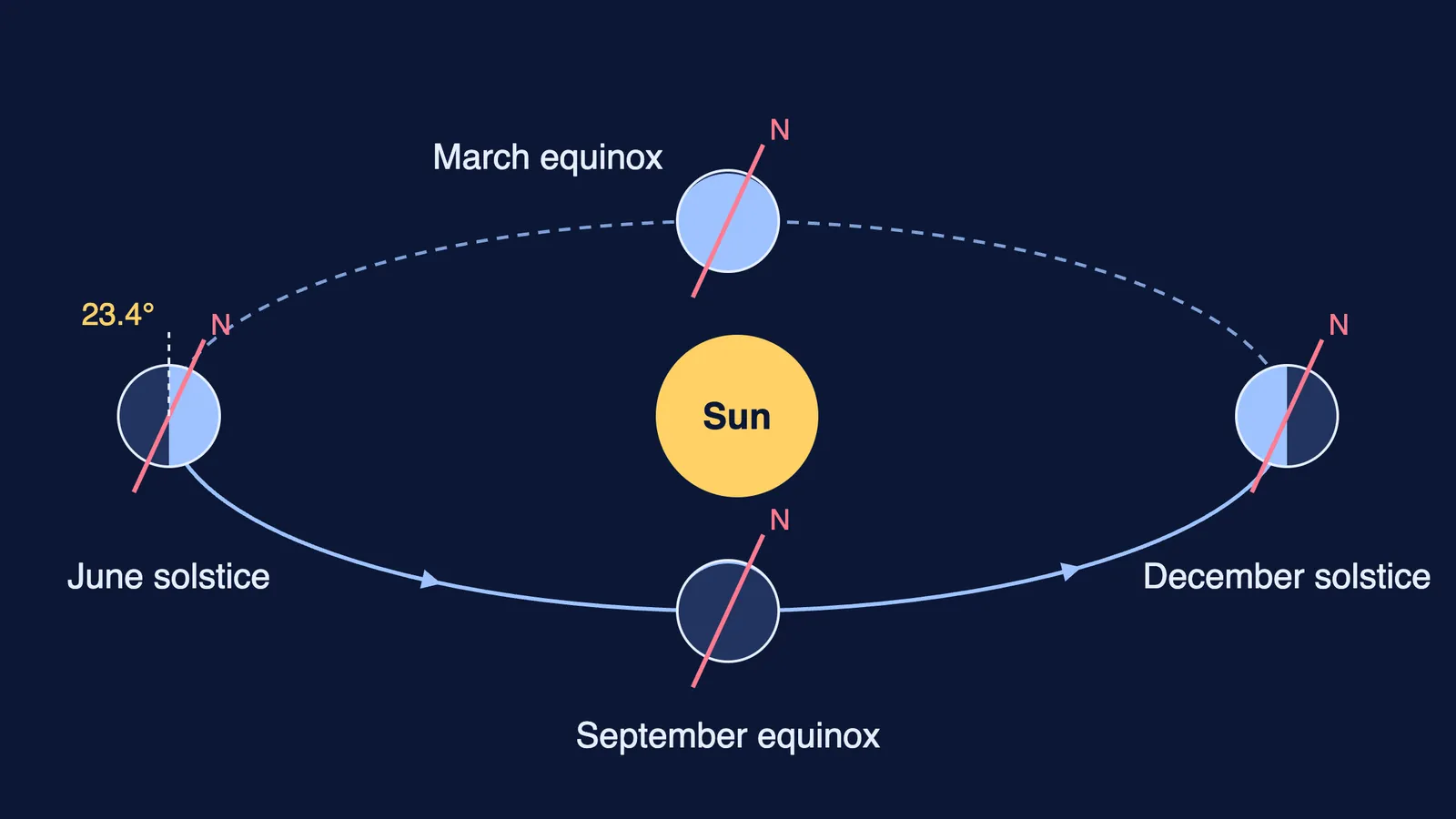
The axis is not upright. NASA gives the tilt as 23.4 degrees. NOAA gives 23.45 degrees from the perpendicular, the line at right angles to the plane of the orbit. The US National Weather Service rounds it to 23.5 degrees.
Some books give the angle between the axis and the plane of the orbit instead: 90 minus 23.5 is 66.5 degrees, or 66½°. It is the same tilt, so check which angle a question asks for.
NASA explains that for part of the year the northern hemisphere leans toward the Sun, and six months later the situation is reversed. To see where the north end of the axis points at night, read why the pole star does not move.
Why do we have seasons if the Earth is closest to the Sun in January?
The US Naval Observatory puts perihelion, the Earth's closest point to the Sun, on 3 January in both 2026 and 2027, in the middle of India's winter. NOAA's page on why Earth has seasons says it plainly: Earth's distance from the Sun is not the cause of the seasons.
The tilt is. When the North Pole points toward the Sun, NASA Space Place says more sunlight reaches the northern half and the rays hit it more directly. Direct rays pack sunlight into a smaller patch of ground, which heats up more: summer in India. Six months later the rays arrive at a slant, and we get winter. The Southern Hemisphere has the opposite season at the same time.
For how the seasons look on the ground here, see our guide to seasons in India.
When are the solstices and equinoxes in 2026 and 2027?
A solstice is when one hemisphere leans furthest toward the Sun: the June solstice for the north, the December solstice for the south. An equinox falls halfway between, when, as The Planetary Society notes, day and night are nearly equal in length across most of Earth.
The US Naval Observatory's seasons data gives the moments in UTC; Indian Standard Time is UTC plus 5 hours 30 minutes, says CSIR-National Physical Laboratory, so in India:
March equinox: 20 March 2026, 8:16 pm; 21 March 2027, 1:55 am
June solstice: 21 June 2026, 1:54 pm; 21 June 2027, 7:41 pm
September equinox: 23 September 2026, 5:35 am; 23 September 2027, 11:32 am
December solstice: 22 December 2026, 2:20 am; 22 December 2027, 8:12 am
Notice that the date moves with the year and the time zone: the December 2026 solstice is 21 December in UTC but already 22 December in India. That is why 20 and 21 March can both be right. For an ancient example of tracking these dates, read why Stonehenge aligns with the solstice.
How can you show rotation and revolution at home?
Mark India with an ink dot on the upper half of the ball.
Put the lamp in the middle of the room. It is the Sun.
Tilt the pencil about a quarter of a right angle from upright and pick a wall for its top to point at. Keep it pointing at that wall the whole time.
Rotation: spin the ball slowly and watch the ink dot cross from dark into light (sunrise) and back (sunset).
Revolution: carry the ball in a circle around the lamp, still spinning, still pointing at the same wall.
Stop where the top leans toward the lamp: the June solstice. Then walk to the opposite side for December and compare.
Stop at the two points in between, where both poles get light: the equinoxes.
Then, without the book, explain why India has winter when the Earth is closest to the Sun.
The Fermi Simulation Lab has interactive simulations for ideas that are easier to see than to read. If a question still will not click, Fermi's AI tutor can draw the figure and check your understanding as it goes.
Tonight, try step 4 with a torch and an orange.


