

On this page
Leave a charge at rest between two charged plates and it does the simplest thing in mechanics: it moves in a straight line with constant acceleration. The rest is the constant-acceleration equations plus one line of energy.
What is the acceleration of a charge in a uniform electric field?
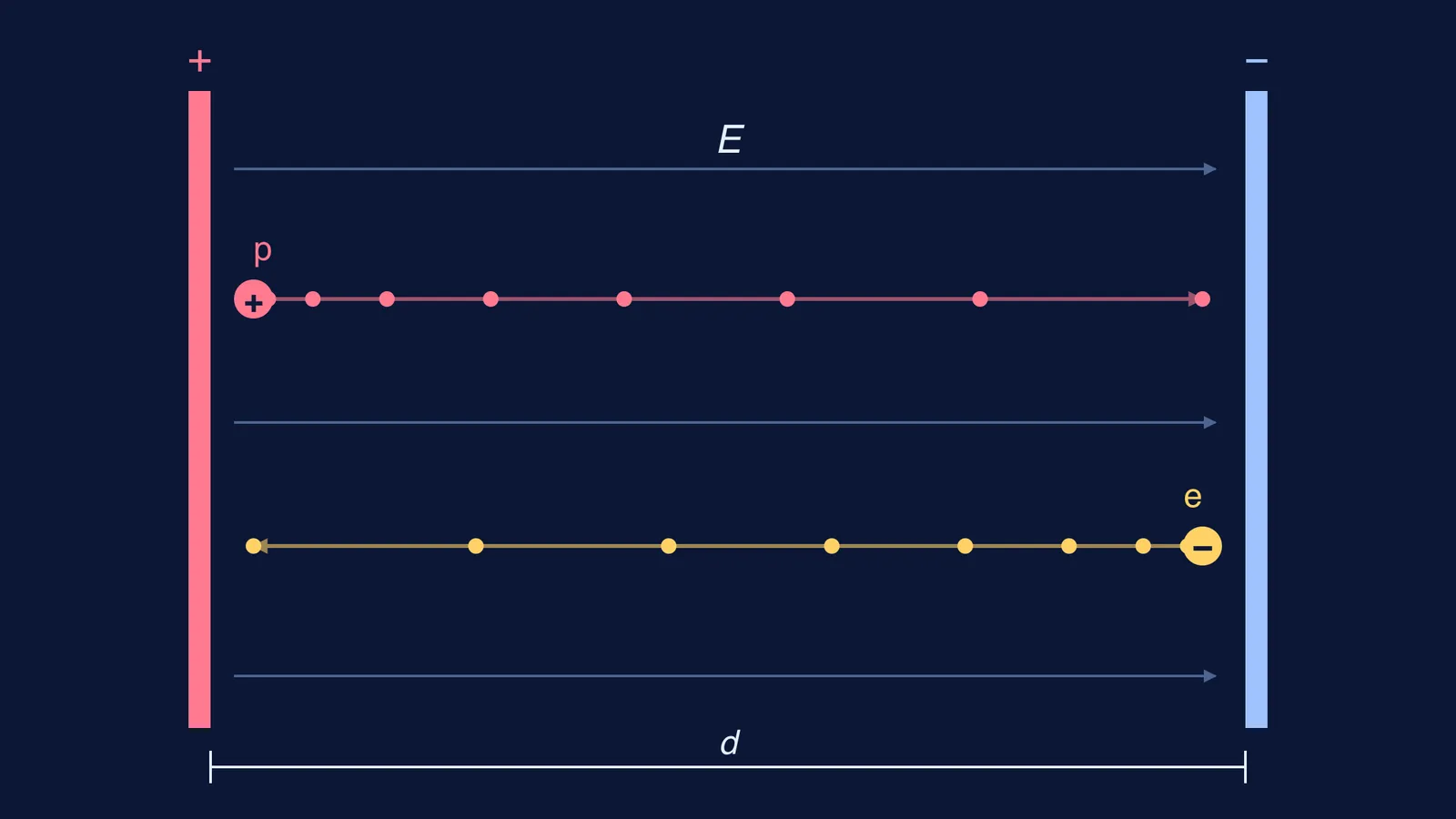
The force on a charge q in an electric field E is F = qE, as set out in OpenStax University Physics, Volume 2, section 5.4. In a uniform field, such as the region between large parallel plates, E has the same size and direction everywhere, so the force never changes as the charge moves.
Newton's second law then gives a constant acceleration:
a = qE/m
A positive charge accelerates along the field, from the + plate towards the − plate. A negative charge accelerates against it. If the charge starts from rest, nothing pushes it sideways, so the path is a straight line along the field. For electrons and protons in laboratory fields, gravity is so much weaker than the electric force that problems ignore it.
What speed does a charge reach after a distance d?
Kinematics. With u = 0 and s = d, the equation v² = u² + 2as gives v² = 2qEd/m, so v = √(2qEd/m). The time taken is t = √(2md/(qE)).
Energy. The field does work W = force × distance = qEd. All of it becomes kinetic energy, so ½mv² = qEd, which gives the same v.
The energy route is usually faster. It also connects to voltage: in a uniform field the potential difference across a distance d has size V = Ed, and the change in potential energy is ΔU = qΔV (OpenStax, section 7.2). So the kinetic energy gained is simply qV. For practice on that form, see our post on the speed of an electron accelerated through a potential difference.
Why do a proton and an electron gain the same energy?
Because the energy is work, and work is force times distance. The force qE depends on charge, not mass. The proton and the electron carry charges of the same size, the elementary charge e, which is exactly 1.602176634 × 10⁻¹⁹ C in the NIST CODATA values. Across the same gap, each feels the same size of force over the same distance, so each gains the same kinetic energy, eEd, moving in opposite directions.
Mass decides how that energy shows up. The proton is about 1836.15 times as massive as the electron, according to NIST's proton-electron mass ratio. Equal kinetic energy means mv² is the same, so the speed ratio is √1836.15 ≈ 42.85. Momentum goes the other way: since p = √(2mK), the proton leaves with about 42.85 times the electron's momentum.
Worked example: a proton and an electron across a 1 cm gap
Take E = 1.0 × 10⁴ V/m (the same as N/C) and d = 1.0 cm = 0.010 m. The proton starts from rest at the + plate, the electron from rest at the − plate. Use e = 1.602 × 10⁻¹⁹ C, electron mass 9.109 × 10⁻³¹ kg (NIST) and proton mass 1.673 × 10⁻²⁷ kg (NIST).
Force on each: eE = 1.60 × 10⁻¹⁵ N.
Energy gained by each: eEd = 1.60 × 10⁻¹⁷ J. Since 1 eV = 1.60 × 10⁻¹⁹ J (OpenStax, section 7.2), that is 100 eV for both, matching V = Ed = 100 V.
Electron: a = eE/m = 1.76 × 10¹⁵ m/s². Then v = √(2ad) = 5.93 × 10⁶ m/s, reached in t = v/a = 3.37 ns.
Proton: a = 9.58 × 10¹¹ m/s². Then v = 1.38 × 10⁵ m/s, reached in t = 0.145 μs.
Check: the speed ratio is about 43, which is √1836.
What mistakes do students make in these questions?
Saying the electron gains more energy because it ends up faster. It gains the same energy; only its speed is higher.
Sending the electron along E. Negative charges accelerate opposite to the field.
Leaving d in centimetres while E is in V/m.
Assuming both take the same time. Time grows as √m, so with the NIST mass ratio of about 1836 the proton takes about 43 times longer.
Using v = √(2qEd/m) when the charge was not at rest. With an initial speed u, use v² = u² + 2qEd/m, where d is the distance moved along the field.
If a magnetic field takes over where the electric field ends, see our post on a charge crossing into a magnetic field region. For how electric deflection was used historically, read how the e/m ratio of cathode rays was measured.
If your answer differs from the book's, the error is usually the sign, the units or the formula. The Fermi Problem Library has worked problems with a step-by-step solver that explains the reasoning rather than printing an answer, so you can compare each step with your own. If work done by a field is the shaky part, the Fermi Concept Library gives each concept its own lesson.
Try it now: double d in the example and predict each particle's new energy, speed and time before calculating.


