

On this page
Chapter 5 of the NCERT Class 10 geography book, Contemporary India II, is a chapter of places: which mineral comes from which belt, and which energy sources count as conventional. Every figure below comes from the NCERT chapter Minerals and Energy Resources, 2026-27 reprint.
What does the Minerals and Energy Resources chapter cover?
The NCERT chapter quotes geologists' definition of a mineral: a "homogenous, naturally occurring substance with a definable internal structure".
It sorts minerals into three groups:
Metallic: ferrous (iron ore, manganese, nickel, cobalt), non-ferrous (copper, lead, tin, bauxite) and precious (gold, silver, platinum).
Non-metallic: mica, salt, potash, sulphur, granite, limestone, marble, sandstone.
Energy minerals: coal, petroleum, natural gas.
Minerals occur in veins and lodes (tin, copper, zinc, lead), in sedimentary beds (coal, gypsum), as a residual mass of weathered rock (bauxite), as placer deposits (gold, silver, tin, platinum) and in ocean water (common salt, magnesium, bromine).
Where are iron ore, bauxite, mica and coal found in India?
Iron ore. Magnetite is the finest ore, with up to 70% iron; hematite has 50-60% iron, according to the NCERT chapter. In 2018-19, about 97% of India's iron ore came from Odisha, Chhattisgarh, Karnataka and Jharkhand. Learn the four belts:
Odisha-Jharkhand: Badampahar (Mayurbhanj and Kendujhar), and Gua and Noamundi in Singhbhum.
Durg-Bastar-Chandrapur: the Bailadila hills in Bastar, Chhattisgarh, exporting via Vishakhapatnam.
Ballari-Chitradurga-Chikkamagaluru-Tumakuru in Karnataka, with Kudremukh, whose ore goes as slurry by pipeline to a port near Mangaluru.
Maharashtra-Goa, exporting through Marmagao.
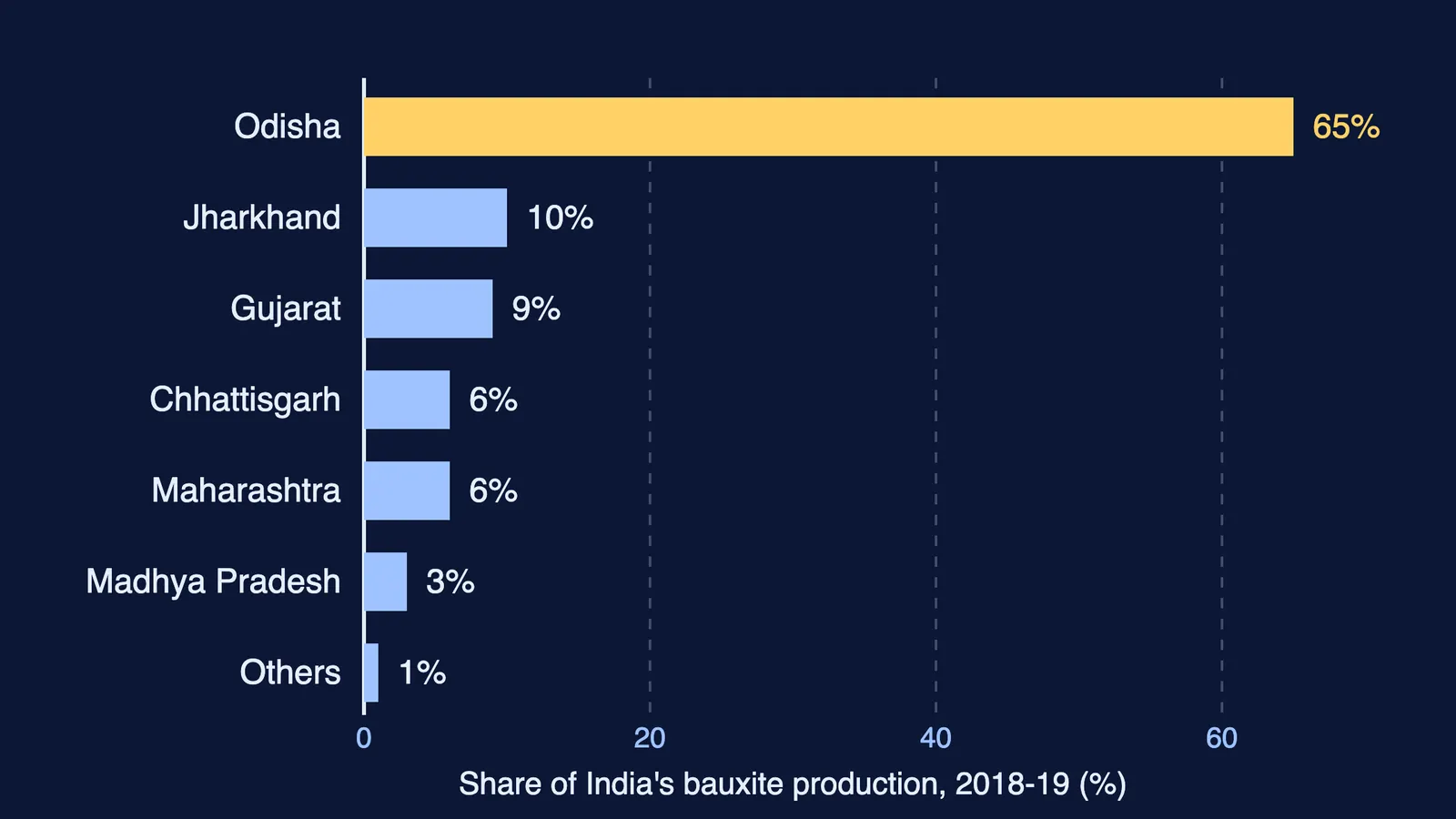
Bauxite. It forms when rocks rich in aluminium silicates decompose. The main deposits are on the Amarkantak plateau, the Maikal hills and the Bilaspur-Katni plateau. Odisha produced 65% of India's bauxite in 2018-19, and Panchpatmali in Koraput district is its most important deposit, per the NCERT chapter.
Mica. It lies on the northern edge of the Chota Nagpur plateau. The Koderma-Gaya-Hazaribagh belt of Jharkhand leads, followed by the area around Ajmer in Rajasthan and the Nellore belt in Andhra Pradesh.
Coal. The major resources of Gondwana coal, a little over 200 million years old, are in the Damodar valley (West Bengal-Jharkhand): Jharia, Raniganj and Bokaro. The Godavari, Mahanadi, Son and Wardha valleys also hold coal. Tertiary coal, about 55 million years old, is in Meghalaya, Assam, Arunachal Pradesh and Nagaland. Lignite comes from Neyveli in Tamil Nadu.
For the CBSE map list and a weekly way to practise it, see our guide to Class 10 geography map work.
What is the difference between conventional and non-conventional energy?
Conventional sources are firewood, cattle dung cake, coal, petroleum, natural gas and electricity (hydel and thermal), as the NCERT chapter lists them. Non-conventional sources are solar, wind, tidal, geothermal, biogas and atomic energy. NCERT cites one estimate that firewood and dung cake meet more than 70% of rural households' energy needs.
The places to know for the non-conventional side:
Nuclear: uranium and thorium from Jharkhand and the Aravalli ranges of Rajasthan; the monazite sands of Kerala are rich in thorium.
Wind: the largest wind farm cluster runs from Nagercoil to Madurai in Tamil Nadu.
Tidal: the Gulf of Khambhat, the Gulf of Kuchchh and the Sunderbans.
Geothermal: experimental projects in the Parvati valley near Manikaran (Himachal Pradesh) and the Puga valley (Ladakh).
For the physics, read how a nuclear reactor uses control rods and a moderator and how rooftop solar and net metering add up. The Fermi Concept Library covers the ideas underneath, such as fission.
How do you answer 'distinguish between conventional and non-conventional energy'?
A model answer in three points, built only from the textbook:
Examples: conventional sources are coal, petroleum, natural gas, firewood, dung cake and thermal or hydel electricity; non-conventional sources are solar, wind, tidal, geothermal, biogas and atomic energy.
Renewal: coal, oil and gas are fossil fuels that are finite; sun, wind and tides are renewable.
Effect: fossil fuels cause serious environmental problems, and rising oil and gas prices raise doubts about future energy supply; this is why NCERT calls for renewable sources such as solar, wind and tide.
Add one Indian example to each side, such as Jharia coal and Nagercoil wind.
How should you revise this chapter in three days?
Day 1, minerals: write the classification tree and the four iron ore belts from memory, then check against the book.
Day 2, maps: mark the mineral locations and the nuclear and thermal power plants on a blank outline map, saying each state aloud.
Day 3, answers: write the model answer above, then explain why thermal power stations sit near coalfields (coal is bulky and loses weight as ash).
If you are not sure where to begin across the whole syllabus, Fermi's AI tutor works out what you already know and builds a plan for the session.
Start with Day 1 tonight: one blank page, the classification tree, ten minutes.


