

On this page
Most students learn that the methoxy group (-OCH3) is a strong electron donor. Then a question asks you to rank m-methoxybenzoic acid against benzoic acid, and that rule gives the wrong answer. The fix is to treat methoxy as two effects travelling by different routes, and check which one reaches the carbon you care about.
Why does methoxy have two opposite effects?
Oxygen is more electronegative than carbon, so it pulls electron density through the sigma bond to the ring. That is the inductive effect, written -I. It acts at every ring position but weakens with each bond it has to cross, which is why it matters most nearby (see our explainer on why the inductive effect fades with distance).
Oxygen also carries lone pairs that can overlap with the ring's pi system. Pushing one lone pair into the ring is the resonance (mesomeric) effect, written +R or +M. It is usually the bigger of the two, which is why anisole reacts with electrophiles much faster than benzene (our post on electrophilic substitution of anisole walks through the products).
The catch is that +R does not reach every carbon.
Where does the resonance donation actually go?
Draw it yourself. Put -OCH3 on carbon 1 and push an oxygen lone pair into the ring. The negative charge appears on carbon 2. Push the next pi bond along and it moves to carbon 4, then to carbon 6. Those are the two ortho positions and the para position.
Now look for carbon 3 or carbon 5 in your structures. They never carry the charge. Resonance moves charge two carbons at a time, so a donor at carbon 1 can only feed carbons 2, 4 and 6.
So a group sitting meta to methoxy feels only the inductive pull. With nothing to oppose it, the net effect at meta is electron withdrawal.
What do benzoic acid pKa values show?
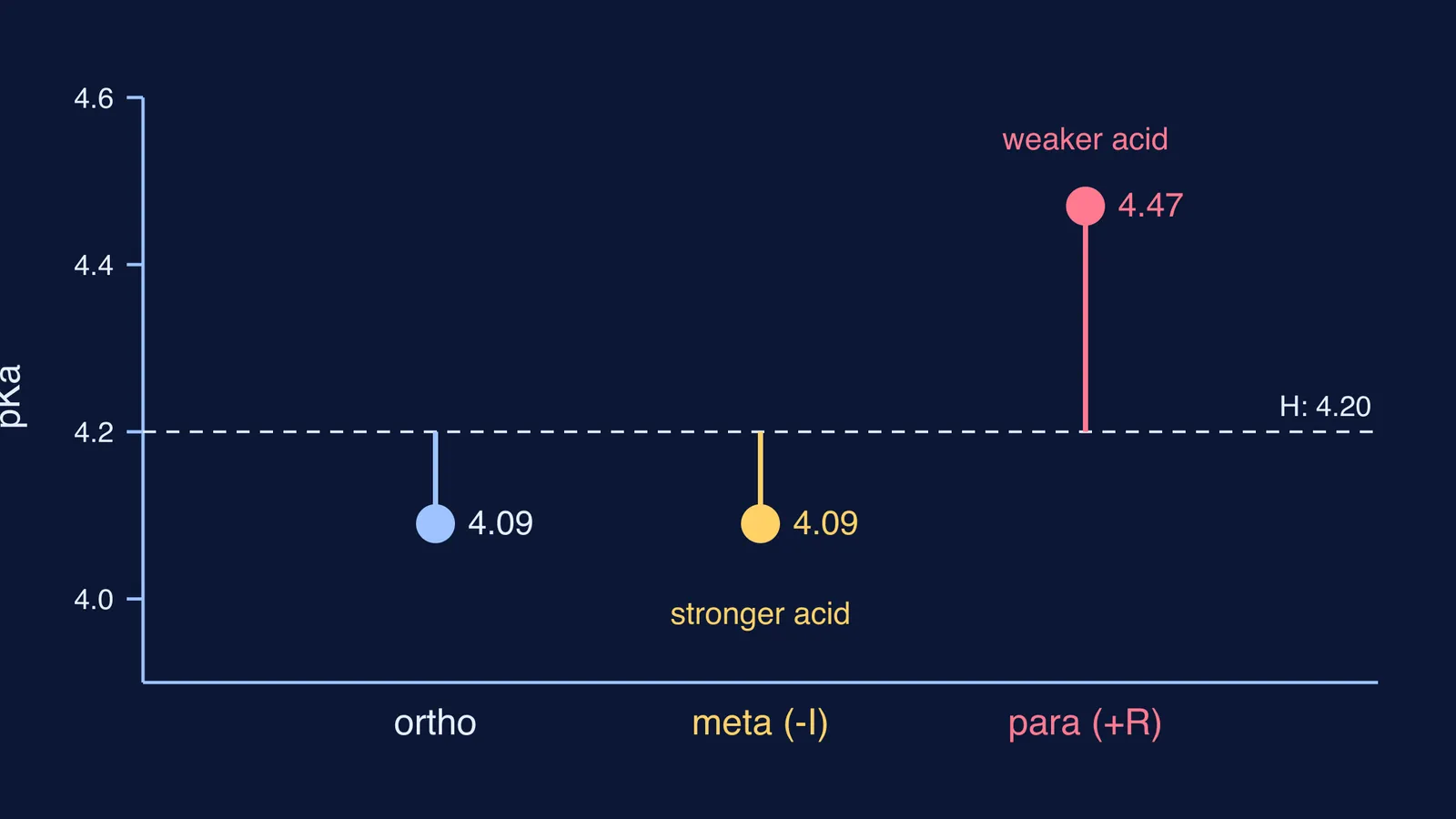
Benzoic acid is the cleanest test: a group that pulls electrons stabilises the benzoate anion and lowers the pKa; a group that pushes electrons raises it. These are the values listed in the pKa compilation by R. Williams, provided by the ACS Organic Division (page 7):
Benzoic acid: pKa 4.20
3-methoxybenzoic acid (meta): pKa 4.09, a stronger acid
4-methoxybenzoic acid (para): pKa 4.47, a weaker acid
2-methoxybenzoic acid (ortho): pKa 4.09
The meta acid is stronger than benzoic acid, exactly as -I alone predicts. The para acid is weaker, because at para the +R donation pushes electron density onto the ring carbon that carries the carboxyl group, and it outweighs the -I pull.
The ortho value is not a clean test of resonance. Most groups next to the carboxyl group strengthen the acid, which is called the ortho effect; our post on why ortho benzoic acids are stronger acids explains it. Keep ortho out of your meta-versus-para argument.
How do Hammett constants put a number on it?
Louis Hammett defined a substituent constant, sigma, from the ionisation of substituted benzoic acids in water at 25 °C, with hydrogen set to zero (Hammett, 1937, Journal of the American Chemical Society). A positive sigma means the group withdraws electrons from that position; a negative sigma means it donates.
In the table of Hammett's original values, methoxy has sigma-meta = +0.115 and sigma-para = -0.268. A later standard survey of these constants is Hansch, Leo and Taft, 1991, Chemical Reviews.
You can check this against the pKa list above. Because sigma is the log of the acid-strength ratio, it equals pKa(benzoic) minus pKa(substituted):
Meta: 4.20 - 4.09 = +0.11. Positive, so withdrawing.
Para: 4.20 - 4.47 = -0.27. Negative, so donating.
The sign flips with position, and that sign flip is the whole answer to the question.
How do you use this in an exam answer?
When a question involves any group with a lone pair on the atom attached to the ring (-OCH3, -OH, -NH2, -Cl), run these four checks:
Name both effects: -I through the sigma bond, +R through the pi system.
Find the position of the group you are asked about relative to the substituent.
If it is meta, only -I applies, so the substituent withdraws.
If it is ortho or para, compare +R with -I. For oxygen and nitrogen, +R usually wins; for halogens, -I wins.
Try it on phenols. The same Williams compilation (page 9) lists phenol at pKa 9.95, m-methoxyphenol at 9.65 and p-methoxyphenol at 10.20. Predict the order first, then check: the pattern matches benzoic acid, with meta stronger and para weaker.
If your rankings keep coming out back to front, revise inductive and resonance effects as separate lessons in the Fermi Concept Library, then practise acid-strength rankings in the Fermi Problem Library, where the step-by-step solver explains the reasoning rather than printing an answer.


