

On this page
Drop a piece of sodium into water and it fizzes and can burst into flame. Drop in a copper wire and nothing happens. Between those two ends sits a favourite Class 10 chemistry question: which metals react with cold water, which need hot water, which need steam, and what forms in each case.
The core facts below come from section 3.2.2 of the NCERT Class 10 Science chapter Metals and Non-metals.
What is the order of reaction of metals with water?
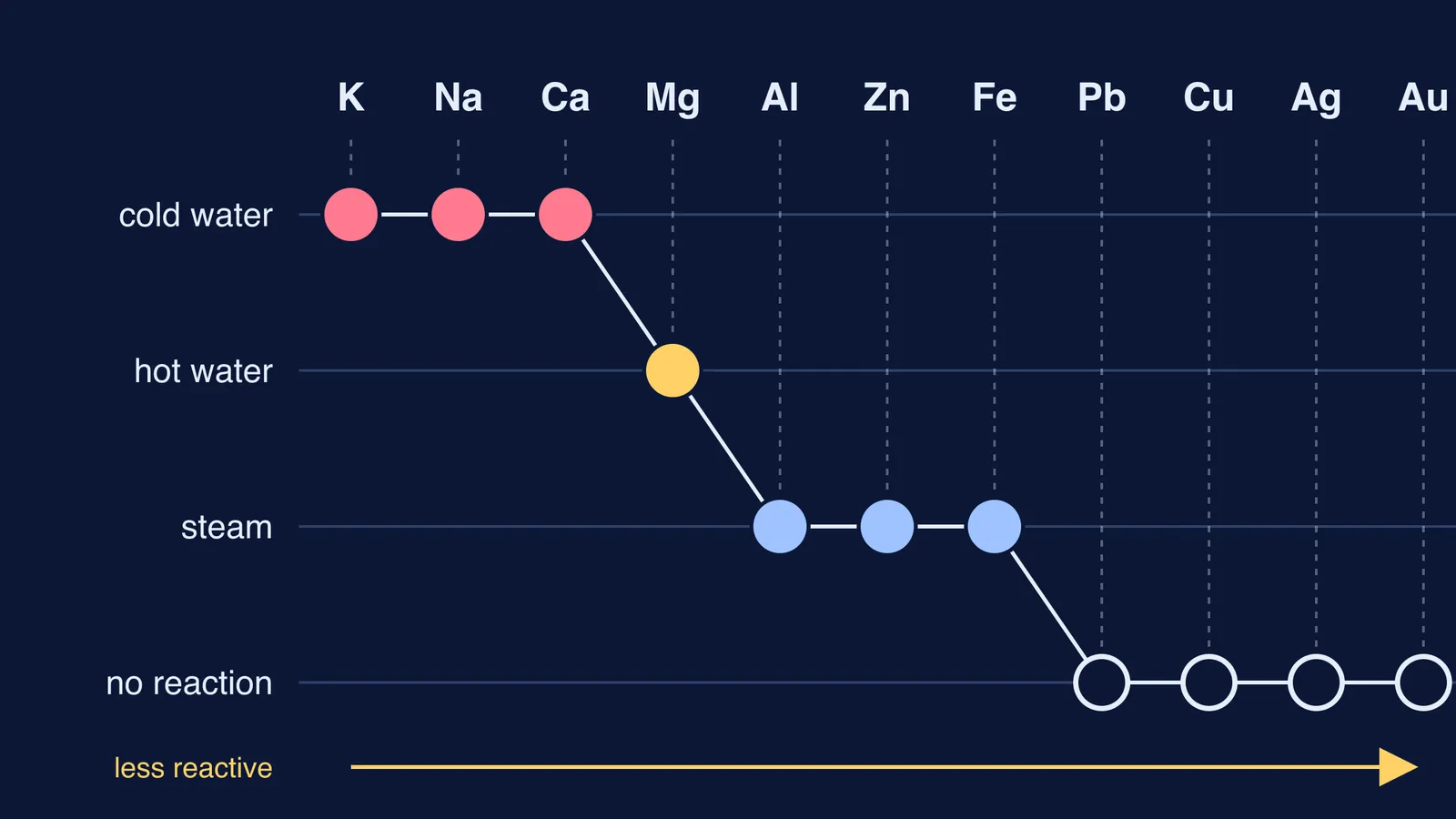
NCERT sorts the metals by the mildest condition at which they react with water, and the order matches its activity series (Table 3.2 in the same NCERT chapter):
Cold water, violently: potassium and sodium. The reaction is so violent and exothermic that the hydrogen given off catches fire.
Cold water, less violently: calcium. The heat is not enough to make the hydrogen catch fire.
Hot water only: magnesium.
Steam only: aluminium, zinc and iron, which react with neither cold nor hot water.
No reaction at all: lead, copper, silver and gold.
Read the list top to bottom and you are reading down the reactivity series: K > Na > Ca > Mg > Al > Zn > Fe > Pb > Cu > Ag > Au. The less reactive the metal, the harsher the conditions it needs before it reacts.
What products form when metals react with cold water, hot water and steam?
NCERT says metals react with water to give a metal oxide and hydrogen, and oxides that are soluble in water dissolve to form the metal hydroxide (NCERT, section 3.2.2). In practice there is one rule:
Cold or hot water gives a hydroxide and hydrogen.
Steam gives an oxide and hydrogen.
Chemguide's page on metals with water and steam gives the reason: the oxides of the reactive metals react with water to make hydroxides, while at the higher temperatures of the steam reactions you get the oxide instead. The equations, from NCERT and Chemguide (magnesium's hot water equation follows NCERT's statement that it forms magnesium hydroxide and hydrogen):
2K + 2H₂O → 2KOH + H₂ + heat
2Na + 2H₂O → 2NaOH + H₂ + heat
Ca + 2H₂O → Ca(OH)₂ + H₂
Mg + 2H₂O (hot water) → Mg(OH)₂ + H₂
Mg + H₂O (steam) → MgO + H₂
2Al + 3H₂O (steam) → Al₂O₃ + 3H₂
Zn + H₂O (steam) → ZnO + H₂
3Fe + 4H₂O (steam) → Fe₃O₄ + 4H₂
Two details worth knowing: zinc oxide is yellow when hot and white when it cools, and the iron product is Fe₃O₄, a black oxide, not Fe₂O₃ (Chemguide).
Why does calcium float, and why doesn't magnesium react with cold water?
Calcium starts floating because bubbles of hydrogen stick to its surface, and magnesium floats in hot water for the same reason (NCERT, section 3.2.2).
In cold water, a small first reaction coats magnesium with a very thin layer of insoluble magnesium hydroxide, which stops more water getting at the metal (Chemguide). Very clean magnesium does slowly bubble over about half an hour, Chemguide notes, but for exams use NCERT's answer.
Sodium and potassium are so reactive that they catch fire if kept in the open, so they are kept under kerosene; we explain that in why sodium is stored under kerosene.
How do you answer the exam question quickly?
NCERT's own end-of-section question asks for equations for iron with steam, and for calcium and potassium with water. Use this four-step check on any metal:
Place the metal. Cold water, hot water, steam or no reaction?
Pick the product. Water means hydroxide; steam means oxide; the last group means write no reaction.
Write hydrogen. If the metal reacts, the gas is always H₂.
Balance and add states. Use (l) for water and (g) for steam.
Worked example: iron and steam. Iron is in the steam group, so the product is an oxide, Fe₃O₄. Balance iron first (3Fe), then oxygen (4H₂O), and hydrogen comes out as 4H₂: 3Fe(s) + 4H₂O(g) → Fe₃O₄(s) + 4H₂(g).
If balancing is where your marks slip, the Fermi Problem Library has worked problems with a step-by-step solver that explains the reasoning rather than printing an answer. If the reactivity series feels like a list to cram, the Fermi Concept Library gives each chemistry concept its own lesson and its place in the map.
Where does the same order show up next?
The same reactivity order decides which metal displaces which from a salt solution, as in the Class 10 practical on metals and salt solutions. It also explains NCERT's acid results: magnesium, aluminium, zinc and iron give hydrogen with dilute hydrochloric acid, but copper does not (NCERT, section 3.2.3). The same idea sits behind the laboratory preparation of hydrogen from zinc and dilute acid.


