

On this page
When tiny droplets join into bigger drops, a little energy is set free. Class 11 physics and JEE problems turn this into a classic question: n identical drops merge into one big drop, so find the energy released and how much the water warms up. Two ideas do all the work: volume conservation and surface energy.
Why does merging drops release energy?
A liquid surface carries extra energy, because molecules at the surface have fewer neighbours pulling on them than molecules inside. NCERT's Class 11 physics textbook defines surface tension S as the surface energy per unit area: the extra energy that molecules at the interface have compared with molecules in the interior (NCERT Class 11 Physics, Chapter 9). The surface tension of water at 20 °C is 0.0727 N/m, according to Table 9.3 of the same chapter.
So surface energy is S × area. Merging keeps the volume but shrinks the total area, and the energy difference comes out, mostly as heat. For how the two terms differ, see our explainer on surface energy versus surface tension.
How do you find the radius of the big drop?
A liquid is nearly incompressible, so volume is conserved:
n × (4/3)πr³ = (4/3)πR³, which gives R = n^(1/3) r.
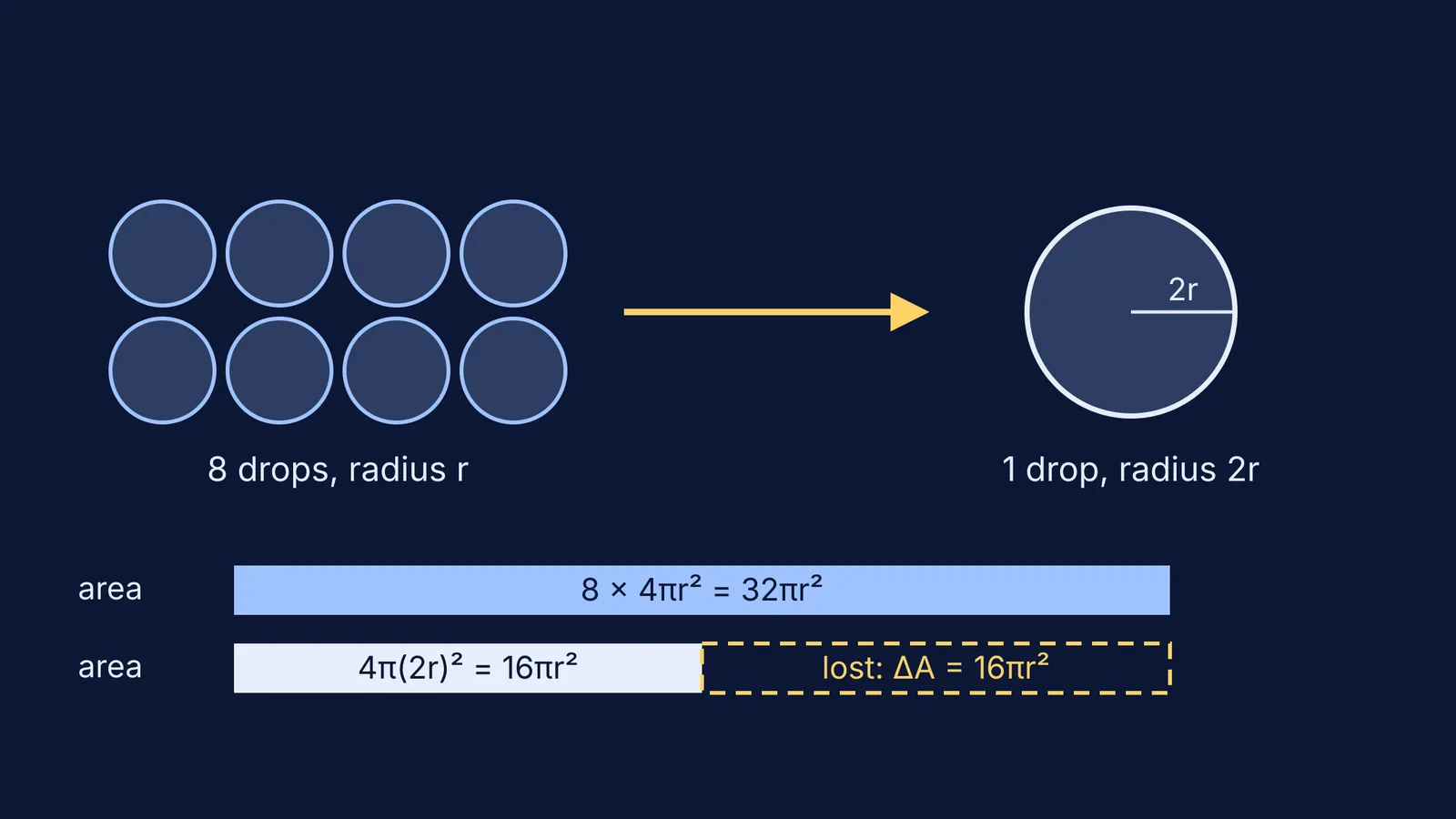
Eight drops make one drop of radius 2r, not 8r. A thousand drops make one drop of radius 10r. Get this step wrong and every number after it is wrong too.
What is the formula for energy released when n drops merge?
Compare the areas before and after.
Before: n × 4πr²
After: 4πR² = 4π n^(2/3) r²
Decrease in area: ΔA = 4πr²(n − n^(2/3))
Multiply by S to get the energy released:
ΔE = 4πr²S(n − n^(2/3)) = 4πR²S(n^(1/3) − 1)
Both forms give the same number, so use the one that matches the data in the question. Reversed, it is the work needed to spray one big drop into n small ones. Soap bubbles add a twist, because a film has two surfaces; that case is covered in work done in blowing a soap bubble.
How much does the temperature of the drop rise?
If no heat escapes, the released energy warms the big drop: ΔE = m s Δθ, with m = ρ(4/3)πR³. Substitute and simplify:
Δθ = (3S / ρs)(1/r − 1/R)
The specific heat capacity of water is 4186 J kg⁻¹ K⁻¹, according to Table 10.3 of NCERT Class 11 Physics, Chapter 10. Take ρ = 1000 kg/m³ for water and S = 0.0727 N/m from Table 9.3 of NCERT Class 11 Physics, Chapter 9.
Worked example: 1000 drops of radius 1 mm
Radius of the big drop: R = 1000^(1/3) × 1 mm = 10 mm = 0.01 m.
Area before: 1000 × 4π(0.001)² = 0.012566 m².
Area after: 4π(0.01)² = 0.0012566 m².
Decrease in area: ΔA = 0.011310 m².
Energy released: ΔE = 0.0727 × 0.011310 ≈ 8.2 × 10⁻⁴ J.
Temperature rise: Δθ = (3 × 0.0727 / (1000 × 4186)) × (1000 − 100) ≈ 4.7 × 10⁻⁵ °C.
Check step 6: the big drop's mass is 4.19 × 10⁻³ kg, so m s ≈ 17.5 J/K, and 8.2 × 10⁻⁴ J ÷ 17.5 J/K ≈ 4.7 × 10⁻⁵ K.
Where does this happen outside an exam paper?
In 2009, Jonathan Boreyko and Chuan-Hua Chen reported in Physical Review Letters that condensed water drops on a superhydrophobic surface leave the surface by themselves when they merge (Boreyko and Chen, 2009). Their abstract says the surface energy released on coalescence drives an out-of-plane jump at speeds as high as 1 m/s. On a strongly water-repellent surface, part of the released energy becomes motion instead of heat, so the drops clear away with no external force.
Mistakes that cost marks
Writing R = nr instead of R = n^(1/3) r.
Saying energy is absorbed on merging. Merging releases energy; splitting needs it.
Using 8πr² per drop. That is for a soap film with two surfaces; a drop has one.
Leaving r in millimetres while S is in N/m.
Using the mass of one small drop instead of the whole merged drop in m s Δθ.
The same n^(1/3) step also decides how fast the merged drop falls through air, worked through in terminal velocity when n small drops merge.
If you keep losing marks on questions like this, the Fermi Problem Library has worked problems with a step-by-step solver that explains the reasoning rather than printing an answer. If the gap is the idea of surface energy itself, the Fermi Concept Library gives each physics concept its own lesson and its place in the map.
Try one now with the same values for water: 27 drops of radius 2 mm merge. You should get R = 6 mm, ΔE ≈ 6.6 × 10⁻⁵ J and Δθ ≈ 1.7 × 10⁻⁵ °C.


