On this page
Meeting Life Challenges is Chapter 3 of the NCERT Class 12 psychology textbook, and it asks a question every board student lives with: when does a challenge turn into stress, and what can you do about it? Here is the chapter in exam-ready form, then as a plan for your exam season.
What is stress in Class 12 psychology?
The NCERT chapter defines stress as "the pattern of responses an organism makes to stimulus event that disturbs the equilibrium and exceeds a person's ability to cope". The events that cause it are stressors; the reaction to them is strain. Not all stress is harmful: eustress is the level that helps you perform, and distress is the kind that wears the body down.
The chapter follows the cognitive theory of Richard Lazarus: what matters is how you appraise an event. In primary appraisal you judge a new situation as positive, neutral or negative, and weigh a negative one for harm, threat or challenge. In secondary appraisal you ask whether your abilities and resources are enough to deal with it. So a number 11 batsman and an opener see the same fast bowler differently.
What are the types and sources of stress?
The NCERT chapter names three types, and stresses that they are interrelated:
Physical and environmental stress: overexertion, a poor diet, too little sleep, noise, pollution, heat, disasters.
Psychological stress: generated in your own mind, from frustration, conflicts, internal pressures ("I must do everything perfectly") and social pressures.
Social stress: from interaction with other people, such as illness in the family or strained relationships.
The sources it lists are major life events, daily hassles and traumatic events. Holmes and Rahe built a life-events measure, the Social Readjustment Rating Scale (1967), and NCERT's Box 3.1 describes an Indian version by Singh, Kaur and Kaur. That scale lists 51 life changes; appearing for examinations carries a mean stress score of 43, against 66 for the death of a close family member (NCERT Box 3.1). The box adds that the link between life events and illness is weak.
What are the three stages of the General Adaptation Syndrome?
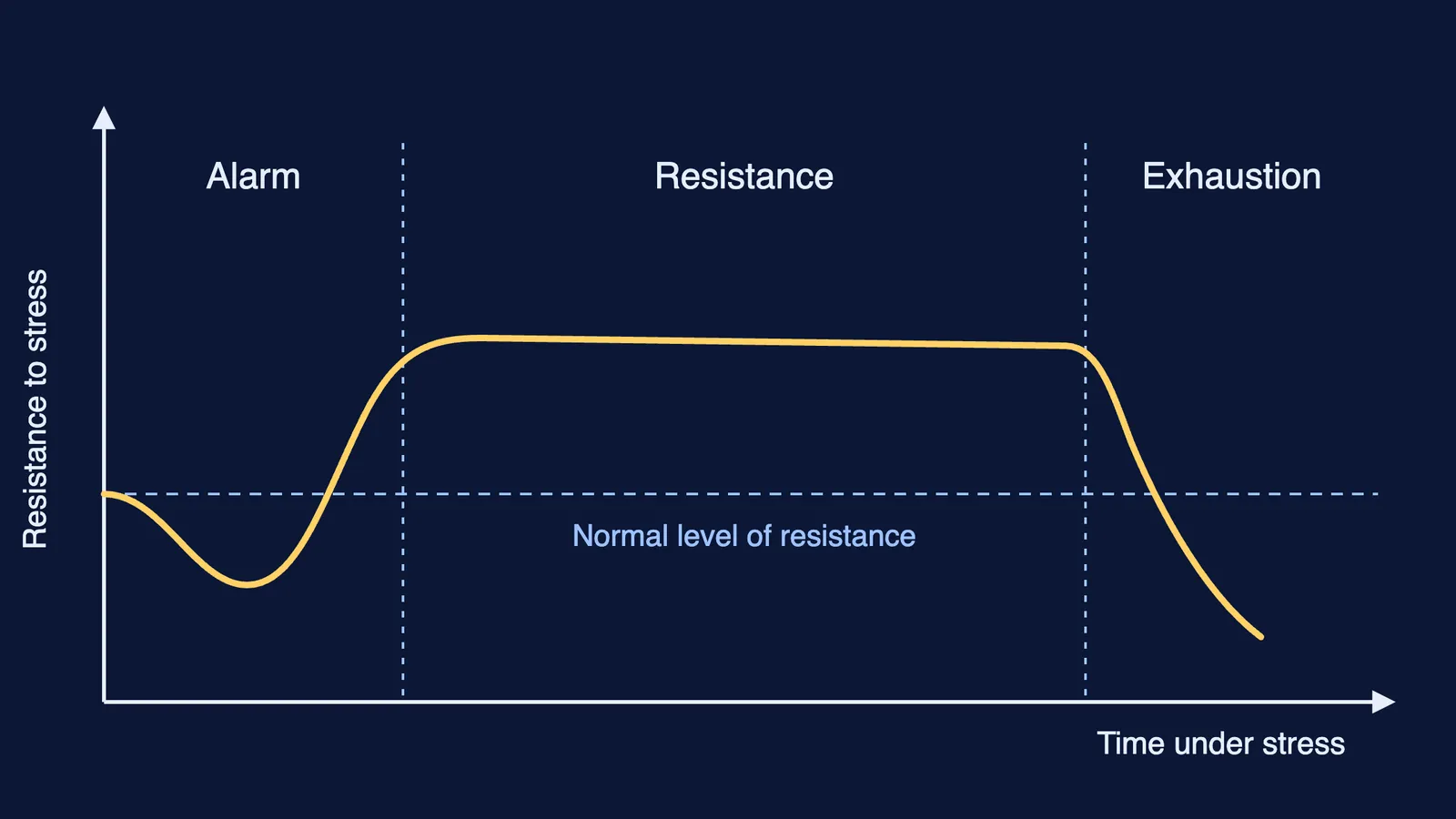
Hans Selye reported in Nature in 1936 that rats damaged by very different agents, such as cold, surgical injury, excessive exercise or drugs, developed a typical syndrome that did not depend on the agent. The pattern became known as the General Adaptation Syndrome (GAS), and the NCERT chapter gives its three stages:
Alarm reaction: a stressor activates the adrenal-pituitary-cortex system, hormones are released and the body is ready for fight or flight.
Resistance: if stress continues, the parasympathetic nervous system calls for more cautious use of the body's resources.
Exhaustion: continued exposure drains those resources, and stress-related illness such as high blood pressure becomes more likely.
For a long answer, add the chapter's criticism: Selye's model assigns a very limited role to psychological factors, while researchers have reported that how a person appraises an event shapes the response.
What coping strategies does the chapter name?
The chapter uses three strategies from Endler and Parker's 1990 paper on assessing coping:
Task-oriented: get information, set priorities and act on the problem ("schedule my time better").
Emotion-oriented: keep hope, control or vent your feelings.
Avoidance-oriented: deny or minimise the problem, or distract yourself with TV or friends.
It also gives Lazarus and Folkman's two groups: problem-focused coping changes the situation, emotion-focused coping changes how you feel about it. Then come techniques (relaxation, meditation, biofeedback, creative visualisation, Meichenbaum's stress inoculation training, exercise) and life skills such as assertiveness and time management.
How can you use the chapter on your own exam stress?
The chapter opens with Raj, who studies until 1 a.m., misses breakfast and blanks when he opens the paper. Apply the chapter to him, then repeat it for yourself:
Name the stressors. The exam is a life event; his self-blame is psychological stress; too little sleep and no breakfast are physical stress.
Redo the appraisal. Raj reads the exam as a threat. Secondary appraisal asks what he has to meet it: a timetable, notes, a teacher to ask.
Spot the GAS stage. A pounding heart and clammy hands fit the alarm reaction; if the late nights ran on for weeks, they would push towards exhaustion.
Pick one task-oriented and one emotion-oriented move. Box 3.2 advises a revision timetable, condensed notes, spaced revision and talking difficulties over with teachers. Pair that with slow, deep breathing before the paper.
If making the plan is the part you cannot start, Fermi's AI tutor can work out what you already know and build a plan for the session, so you sit down to a clear next step.
If weeks of strain have left you drained, see student burnout signs and a week-long recovery plan. Parents can read how to manage your own anxiety about your child's exams.
This chapter helps you understand stress, not diagnose it. If stress stays for weeks, or you feel hopeless or unsafe, talk to a parent, teacher or counsellor. The government's Tele MANAS helpline is toll-free and open 24/7 on 14416.