

On this page
Heat a gas in a sealed cylinder, then in a cylinder with a free piston, and the second needs more heat for the same temperature rise. The gap is fixed: for one mole of ideal gas it is exactly the gas constant R. The result is called Mayer's relation, after the German physician and physicist Julius Robert von Mayer (Wikipedia), and you can derive it in five lines.
Why is Cp greater than Cv for a gas?
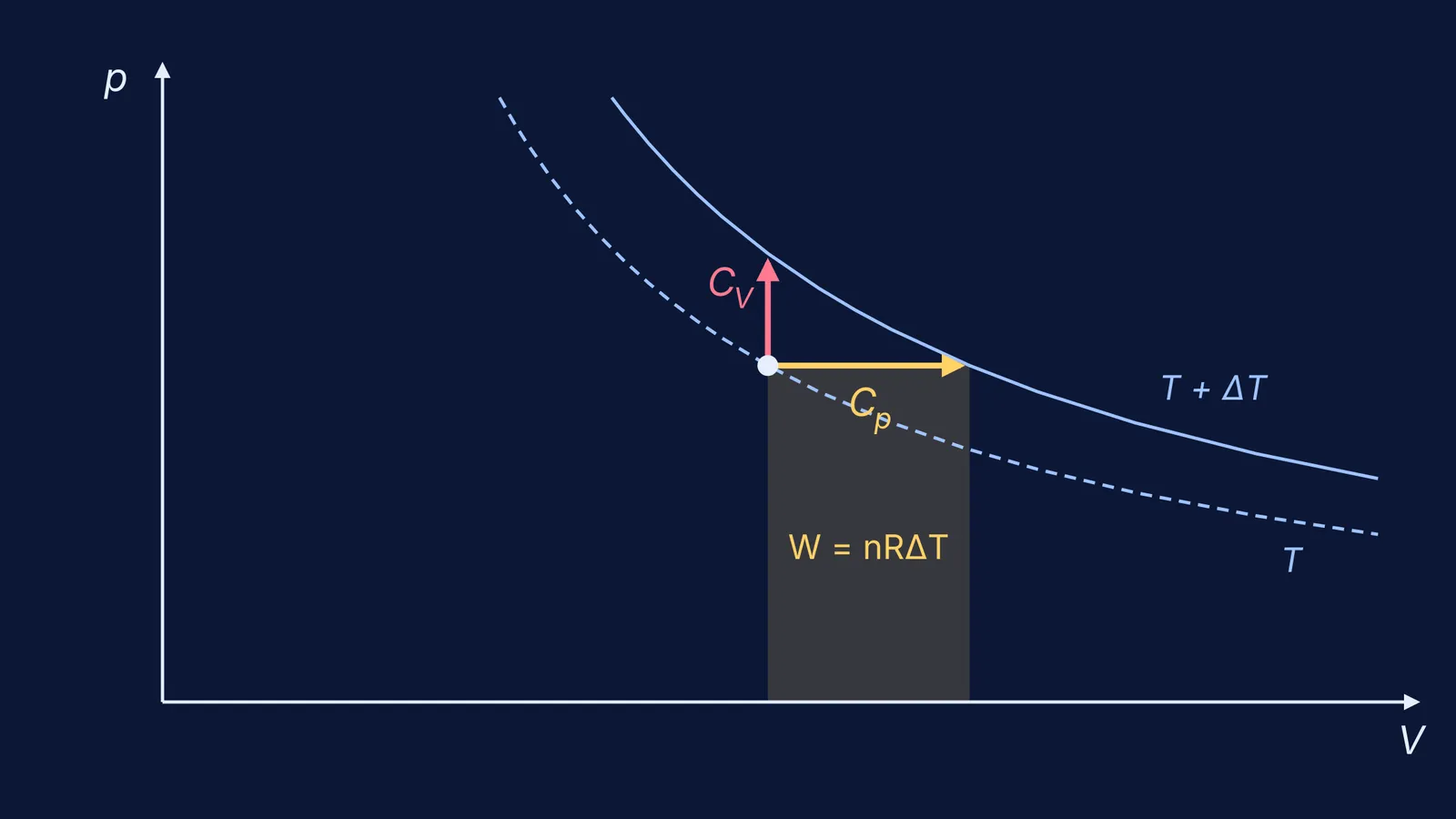
At constant volume the gas cannot push anything, so every joule of heat goes into internal energy. At constant pressure the gas expands against the piston and does work p dV, so it needs extra heat for the same rise in temperature (OpenStax University Physics, Vol. 2, section 3.5). The internal energy change is the same in both cases; only the work differs.
How do you derive Cp − Cv = R from the first law?
Take n moles of an ideal gas and a small temperature rise dT.
First law: dQ = dU + p dV, where p dV is the work done by the gas.
At constant volume, dV = 0, so dQ = nCv dT. That means dU = nCv dT.
An ideal gas's internal energy depends only on temperature, so dU = nCv dT for any process. Our post on why an ideal gas's internal energy depends only on temperature explains this step.
At constant pressure, pV = nRT gives p dV = nR dT.
Substitute into the first law: nCp dT = nCv dT + nR dT. Cancel n dT to get Cp − Cv = R.
The molar gas constant is R = 8.314462618 J per mol per kelvin, an exact value in the 2022 CODATA set (NIST).
Worked example: where does the extra heat go?
Take 2 mol of nitrogen, a diatomic gas, and raise its temperature by 10 K. For diatomic gases at room temperature, Cv = (5/2)R and Cp = (7/2)R (OpenStax, Table 3.3).
Constant volume: Q = nCvΔT = 2 × 2.5 × 8.314 × 10 ≈ 415.7 J.
Constant pressure: Q = nCpΔT = 2 × 3.5 × 8.314 × 10 ≈ 582.0 J.
Difference: 166.3 J, which is exactly nRΔT, the work pΔV the gas does on the piston.
So at constant pressure only Cv/Cp = 5/7 of the heat, about 71%, raises the internal energy. We look at that fraction in more detail in how much of the heat goes into internal energy at constant pressure.
What does γ tell you about molecular structure?
The equipartition theorem says energy is shared equally among a molecule's active degrees of freedom, which gives Cv = (f/2)R for f degrees of freedom (OpenStax, section 2.3). Add Mayer's relation and Cp = (f/2 + 1)R, so γ = Cp/Cv = 1 + 2/f. Turn it around and f = 2/(γ − 1), so γ tells you how many ways a molecule stores energy.
Monatomic gas such as helium or argon: 3 translational degrees of freedom, so f = 3 and γ = 5/3 ≈ 1.67.
Diatomic gas such as nitrogen or oxygen at room temperature: 3 translational plus 2 rotational, so f = 5 and γ = 7/5 = 1.4.
Polyatomic gas with Cv = 3R: f = 6 and γ = 4/3 ≈ 1.33.
Why not count vibration? Quantum mechanics controls which modes are active: in the same OpenStax section, hydrogen's vibrations become fully active only above about 3000 K. HyperPhysics gives γ = 1.4 for air, which is mostly diatomic (HyperPhysics). You can also measure γ from the speed of sound in a gas.
Do real gases pass the quick check?
OpenStax Table 2.3 lists measured Cv/R values for real gases (OpenStax, section 2.3). Using Cp = Cv + R, γ = (Cv/R + 1) ÷ (Cv/R):
Helium and argon: Cv/R = 1.50, so γ = 2.50/1.50 ≈ 1.67, as f = 3 predicts.
Nitrogen: Cv/R = 2.50, so γ = 3.50/2.50 = 1.40, as f = 5 predicts.
Carbon dioxide: Cv/R = 3.48, so γ ≈ 1.29. That is above the 2.5 that translation and rotation give a linear molecule, so something more is storing energy.
Mixtures catch students out. For 1 mol of helium plus 1 mol of nitrogen, Cv = 2R and Cp = 3R, so γ = 1.5, not the 1.53 you get by averaging the γ values.
If you keep picking Cv where the process needs Cp, the Fermi Problem Library has worked problems with a step-by-step solver that explains the reasoning rather than printing an answer. If degrees of freedom feel shaky, revisit equipartition in the Fermi Concept Library, where each concept has its own lesson.
Next time γ appears in a question, write f = 2/(γ − 1) first.


