

On this page
When an ideal gas is heated in a rigid container with constant volume (ΔV = 0), it does zero work, so all supplied heat increases internal energy. At constant pressure, however, the gas expands against the atmosphere, dividing heat input Q between internal energy rise ΔU and mechanical work W: Q = ΔU + W, following the first law of thermodynamics sign conventions. In OpenStax University Physics Volume 2, Section 3.5 establishes that Q = n C_p ΔT and ΔU = n C_v ΔT, where C_p − C_v = R accounts for the work.
Why does heat split during constant pressure heating?
In an isobaric process, pressure P remains constant while volume expands by ΔV. For example, a gas enclosed in a cylinder under a movable, weighted piston pushes the piston upward as temperature rises. The expansion work performed by the gas is W = P ΔV = n R ΔT. Because the gas must both warm up and expand against the atmosphere, the heat required per mole per kelvin, C_p, is always strictly greater than C_v.
How do you derive the fraction of heat that increases internal energy?
The fraction of heat converted into internal energy is the ratio ΔU/Q.
The fraction of heat used to increase internal energy at constant pressure equals the ratio of molar heat capacities, ΔU/Q = C_v/C_p = 1/γ, as derived in OpenStax University Physics Volume 2.
You can see this in four direct steps:
Write internal energy change: ΔU = n C_v ΔT.
Write heat supplied at constant pressure: Q = n C_p ΔT.
Form the ratio: ΔU/Q = (n C_v ΔT) / (n C_p ΔT) = C_v/C_p.
Substitute γ = C_p/C_v to obtain ΔU/Q = 1/γ.
By energy conservation, the work fraction is W/Q = 1 − 1/γ = (γ − 1)/γ. For process comparisons, see our guide on heat in isobaric and isochoric processes.
What is the heat fraction for monatomic and diatomic gases?
Because ΔU/Q = 1/γ, the partition depends solely on molecular degrees of freedom f. In OpenStax University Physics Volume 2, Section 2.3 shows that C_v = (f/2) R and C_p = ((f + 2)/2) R, yielding γ = (f + 2)/f and ΔU/Q = f/(f + 2).
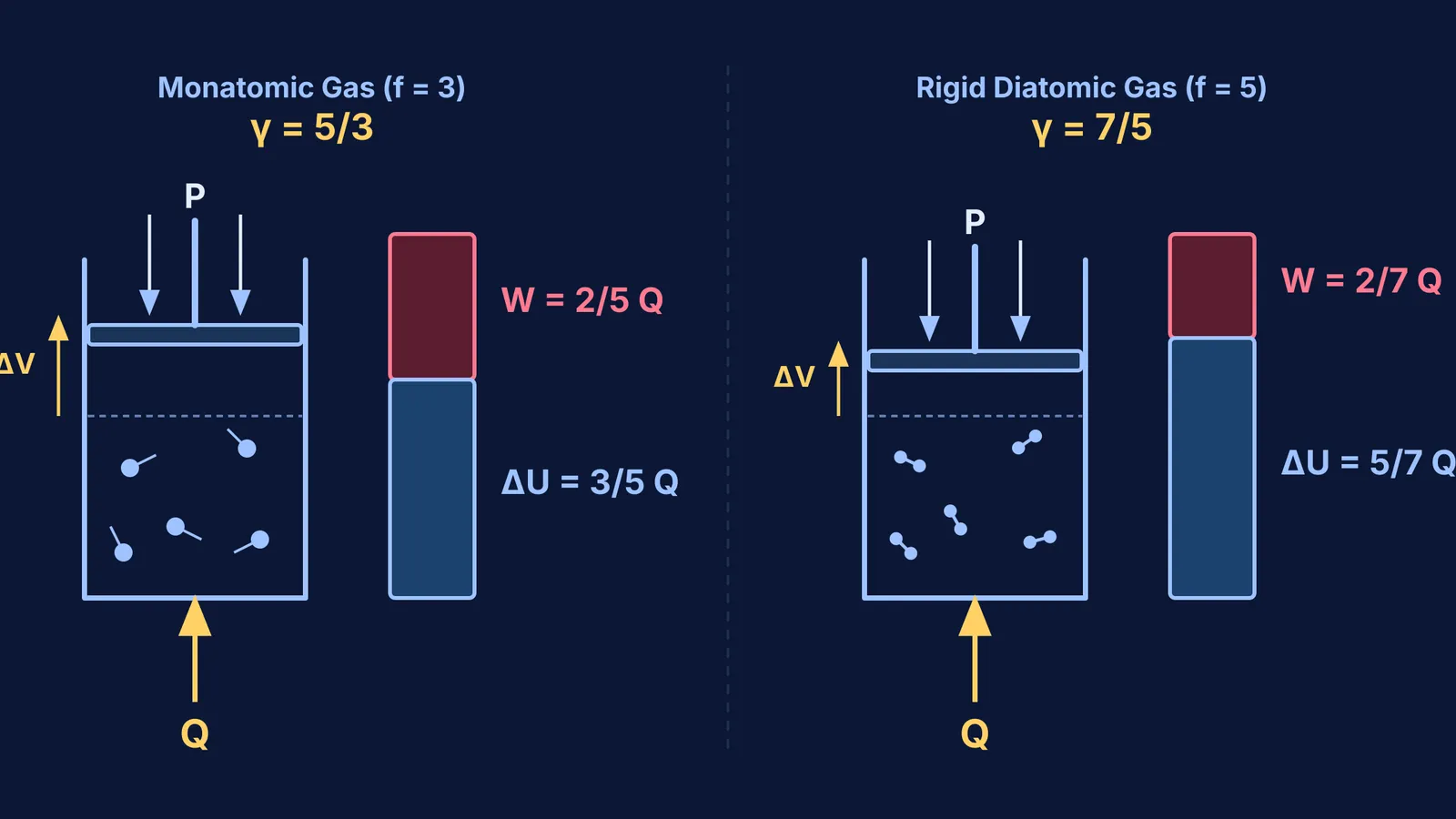
Monatomic gases (such as helium and argon): Single atoms possess 3 translational degrees of freedom (f = 3), so C_v = (3/2) R, C_p = (5/2) R, and γ = 5/3 (approximately 1.67).
For an ideal monatomic gas at constant pressure, exactly 3/5 (or 60%) of the absorbed heat increases internal energy, while 2/5 (or 40%) performs expansion work, according to OpenStax University Physics Volume 2.
Diatomic gases at room temperature (such as nitrogen and oxygen): Linear molecules have 3 translational and 2 rotational degrees of freedom (f = 5), giving C_v = (5/2) R, C_p = (7/2) R, and γ = 7/5 (exactly 1.40).
For a rigid diatomic gas at room temperature, exactly 5/7 (approximately 71.4%) of the heat energy increases internal energy, while 2/7 (approximately 28.6%) is spent on external work, as documented in OpenStax University Physics Volume 2.
Diatomic gases at high temperatures: Above roughly 3000 K, molecular vibrational modes activate, raising f to 7 and the internal energy fraction to 7/9 (approximately 77.8%), as discussed in OpenStax University Physics Volume 2.
Read more about molecular motion in our explainer on equipartition of energy and molecular degrees of freedom.
Worked example: how do 2 moles of helium divide heat at constant pressure?
Consider a standard problem from the NTA JEE Main physics syllabus.
Suppose 2.0 moles of helium gas are heated at constant pressure, raising its temperature by 40 K. Taking R = 8.314 J/(mol K):
Heat added: Q = n C_p ΔT = 2.0 mol × (5/2 × 8.314 J/(mol K)) × 40 K = 1662.8 J (or 1.66 kJ).
Internal energy change: ΔU = n C_v ΔT = 2.0 mol × (3/2 × 8.314 J/(mol K)) × 40 K = 997.68 J (or 1.00 kJ).
Work done: W = n R ΔT = 2.0 mol × 8.314 J/(mol K) × 40 K = 665.12 J.
The energy ratios match the theoretical prediction from OpenStax University Physics Volume 2: ΔU/Q = 997.68 / 1662.8 = 0.600 (3/5 or 60%), and W/Q = 665.12 / 1662.8 = 0.400 (2/5 or 40%).
How do you solve isobaric heat problems on exam day?
When facing timed exam questions, use energy ratios to bypass unnecessary variables:
Verify the process: Confirm that pressure is constant. The formula ΔU/Q = 1/γ applies only to isobaric processes, as detailed in OpenStax University Physics Volume 2.
Identify atomicity: Note whether the gas is monatomic (f = 3, γ = 5/3) or rigid diatomic (f = 5, γ = 7/5).
Multiply directly: Set ΔU = (1/γ) Q and W = (1 − 1/γ) Q. For helium, work is simply 2/5 of Q; for nitrogen, it is 2/7 of Q.
The Fermi Problem Library provides worked problems with a step-by-step solver that explains the reasoning rather than printing an answer. To see how these thermodynamic principles connect across physics and chemistry, visit the Fermi Concept Library.


