

On this page
When you look at Mount Everest standing at 8.8 km (NCERT), you might wonder why there are no 15 km or 20 km mountains on Earth. The answer lies in the mechanical properties of solids. The rocks at the base of a mountain can only support so much weight before they yield and deform.
Why is there a maximum height of a mountain on Earth?
A mountain has immense weight, which exerts pressure—or stress—on its base. However, the sides of a mountain are unsupported, meaning the base is subjected to shearing stress rather than uniform compression. If this stress exceeds the elastic limit (the maximum stress a material can handle before permanently deforming) of the rock, the material stops behaving rigidly. It begins to flow plastically, causing the mountain to sink and spread outwards until the base stress falls back within safe limits.
If you find it hard to picture how solid rock can flow under immense pressure, the Fermi Concept Library has every concept in physics, chemistry, biology, mathematics and computing, each with its own lesson and its place in the map, so you can build intuition for how solids behave under extreme forces.
How to calculate the maximum height estimate?
To find this theoretical limit, you equate the stress at the base to the elastic limit of typical rock. This standard NCERT application follows a simple four-step framework (NCERT):
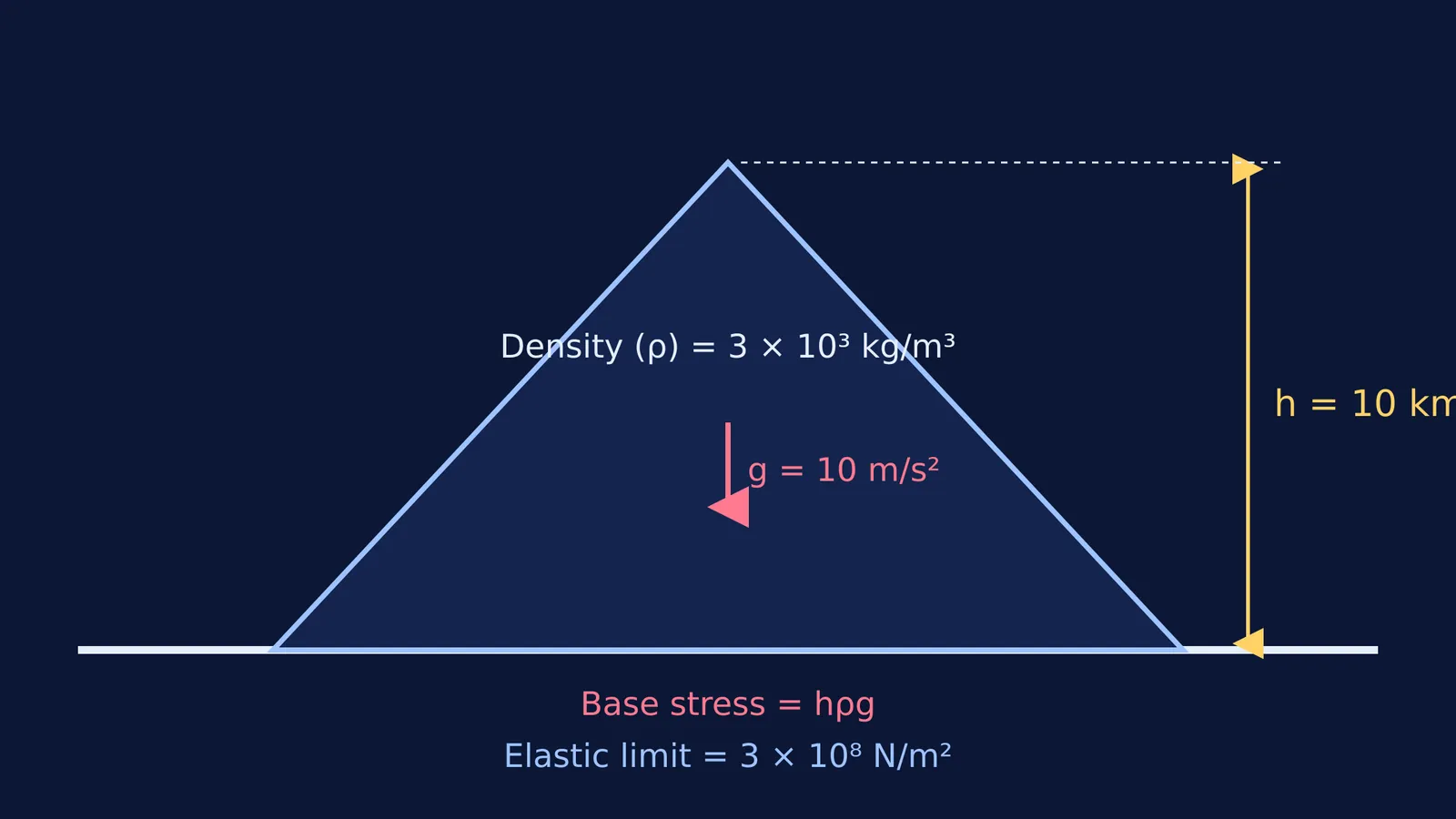
Find the base stress: The pressure exerted by a block of rock of height h and density ρ is calculated as h × ρ × g, where g is the acceleration due to gravity.
Apply the rock's limit: The elastic limit of typical Earth rock is approximately 3 × 10⁸ N/m² (NCERT). Therefore, hρg must be less than 3 × 10⁸.
Substitute the constants: Use the average density of rock (ρ = 3 × 10³ kg/m³) and Earth's gravity (g = 10 m/s²) (NCERT).
Solve for height:
h × (3 × 10³) × 10 = 3 × 10⁸ h × (3 × 10⁴) = 3 × 10⁸ h = 10⁴ metres (or 10 km).
This physics estimate proves why Mount Everest is so close to Earth's planetary ceiling. A peak significantly taller would simply crush its own foundation. When you need to review the steps of similar derivations, the Fermi Problem Library offers worked problems with a step-by-step solver that explains the reasoning rather than printing an answer.
Why can mountains on Mars grow taller?
The height formula (h = Elastic Limit / ρg) shows that maximum height is inversely proportional to gravity. A planet with weaker gravity can support much taller structures made of the exact same rock. Mars has a surface gravity that is roughly 38% of Earth's (Wikipedia). As a result, its largest volcano, Olympus Mons, towers at about 21.3 km (Wikipedia). If Olympus Mons were transported to Earth, its immense weight under our stronger gravity would cause it to collapse into the crust.
For more on mechanical properties, you might find our guides on Poisson's ratio and the volume change of a stretched wire and the extension of a wire when its length and radius are doubled useful. If you struggle to picture these forces in 3D, check out our guide on how to visualise hard physics ideas.


