

On this page
Pull on a wire and it gets longer. It also gets thinner, and the ratio between those two changes is Poisson's ratio. A typical physics problem on this topic asks one of three things: find the ratio, explain why it cannot go above 0.5, or find how much the volume changes. All three come from one short derivation.
What are lateral strain and longitudinal strain?
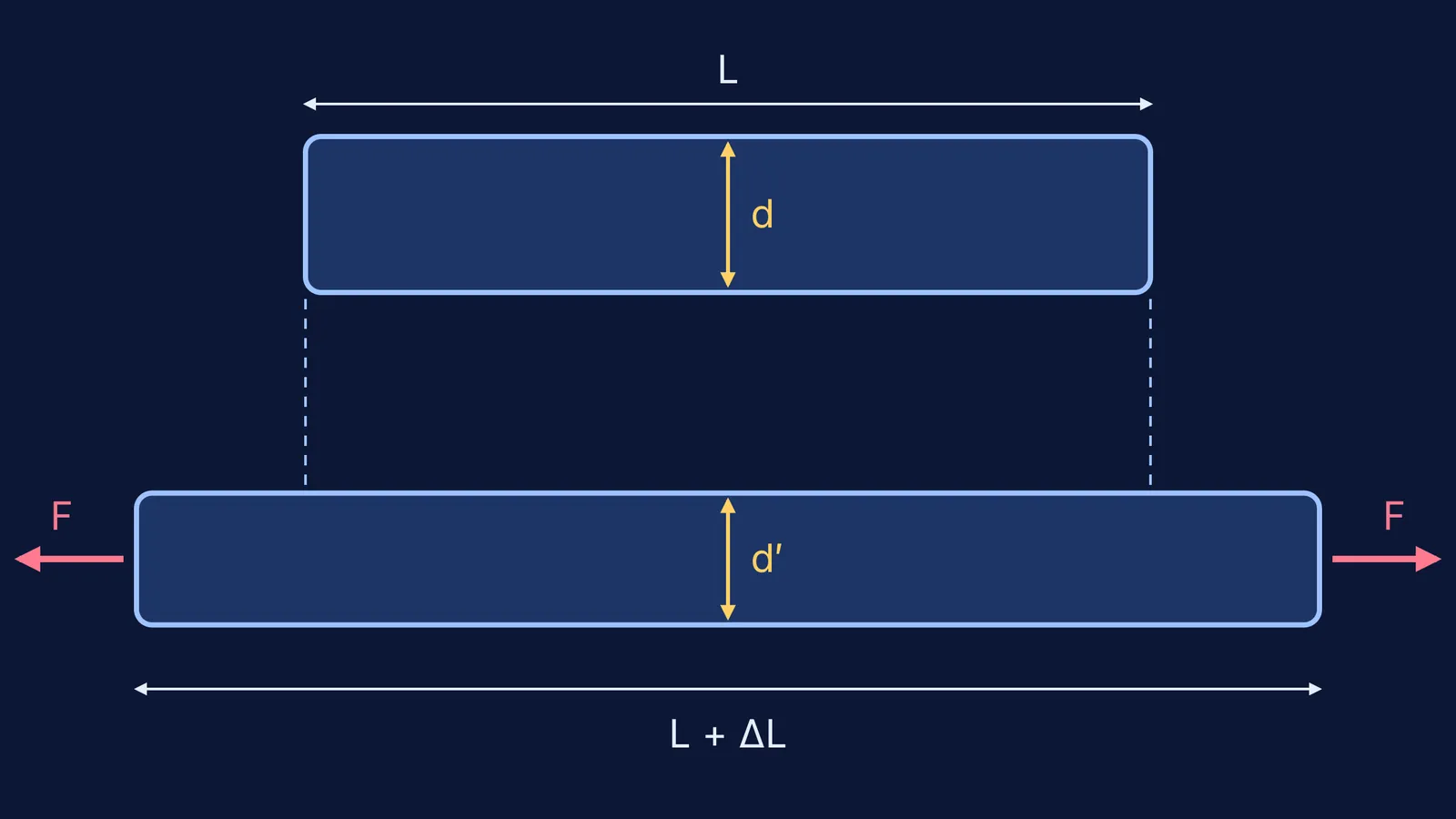
Longitudinal strain is the fractional change in length along the pull, ΔL/L. Lateral strain is the fractional change in width at right angles to the pull, Δd/d for a wire of diameter d. When you stretch a wire, ΔL is positive and Δd is negative.
Poisson's ratio is "the ratio of transverse contraction strain to longitudinal extension strain in the direction of stretching force", in the words of materials scientist Rod Lakes of the University of Wisconsin-Madison. As a formula, ν = −(Δd/d)/(ΔL/L). The minus sign makes ν positive for ordinary materials, and because it is a ratio of two strains it has no unit.
Typical values from the same Lakes page: steel is about 0.29, aluminium 0.34, copper 0.34 to 0.37, fused quartz 0.17, and rubber 0.48 to about 0.5. The page notes that most polycrystalline materials sit near 1/3.
If stress and strain still feel shaky, start with our walkthrough of stress, strain and Young's modulus problems.
How do you find the volume change when a wire is stretched?
A wire is a cylinder, so V = (π/4)d²L. Take the fractional change of each factor; for small changes, the fractional changes add, and a squared factor counts twice:
ΔV/V = ΔL/L + 2(Δd/d)
Substitute Δd/d = −ν(ΔL/L)
ΔV/V = (ΔL/L)(1 − 2ν)
That last line is the standard small-strain result, ΔV/V ≈ (1 − 2ν)ΔL/L, listed in the Poisson's ratio article on Wikipedia along with the larger-strain version.
Why is Poisson's ratio 0.5 for constant volume?
Set ΔV = 0 in the result above. Since ΔL/L is not zero, the bracket must be: 1 − 2ν = 0, so ν = 0.5. Physically, the stretch along the length is shared equally by the two sideways directions, each contracting by half of it.
The same source puts it plainly: "A perfectly incompressible isotropic material deformed elastically at small strains would have a Poisson's ratio of exactly 0.5" (Wikipedia). For an isotropic material with free, unconstrained surfaces, linear elasticity allows values only from −1 to 0.5, according to Lakes. Above 0.5, stretching would shrink the volume. Negative values occur in designed "auxetic" materials such as re-entrant foams, which Lakes lists at −0.7; they are discussed in a review by Greaves, Greer, Lakes and Rouxel in Nature Materials (2011).
So a wire with ν below 0.5 gains a little volume when stretched. Most materials, Lakes notes, resist a change in volume more than a change in shape; the volume side of that story is covered in our post on bulk modulus and compressibility.
Worked example: how much does a steel wire's volume change?
A steel wire is 2 m long and 1 mm in diameter. It stretches by 1 mm. Take ν = 0.29, the steel value from Lakes.
Longitudinal strain: ΔL/L = 1 mm / 2000 mm = 5 × 10⁻⁴.
Lateral strain: Δd/d = −0.29 × 5 × 10⁻⁴ = −1.45 × 10⁻⁴.
Change in diameter: 1 mm × 1.45 × 10⁻⁴ = 1.45 × 10⁻⁴ mm, a decrease of about 0.15 micrometres.
Volume change: ΔV/V = (1 − 0.58) × 5 × 10⁻⁴ = 2.1 × 10⁻⁴, an increase of 0.021%.
Run the same stretch on a material with ν = 0.5 and step 4 gives exactly zero.
Going the other way
Problems also hand you the strains and ask for ν. If a wire's length rises by 0.5% while its diameter falls by 0.15%, then ν = 0.15/0.5 = 0.3; you can use percentages directly because they cancel. If instead you are told a strain of 0.2% raises the volume by 0.08%, then 1 − 2ν = 0.08/0.2 = 0.4, so ν = 0.3.
A three-line plan for the exam hall
Write the two strains with signs: ΔL/L positive, Δd/d negative.
Write V = (π/4)d²L and differentiate in fractions: ΔV/V = ΔL/L + 2Δd/d.
Substitute ν and simplify to (1 − 2ν)ΔL/L before putting in any numbers.
The same fractional-change trick, with the same factor of 2 from d², also gives the change in a wire's resistance; see stretching a wire and its resistance.
For more practice, the Fermi Problem Library has worked problems with a step-by-step solver that explains the reasoning rather than printing an answer, so you can see where a missing factor of 2 enters. If the strain ideas themselves are the gap, the Fermi Concept Library gives each physics concept its own lesson and its place in the map.


