

On this page
Manufacturing Industries is chapter 6 of Contemporary India II, and it is on this year's board syllabus. CBSE's Class X Social Science curriculum for 2026-27 gives geography 20 marks, 3 of them for map pointing, and expects you to tell industries apart by inputs and products and link an industry's location to its raw materials.
What is manufacturing, and how are industries classified?
Manufacturing is the processing of natural resources into more useful items, as the NIOS geography lesson on industrial development defines it. One industry's product can be the next one's raw material, as cotton yarn and pig iron are.
The same lesson classifies industries on five bases:
Raw material: agro-based (cotton textile, jute, sugar, paper) or mineral-based (iron and steel, cement, chemicals).
Ownership: public sector (Bokaro steel plant), private sector (Tata Iron and Steel), joint sector (Maruti Udyog) or cooperative sector (Maharashtra's sugar mills, Amul).
Role: basic industries supply raw material to other industries (iron and steel); consumer goods industries make things people use directly (soap, toothpaste).
Size: large-scale (oil refineries), small-scale (cycles) or rural and cottage (handlooms, handicrafts).
Weight: heavy industries handle bulky goods at high transport cost (iron and steel); light industries make light goods (watches, garments).
The five-question test
Does it start from a farm product or a mineral?
Who owns it: government, a company, both, or the producers?
Does its product feed other industries or go straight to people?
How big are the investment and workforce?
Are its inputs and products bulky to move?
Worked example, Tata Steel's plant at Jamshedpur: iron ore, so mineral-based; a company, so private sector; steel feeds other industries, so basic; a huge plant, so large-scale; bulky ore and steel, so heavy.
Why does the textile industry matter so much?
India's first successful modern cotton mill opened in Mumbai in 1854, and jute manufacturing began in 1855 in the Hooghly valley near Kolkata, according to the NIOS lesson.
A Press Information Bureau backgrounder of February 2026 says India is the largest producer of jute, the second-largest producer of silk and cotton, and the sixth-largest global exporter of textiles and apparel. A cotton mill is agro-based: its main input comes from farms, not mines.
Why is iron and steel called a basic industry?
Iron and steel is a basic industry because its products are raw materials for many other industries, as the NIOS lesson puts it. The major plants stand in Jharkhand, West Bengal, Odisha, Chhattisgarh, Andhra Pradesh, Karnataka and Tamil Nadu, near iron ore and coal, because heavy raw materials are costly to move.
India is the world's second-largest crude steel producer, after China, and made 170.15 million tonnes of crude steel in 2025-26, according to the Ministry of Steel's July 2026 overview.
Why do IT industries cluster in cities?
IT and electronics is the opposite of steel: its main input is skilled people, not bulky ore, so it gathers in cities. On the government side, Software Technology Parks of India sits under the Ministry of Electronics and Information Technology.
How do industries pollute, and what reduces it?
A standard answer to the chapter's exercise question names four types of industrial pollution: air, water, land and noise, as in these NCERT solutions for chapter 6. The remedies it lists include:
reuse and recycle water, and harvest rainwater;
treat hot water and effluents before releasing them into rivers and ponds;
fit smokestacks with electrostatic precipitators, fabric filters or scrubbers;
use silencers on noisy machinery.
The Central Pollution Control Board was constituted in September 1974 under the Water (Prevention and Control of Pollution) Act, 1974, and later given powers under the Air Act, 1981, according to the CPCB. For how water pollution is measured, read our explainer on BOD and dissolved oxygen in polluted water.
Electrostatic precipitators rest on an idea from physics: charged particles are attracted to oppositely charged plates. If that feels hazy, the Fermi Concept Library has a lesson for each concept in physics, chemistry, biology, mathematics and computing.
How should you revise this chapter in a week?
Day 1: the five bases of classification, two examples each.
Day 2: the five-question test on ten industries.
Day 3: textiles and iron and steel, and why each sits where it does.
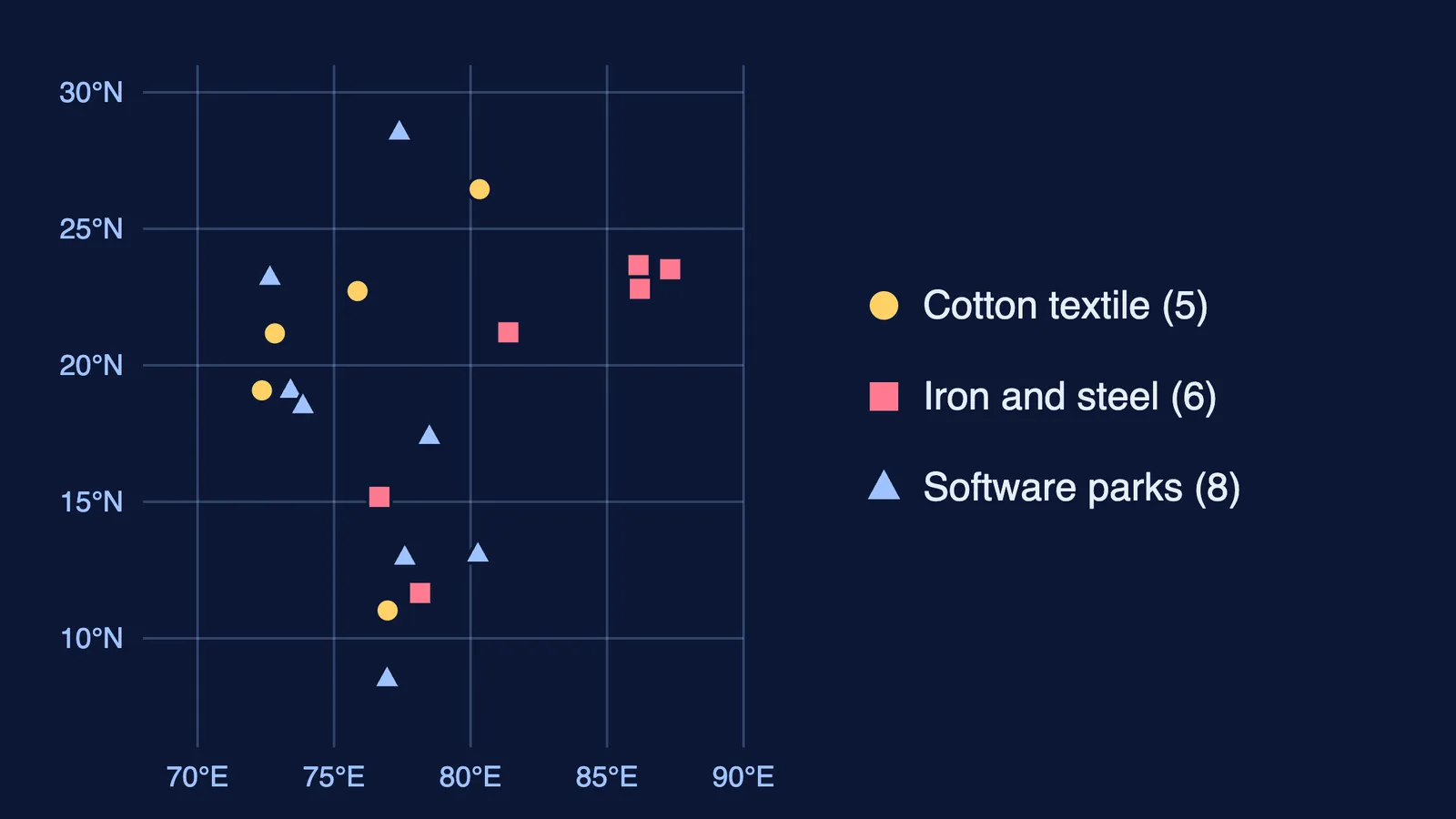
Day 4: map work. The CBSE list has five cotton textile centres (Mumbai, Indore, Surat, Kanpur, Coimbatore), six iron and steel plants (Durgapur, Bokaro, Jamshedpur, Bhilai, Vijayanagar, Salem) and eight software technology parks (Noida, Gandhinagar, Mumbai, Pune, Hyderabad, Bengaluru, Chennai, Thiruvananthapuram). Pair it with our weekly plan for Class 10 geography map work.
Day 5: pollution types and remedies; write one long answer.
Day 6: link back to chapter 5 with our guide to the difference between minerals and ores.
Day 7: a timed paper on the whole unit.
If you are unsure where to begin on your science chapters, Fermi's AI tutor can work out what you already know and build a plan for the session.


