

On this page
Three small molecules go into one flask and come out as one molecule with a nitrogen two carbons from a C=O. Once you see the reactive intermediate in the middle, you can rebuild the mechanism instead of memorising it.
What is the Mannich reaction?
The Mannich reaction is a three-component reaction: a ketone (or aldehyde) with an α-hydrogen, formaldehyde, and ammonia or a primary or secondary amine combine to put an aminomethyl group (–CH₂–NR₂) on the ketone's α-carbon. The product is a β-amino carbonyl compound, called a Mannich base (Wikipedia summary of the reaction).
Carl Mannich and W. Krösche described it in 1912 in *Archiv der Pharmazie*, in a paper on a condensation product of formaldehyde, ammonia and antipyrine (Mannich and Krösche, 1912, DOI 10.1002/ardp.19122500151).
If you have studied the aldol reaction, the plan will feel familiar: an enol attacks a carbon that has been made electron-poor. Our step-by-step aldol condensation mechanism is a good warm-up. In the Mannich reaction the electrophile is not a C=O but a C=N⁺.
How does the iminium ion form, and why does it matter?
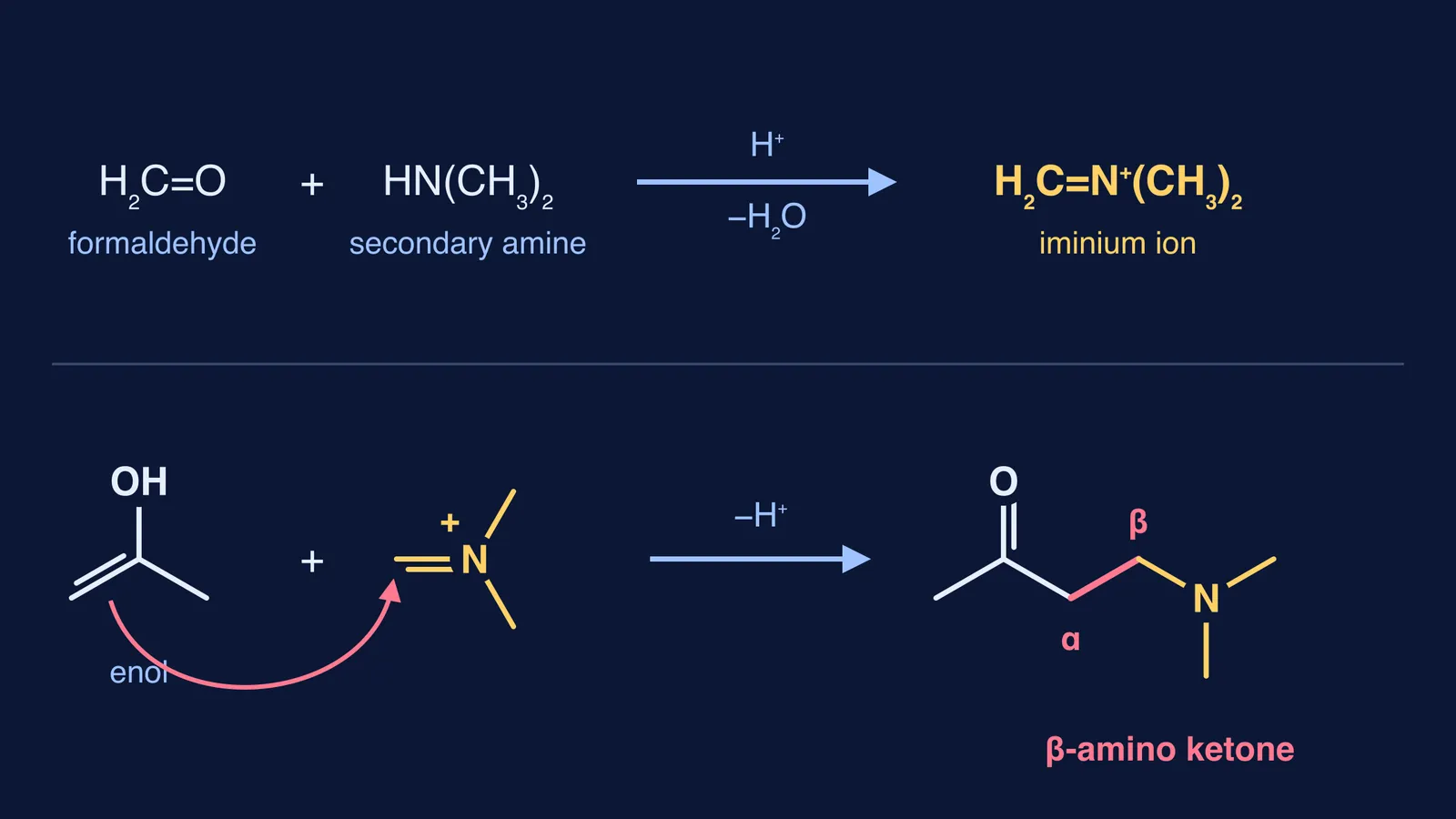
The reaction usually runs in mildly acidic conditions, and the steps go like this:
The amine's lone pair attacks the carbon of formaldehyde, giving a hemiaminal (HO–CH₂–NR₂).
Acid protonates the OH, which leaves as water.
The nitrogen's lone pair pushes in to form CH₂=N⁺R₂, the iminium ion.
Meanwhile the ketone tautomerises to its enol.
The enol's C=C π bond attacks the CH₂ carbon of the iminium ion, making the new C–C bond.
Loss of a proton from the oxygen restores the C=O, leaving R–CO–CH₂–CH₂–NR₂.
The iminium ion is the reason the reaction works. A positive charge on nitrogen makes the attached CH₂ strongly electrophilic, much more so than a neutral carbonyl. Formaldehyde is used because it has no α-hydrogen, so it cannot form an enol and attack itself, and it is small and reactive.
That is why the Wikipedia definition lists only ammonia, primary and secondary amines. Secondary amines are the classroom favourite because their iminium ion has no N–H left to lose, so it stays a charged, reactive electrophile. For a related use of secondary amines, see our post on enamine formation and Stork enamine alkylation.
Worked example: acetophenone, formaldehyde and dimethylamine
Organic Syntheses, which publishes checked lab procedures, gives a classic run (Organic Syntheses, Coll. Vol. 3, p. 305, DOI 10.15227/orgsyn.023.0030). It mixes 0.5 mole of acetophenone, 0.65 mole of dimethylamine hydrochloride and paraformaldehyde (a solid source of formaldehyde) in 95% ethanol with 1 ml of concentrated HCl. The mixture is refluxed for 2 hours. The crude product, β-dimethylaminopropiophenone hydrochloride, comes out in 68–72% yield.
Now work it out yourself, the way an exam would ask it:
Find the enolisable carbon. Acetophenone is C₆H₅–CO–CH₃. Only the CH₃ has α-hydrogens.
Build the electrophile. HCHO + (CH₃)₂NH gives CH₂=N⁺(CH₃)₂.
Join them. The enol carbon (the old CH₃) bonds to the iminium CH₂.
Write the product. C₆H₅–CO–CH₂–CH₂–N(CH₃)₂. Count from the C=O: α-carbon, then β-carbon carrying nitrogen. That is the β-amino ketone.
Check the salt. In acid, the amine nitrogen is protonated, so it is isolated as the hydrochloride.
How do you spot a Mannich product in a question?
Work backwards. This checklist covers most "identify the reactants" questions:
Find a nitrogen joined to a CH₂ that is two carbons away from a C=O.
Break the bond between the α-carbon and the CH₂ next to nitrogen.
The carbonyl piece is your ketone. The CH₂ came from formaldehyde. The NR₂ came from the amine.
If the nitrogen carries an H in the product, the starting amine was primary (or ammonia). That N–H can react again.
That last point is how one nitrogen can join two Mannich reactions. Robert Robinson's 1917 tropinone synthesis (Robinson, 1917, DOI 10.1039/CT9171100762) combined succinaldehyde, methylamine and acetonedicarboxylic acid in one pot. It is often described as a double Mannich reaction, with each Mannich step forming one side of the bicyclic molecule (Wikipedia on tropinone). The story is in our post on Robert Robinson and the one-pot tropinone synthesis.
The Wikipedia summary lists this elimination, and uses such as making tramadol and fluoxetine. Arend, Westermann and Risch reviewed modern versions in *Angewandte Chemie* in 1998 (Modern Variants of the Mannich Reaction1521-3773(19980504)37:8%3C1044::AID-ANIE1044%3E3.0.CO;2-E)).
How should you practise it?
Take three ketones: acetone, cyclohexanone and acetophenone. Write the Mannich product of each with dimethylamine, and draw every curly arrow from hemiaminal to final proton loss. Then cover the reactants and work backwards from the product. If the iminium step feels shaky, the Fermi Concept Library has a lesson for each organic chemistry idea, with its place on the concept map. When you want to check a full mechanism problem, the Fermi Problem Library has worked problems with a step-by-step solver that explains the reasoning rather than printing an answer.


