

On this page
When preparing complex organic molecules, directly alkylating a ketone using a strong base often leads to a messy mixture. The base can pull off protons from either side of an asymmetrical ketone, and the resulting enolate is so reactive that it may attack multiple times, causing over-alkylation.
In 1954, Gilbert Stork published a solution in the *Journal of the American Chemical Society* that bypassed these strong bases entirely. By first converting the ketone into an enamine, you create a milder, more controlled nucleophile.
Why use the Stork enamine alkylation instead of an enolate?
Direct alkylation of ketones via metal enolates (using bases like LDA or NaH) suffers from three main problems: over-alkylation, poor regioselectivity, and the risk of self-condensation, such as the aldol reaction.
The Stork enamine synthesis solves these by operating under milder conditions. The enamine intermediate is neutral and less reactive than a negatively charged enolate. This means it strongly prefers mono-alkylation, neatly stopping after one equivalent of the alkyl halide is added. Furthermore, when an asymmetrical ketone is used, the less sterically hindered enamine forms preferentially, giving you predictable regioselectivity. For activated electrophiles—such as benzylic halides, allylic halides, and Michael acceptors—the reaction consistently delivers good yields.
How does enamine formation work?
An enamine (an *ene* + *amine*) forms when a ketone or aldehyde reacts with a secondary amine under mildly acidic conditions. Pyrrolidine, morpholine, and piperidine are the most common choices because their cyclic structures minimise steric hindrance.
The secondary amine nucleophilically attacks the carbonyl carbon, and a molecule of water is eliminated. Because the amine is secondary, it has no remaining hydrogen on the nitrogen to lose in order to form an imine (the standard product for a primary amine). Instead, a proton is removed from the adjacent α-carbon, creating a carbon-carbon double bond. This double bond is remarkably electron-rich because the nitrogen's lone pair donates electron density into it through resonance.
Crucially, if the starting ketone is asymmetrical—such as 2-methylcyclohexanone—the double bond will form preferentially on the less substituted side. The bulky secondary amine ring creates a steric clash if it sits too close to the existing alkyl group. This built-in regioselectivity is a clear advantage when designing a reliable chemical synthesis.
If you struggle to trace which electrons move where during these carbonyl additions, the Fermi Problem Library provides a step-by-step solver that explains the reasoning for each mechanistic step rather than just printing the final product.
What are the three steps of the Stork enamine alkylation?
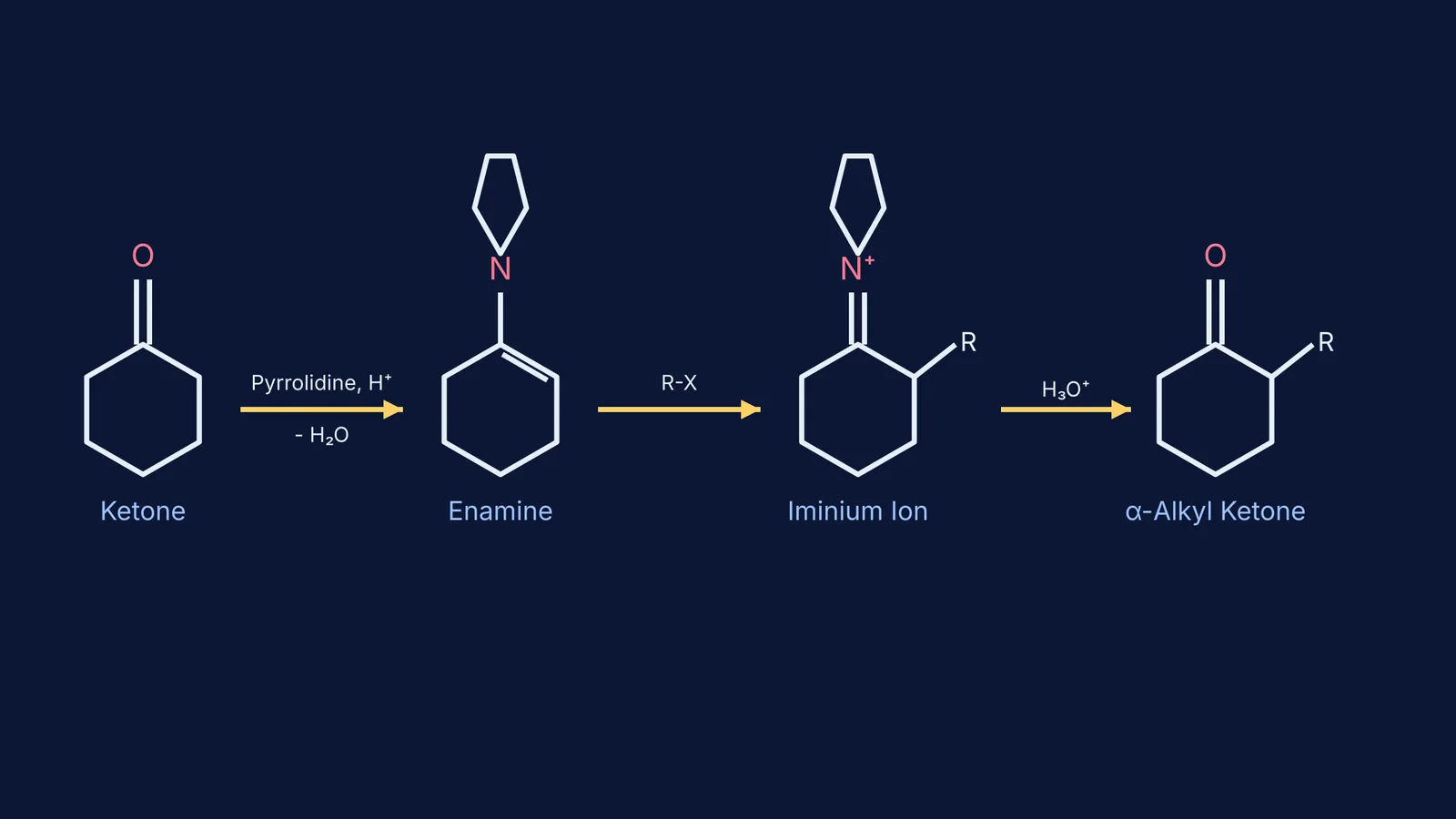
The overall transformation is a three-step sequence that substitutes the α-carbon of the original ketone.
Enamine Formation: The ketone is heated with a secondary amine (like pyrrolidine) and a catalytic amount of acid, such as p-toluenesulfonic acid. Because this is an equilibrium reaction, water must be continuously removed (often using a Dean-Stark apparatus) to drive the equilibrium forward.
Alkylation: The purified enamine is reacted with an alkyl halide (R–X). The electron density from the nitrogen pushes through the double bond, making the α-carbon nucleophilic enough to displace the halide via an SN2 mechanism. Much like choosing the right substrate for a Williamson ether synthesis, primary and activated halides work best here. Steric hindrance will block bulkier secondary or tertiary halides, which may instead undergo elimination or cause undesired alkylation directly on the nitrogen atom. This step forms a positively charged iminium salt intermediate.
Hydrolysis: Adding aqueous acid to the reaction mixture hydrolyses the iminium salt. This breaks the carbon-nitrogen double bond, restoring the ketone functional group and releasing the secondary amine as a water-soluble salt, which can be easily washed away.
If you are mapping out a multi-step synthesis for your exams and aren't sure where to start, Fermi's AI tutor can work out what you already know and build a plan for the session, testing your recall of these standard reactions.
How do you choose your alkylation method?
When you see a ketone and an alkyl halide (for example, in a reaction sequence similar to treating aqueous vs alcoholic KOH with haloalkanes, look closely at the reagents to determine the pathway):
If the reagents are LDA at -78 °C, then R-X: This is kinetic enolate alkylation. It will alkylate the less hindered side but is highly prone to over-alkylation and requires strictly anhydrous, low-temperature conditions.
If the reagents are Pyrrolidine/H⁺, then R-X, then H₃O⁺: This is the Stork enamine alkylation. It guarantees mono-alkylation, works at room temperature or gentle reflux, and strongly favours substitution at the less hindered α-position.
If the electrophile is a tertiary halide: Neither method works well due to competing elimination reactions; you must look for an entirely different synthetic route to build your carbon framework.
By understanding the electron flow through the enamine, you can replace the rote memorisation of organic reagents with a clear structural logic.


