

On this page
Wind a wire flat, like a mosquito coil, with N turns packed tightly from an inner radius a out to an outer radius b. The turns are not all the same size, so the familiar flat-coil formula μ0NI/2R has no single R to put in. The fix is to slice the spiral into thin rings, find each ring's field at the centre, and add them up. Here is the derivation, a worked example, and five checks to run on your answer.
What is the formula for the field at the centre of a flat spiral coil?
A loop of radius R carrying current I produces a field B = μ0I/2R at its centre, pointing along the axis, as derived in OpenStax University Physics Volume 2, section 12.4. For a flat coil of N turns of the same radius, the same section gives B = μ0NI/2R.
A tightly wound flat spiral is very nearly a set of concentric rings. Assume the N turns are spread evenly across the radial width b − a. Then:
Turns per unit radius: n = N/(b − a).
A thin ring between r and r + dr holds dN = N dr/(b − a) turns.
That ring adds dB = μ0I dN/2r = μ0NI dr/[2(b − a)r] at the centre.
Every ring's field points the same way along the axis, so the contributions add as plain numbers.
Integrate from r = a to r = b. The integral of dr/r is ln(b/a), so B = μ0NI ln(b/a)/[2(b − a)].
Why does a logarithm appear in the answer?
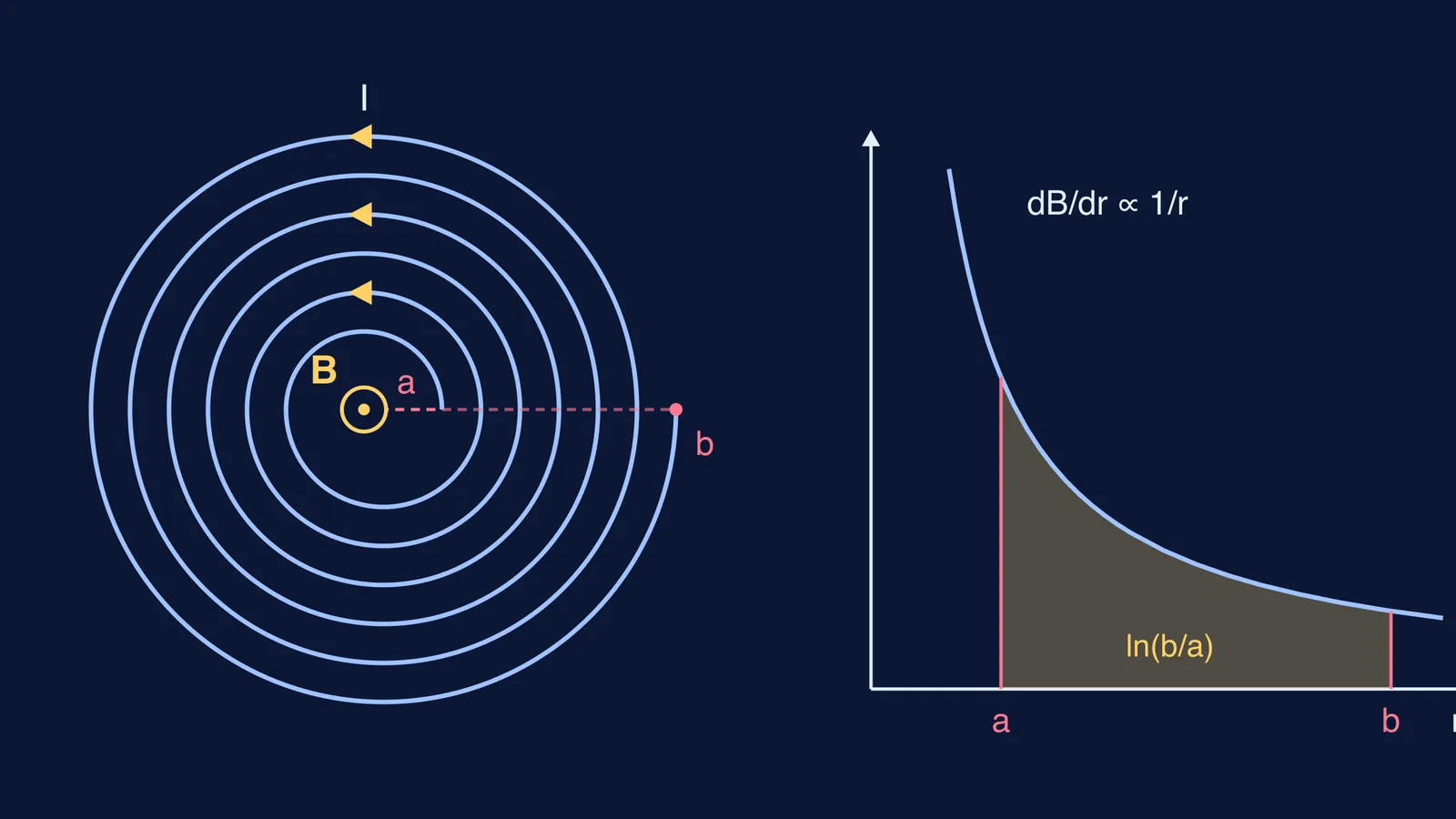
Each ring's field goes as 1/r, and adding up 1/r over a range of radii gives a logarithm. In the graph beside the spiral above, the shaded area under the 1/r curve between a and b is proportional to ln(b/a).
Inner turns are smaller and closer to the centre, so each contributes more field than an outer turn carrying the same current. That is why you cannot simply put the average radius into μ0NI/2R.
Another way to read the result: the spiral acts like N turns all at one effective radius, R = (b − a)/ln(b/a), the logarithmic mean of a and b. It is always smaller than the ordinary mean (a + b)/2, because inner turns count for more.
Worked example: how strong is the field?
Take N = 50 turns, I = 2 A, a = 1 cm and b = 3 cm, with μ0 = 4π × 10⁻⁷ N A⁻². The CODATA 2022 value listed by NIST is 1.25663706127 × 10⁻⁶ N A⁻², which matches 4π × 10⁻⁷ to ten significant figures.
Convert to metres: a = 0.01 m and b = 0.03 m, so b − a = 0.02 m and 2(b − a) = 0.04 m.
Work out μ0NI = 4π × 10⁻⁷ × 50 × 2 = 1.257 × 10⁻⁴ T m.
Find ln(b/a) = ln 3 = 1.099.
Combine: B = 1.257 × 10⁻⁴ × 1.099 / 0.04 = 3.45 × 10⁻³ T, about 3.45 mT.
Putting the mean radius of 2 cm into μ0NI/2R gives 3.14 mT, about 9% too low. The effective radius here is 0.02/1.099 = 1.82 cm, below the 2 cm mean, as expected.
How can you check your answer in the exam?
Bounds: the answer must lie between μ0NI/2b (all turns at the outer radius) and μ0NI/2a (all turns at the inner radius). Here that range is 2.09 mT to 6.28 mT, and 3.45 mT sits inside it.
Thin-coil limit: if b is only slightly larger than a, ln(b/a) is close to (b − a)/a, and the formula reduces to μ0NI/2a, the flat-coil result.
Units: μ0I divided by a length gives tesla; N and ln(b/a) are pure numbers.
Direction: curl your right-hand fingers along the current; your thumb gives B at the centre, perpendicular to the coil. All turns circulate the same way, so no ring cancels another.
Inner radius going to zero: the formula blows up, since a turn of zero radius would give an infinite field. Real spirals have a gap in the middle, so a must be greater than zero.
The same slice-and-add habit runs through the field at the centre of arcs and straight wires and the field at the centre of a square current loop. For where μ0I/2R comes from, read our guide to Biot-Savart and Ampère's law for wires, loops and solenoids.
If you keep reaching for the mean radius, the Fermi Problem Library has worked problems with a step-by-step solver that explains the reasoning rather than printing an answer. To revise the single-loop result first, the Fermi Concept Library gives each physics concept its own lesson and its place in the map.
Next time a coil question gives you two radii, write dN = N dr/(b − a) first; the rest follows.


