

On this page
When you first look at a square current loop, calculating its magnetic field might seem difficult. The trick is to stop looking at the square as one single object. Instead, treat it as four straight, finite wires joined at the corners.
By finding the field of just one of those straight sides using the Biot-Savart law, you can multiply the result by four to get the total field.
How do you find the magnetic field at the centre of a square loop?
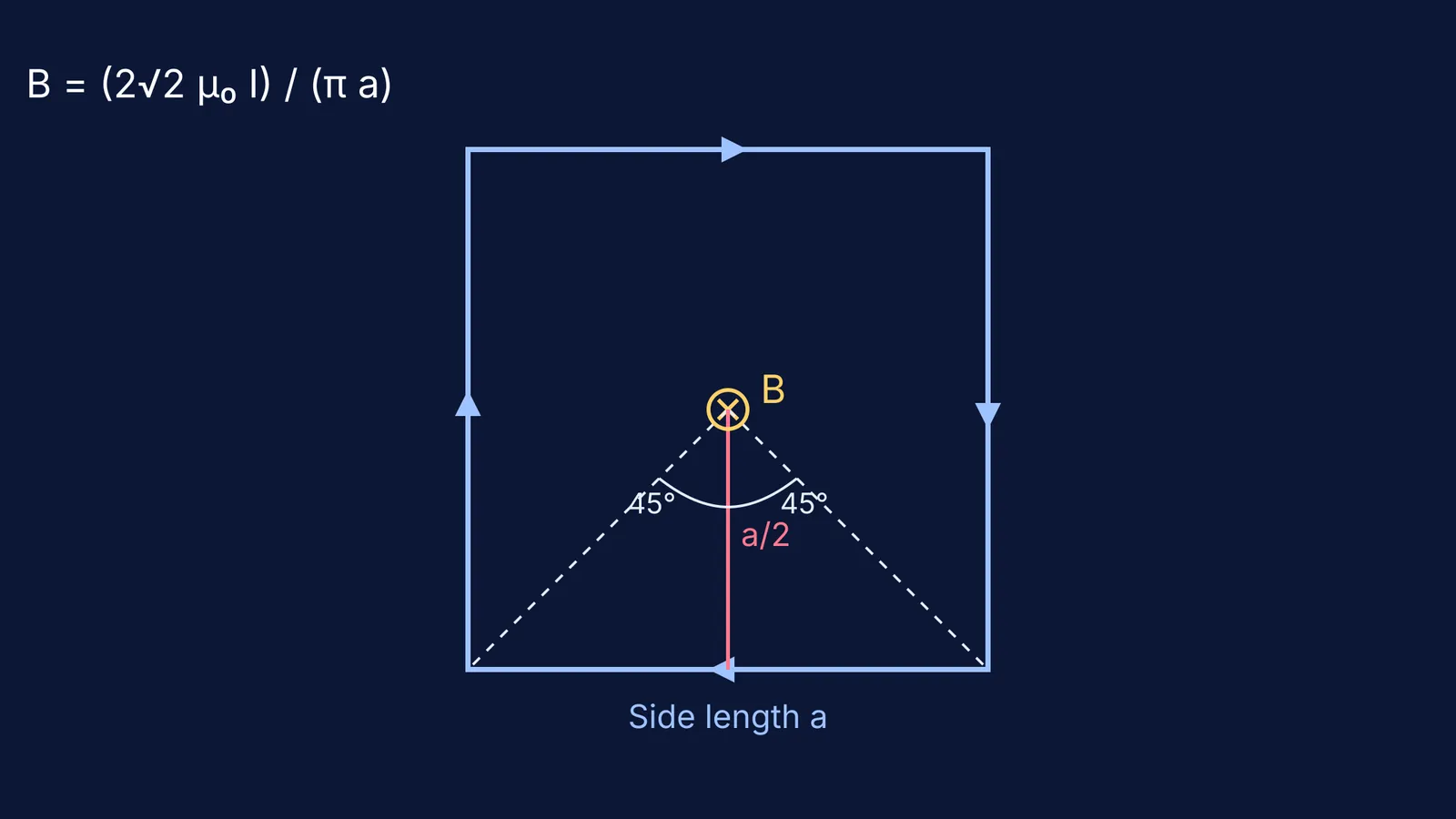
To start, imagine a square loop with side length a carrying a steady current I.
The magnetic field of any straight wire segment at a perpendicular distance r from its centre is given by: B = (μ₀I / 4πr) × (sin α + sin β)
For one side of our square:
The perpendicular distance from the centre of the square to the wire is r = a/2.
The lines drawn from the centre to the corners of the square form a triangle. Because it is a square, the angles from the centre to the ends of the wire are exactly 45°. Therefore, α = 45° and β = 45°.
Since sin 45° = 1/√2, the sum in the brackets becomes: 1/√2 + 1/√2 = 2/√2 = √2
Now, substitute these into the formula for one side: B_side = [μ₀I / 4π(a/2)] × √2 B_side = [μ₀I / 2πa] × √2 B_side = (√2 μ₀I) / (2πa)
Since the current flows continuously around the loop, the right-hand rule tells us that the magnetic field from all four sides points in the exact same direction at the centre (either straight into the page or straight out of it).
To find the total magnetic field, simply multiply the field of one side by four: B_total = 4 × [(√2 μ₀I) / (2πa)] B_total = (2√2 μ₀I) / πa
Why does breaking down complex problems help you learn?
Approaching the square loop as four separate straight wires is more than just a neat mathematical trick. It aligns perfectly with how your brain actually learns physics.
Educational research shows that your working memory can only hold a few new pieces of information at once. A foundational 1988 study on cognitive load theory by John Sweller demonstrated that conventional problem solving can easily overwhelm this limited capacity, leaving no mental space to form long-term memories or schemas.
When you try to picture the whole square, the current, the distances, and the angles all at once, the "intrinsic load" (the inherent difficulty of the task) is too high. By focusing only on one straight wire, you reduce the number of elements your brain has to process simultaneously. Once you have the answer for one wire, multiplying by four is a trivial final step.
This strategy of problem decomposition is something you can apply across all of physics, from calculating the helical path of a charge in a magnetic field to finding the magnetic moment of a spinning charged ring.
If you struggle with knowing how to split a problem into manageable chunks, an AI tutor can help. The Fermi Problem Library features a step-by-step solver that explains the reasoning behind each step, rather than simply printing the final answer. Over time, practicing with structured examples trains your brain to break down complex problems automatically.
How do you calculate the field in a real square loop?
Let's put the formula to work with some real numbers. Suppose you have a square wire loop with a side length of 10 cm (0.1 m) carrying a current of 5 A. What is the magnetic field at its centre?
Identify the given values: a = 0.1 m, I = 5 A.
Recall the permeability of free space: μ₀ = 4π × 10⁻⁷ T·m/A.
Plug them into our derived formula:
B = (2√2 × 4π × 10⁻⁷ × 5) / (π × 0.1)
The π in the numerator and denominator cancel out:
B = (40√2 × 10⁻⁷) / 0.1
Dividing by 0.1 is the same as multiplying by 10:
B = 400√2 × 10⁻⁷ T
Since √2 is approximately 1.414, the final magnetic field is about 5.66 × 10⁻⁵ Tesla, or 56.6 μT.
By taking the time to understand the geometry of one finite wire segment, you can confidently solve any square loop question without having to memorize a disconnected formula.


