

On this page
A charge that goes round and round is a current, and a current loop makes a magnetic field at its centre. That one idea turns a scary-looking question, "find the magnetic field at the nucleus due to the electron in a hydrogen atom", into three lines of working. It joins two chapters, the Bohr model and moving charges, which is why it turns up in Class 12 and JEE practice.
How does an orbiting electron make a magnetic field?
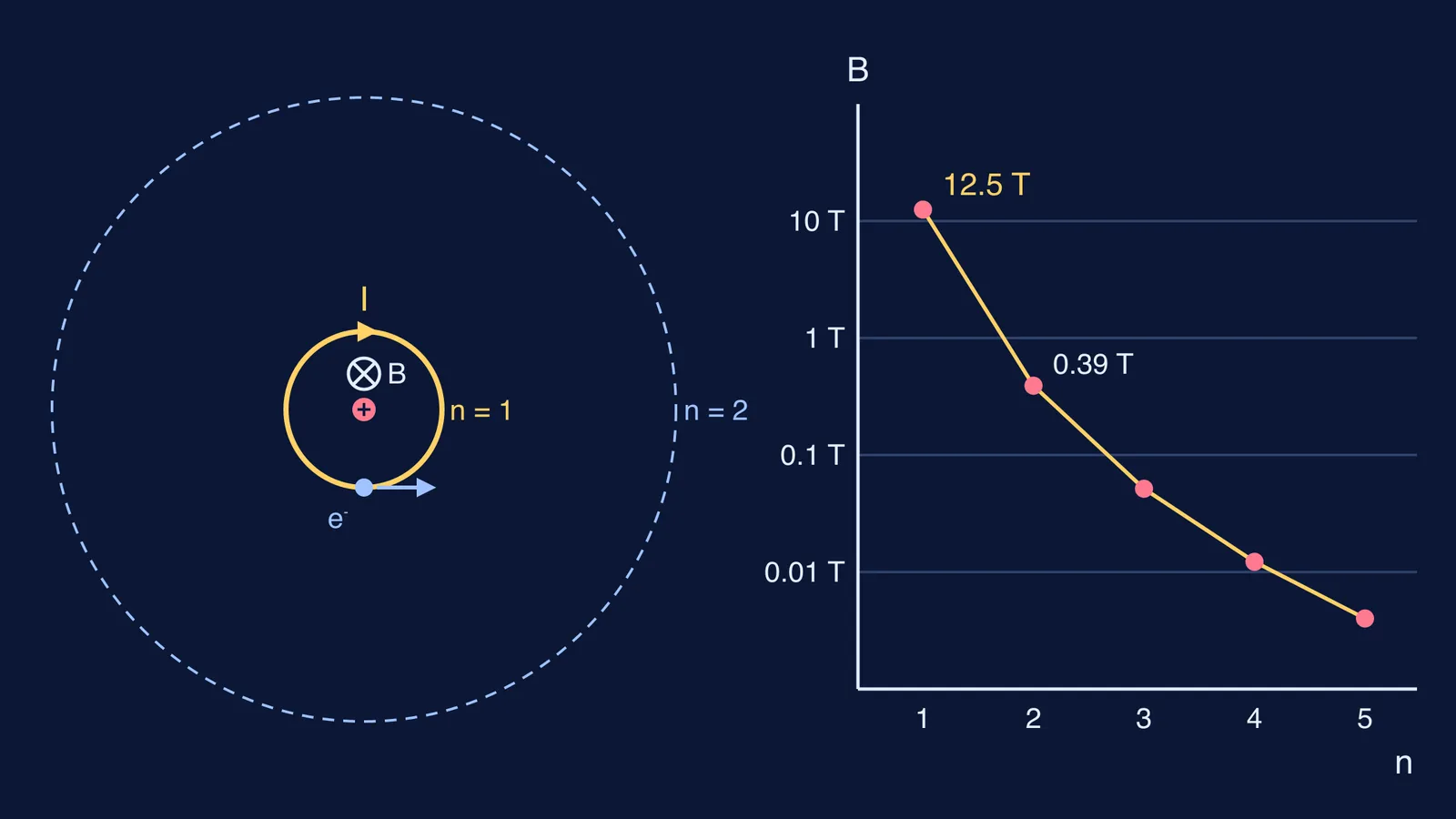
In the Bohr picture the electron moves in a circle of radius r at speed v. It passes any point on the orbit once every period T = 2πr/v. Charge e crossing a point once per period is an average current I = e/T = ev/2πr.
The field at the centre of a circular current loop of radius R is B = μ₀I/2R, pointing along the axis by the right-hand rule (OpenStax University Physics, Vol. 2, section 12.4). The nucleus sits at the centre of the orbit, so that is exactly the field it feels.
Put the two together and B = μ₀ev/4πr². If you have met the field of a single moving charge, this is the same expression; our post on the magnetic field of a moving point charge reaches it from the other direction.
What is the magnetic field at the nucleus for n = 1?
Use the 2022 CODATA values published by NIST. The Bohr radius is a₀ = 5.29177 × 10⁻¹¹ m (NIST). The ground-state speed is v₁ = αc, the fine-structure constant times the speed of light (Wikipedia: fine-structure constant), with α = 7.29735 × 10⁻³ (NIST) and c = 299 792 458 m/s (NIST). The electron charge is e = 1.602177 × 10⁻¹⁹ C (NIST) and μ₀ = 1.25664 × 10⁻⁶ N A⁻² (NIST).
Speed: v₁ = αc = 2.188 × 10⁶ m/s.
Period: T = 2πa₀/v₁ = 3.325 × 10⁻¹⁰ m ÷ 2.188 × 10⁶ m/s = 1.520 × 10⁻¹⁶ s, about 6.6 × 10¹⁵ turns a second.
Current: I = e/T = 1.602 × 10⁻¹⁹ C ÷ 1.520 × 10⁻¹⁶ s = 1.054 × 10⁻³ A, about 1.05 mA.
Field: B = μ₀I/2a₀ = (1.2566 × 10⁻⁶ × 1.054 × 10⁻³) ÷ (1.0584 × 10⁻¹⁰) = 12.5 T.
That is a large field. A CADTH systematic review compared hospital MRI scanners running at 1.5 T and 3.0 T; the Bohr nucleus sits in a field several times stronger, from about a milliampere. The reason is the tiny radius, squared in the denominator.
How does the field change with n?
In the Bohr model the orbit radius is rₙ = n²a₀ and the speed is vₙ = v₁/n (OpenStax University Physics, Vol. 3, section 6.4). Our post on the radius and speed in the nth Bohr orbit derives both. Now follow the powers of n:
Period T = 2πr/v grows as n² × n = n³.
Current I = e/T falls as 1/n³.
Field B = μ₀I/2r falls as (1/n³) × (1/n²) = 1/n⁵.
So Bₙ = 12.5 T / n⁵. Working it through with the same constants:
n = 1: 12.5 T
n = 2: 0.391 T
n = 3: 0.0515 T
n = 4: 0.0122 T
n = 5: 0.0040 T
Going from n = 1 to n = 2 cuts the field 32 times. Answers such as 1/n³ or 1/n⁴ are traps: 1/n⁴ forgets that the speed falls as 1/n, and 1/n³ forgets the extra 1/r in the loop formula.
Where do students lose marks on this question?
Run this checklist before you circle an answer:
Did you use the radius n²a₀ of the given orbit?
Did you reduce the speed as 1/n?
Did you use μ₀I/2r for a loop centre, not μ₀I/2πr for a straight wire?
Is the current e/T, or eω/2π, and not eω?
Did you reverse the direction for a negative charge?
Does your n = 1 answer match the worked value above? An answer in microtesla or kilotesla means a power-of-ten slip.
If you get stuck on a step like this, the Fermi Problem Library has worked problems with a step-by-step solver that explains the reasoning rather than printing an answer, so you can see which dependence you dropped.
What should you try next?
The same current loop has a magnetic moment, μ = IA, which leads straight to the Bohr magneton; our explainer on the magnetic moment of an orbiting electron picks up from here. For practice, redo n = 2 from scratch without the 1/n⁵ shortcut and check you land on the n = 2 value in the list above. If the picture of a charge-as-current is still fuzzy, the Fermi Concept Library gives every physics concept its own lesson and its place in the map.


