

On this page
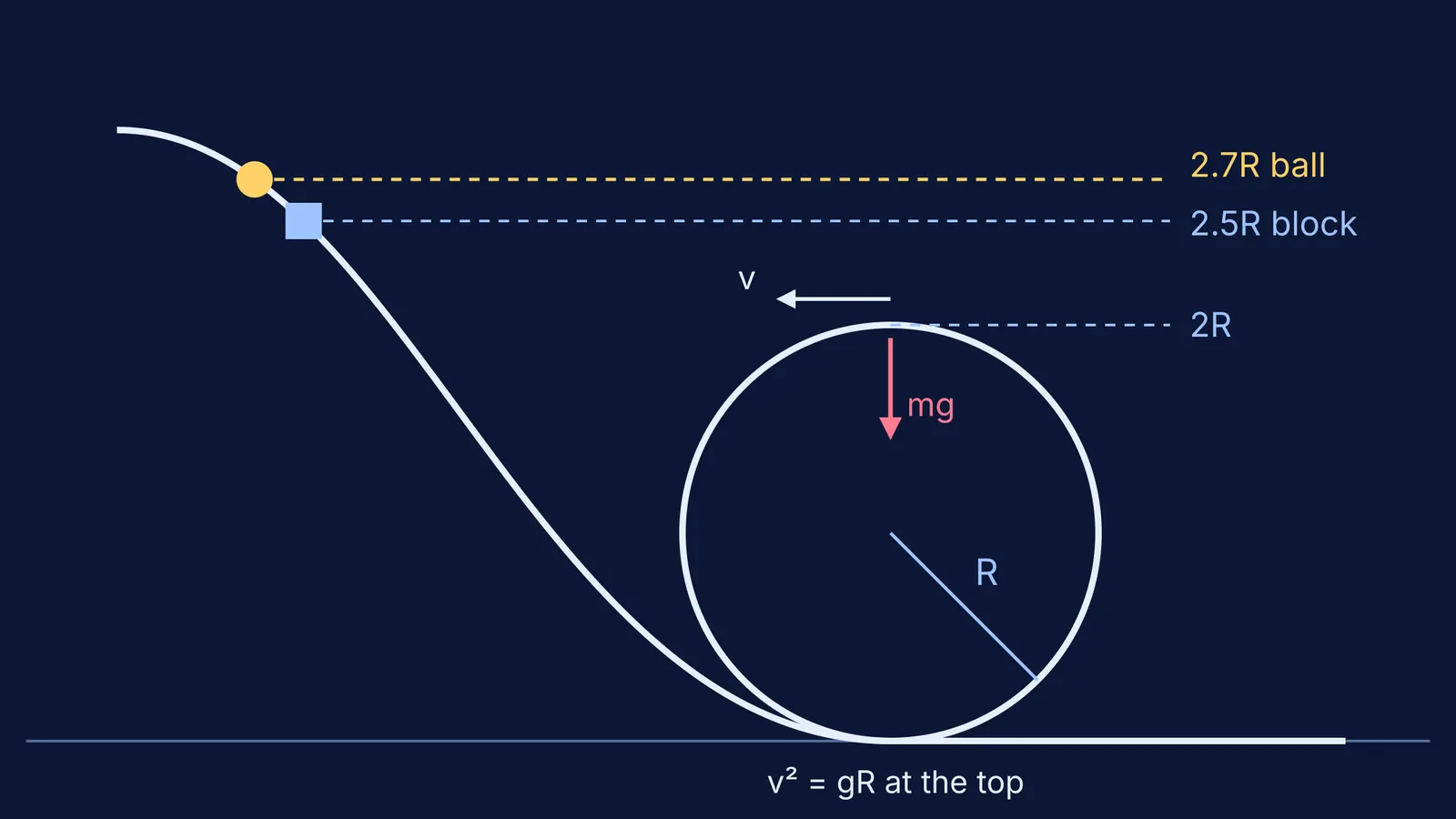
How high must you release a ball so it stays on a vertical loop all the way round? The textbook answer, h = 5R/2, is right only for something that slides without friction. The gap between 2.5R and 2.7R is the rotational kinetic energy students forget to write down.
What is the condition at the top of the loop?
At the top, both the track's normal force N and gravity mg point down, towards the centre. Together they provide the centripetal force:
N + mg = mv²/R
The object stays on the track while N is zero or more. At the slowest possible speed N = 0, so gravity alone bends the path: v² = gR at the top. Oberlin College's loop-the-loop demonstration notes use the same condition.
More in why a rod and a string need different speeds in a vertical circle.
How do you derive h = 5R/2 for a sliding block?
Conserve energy from release (height h) to the top of the loop (height 2R):
mgh = mg(2R) + ½mv²
Put in v² = gR: mgh = 2mgR + ½mgR
Cancel m and g: h = 2R + R/2 = 5R/2
The University of Maryland lecture-demonstration notes give the same 2.5R for an object sliding on a frictionless loop. For a general routine, see our step-by-step method for energy conservation problems.
Why does a rolling ball need 2.7R instead of 2.5R?
A rolling ball carries two kinds of kinetic energy. OpenStax University Physics writes the total energy of a rolling object as ½mv² + ½Iω² + mgh, and links speed to spin for rolling without slipping as v = Rω. We write the ball's radius as r, to keep it apart from the loop's R. For a solid sphere of radius r, I = (2/5)mr², the value OpenStax uses in Example 10.12.
Now add the missing term:
Rolling without slipping: ω = v/r
Rotational energy: ½Iω² = ½ × (2/5)mr² × v²/r² = (1/5)mv²
Total kinetic energy: ½mv² + (1/5)mv² = (7/10)mv²
Energy: mgh = 2mgR + (7/10)m(gR)
So h = 2R + 0.7R = 2.7R
The ball's own radius cancels in step 2. The spin takes (1/5) ÷ (7/10) = 2/7 of the kinetic energy, about 29%. The Maryland notes give h = 2.7R for the ball and say it stays on the track at the top only when that height is reached.
Two refinements:
Friction is not a problem here. In rolling without slipping, the contact point is momentarily at rest, so static friction does no work, as OpenStax explains.
A big ball sees a smaller loop. Its centre moves on a circle of radius R − r, so the Oberlin notes use v² = g(R − r) and give h = 2.7(R − r), with heights taken for the ball's centre. For a small ball, this is close to 2.7R.
Where do students lose marks on this problem?
Check these before you write the final answer:
Does it roll? If yes, write ½Iω² next to ½mv². This is the term the 2.5R answer leaves out.
Can the speed at the top be zero? Only for a rod or a bead on a wire. For a track or a string, the minimum is v² = gR.
Which I? Write I = kmr². For a ball small next to the loop, h = 2R + (1 + k)R/2.
Where is h measured from? From the bottom of the loop, not the top.
With moments of inertia from the standard list, the formula gives:
Sliding block, k = 0: h = 2.5R
Solid sphere, k = 2/5: h = 2.7R
Solid cylinder, k = 1/2: h = 2.75R
Hollow sphere, k = 2/3: h ≈ 2.83R
Thin ring, k = 1: h = 3R
More mass far from the axis means more energy in spin, so a higher start.
If you keep getting 2.5R for a rolling ball, the Fermi Problem Library has worked problems with a step-by-step solver that explains the reasoning rather than printing an answer, so you can find the line where the spin term went missing.
A worked example you can check in two minutes
Take R = 20 cm and the results from the Maryland notes.
Frictionless block: h = 2.5 × 20 = 50 cm
Solid ball: h = 2.7 × 20 = 54 cm
Speed at the top, in every case: v = √(gR) = √(9.8 × 0.20) ≈ 1.4 m/s
To see how speed and normal force change around the loop, try our vertical circle motion simulation. If rolling or moment of inertia still feels shaky, each has its own lesson in the Fermi Concept Library.


