

On this page
Many log slips come from a rule that looks right but does not exist. Here are the real rules, the invented ones, and worked examples with checks.
Which logarithm rules are actually true?
For a base a > 0 with a ≠ 1, and positive M and N, OpenStax College Algebra 2e gives these rules:
Product rule: logₐ(MN) = logₐ M + logₐ N
Quotient rule: logₐ(M/N) = logₐ M − logₐ N
Power rule: logₐ(Mⁿ) = n logₐ M
Change of base: logₐ M = log M / log a, using any one base (such as 10 or e) for both logs on the right
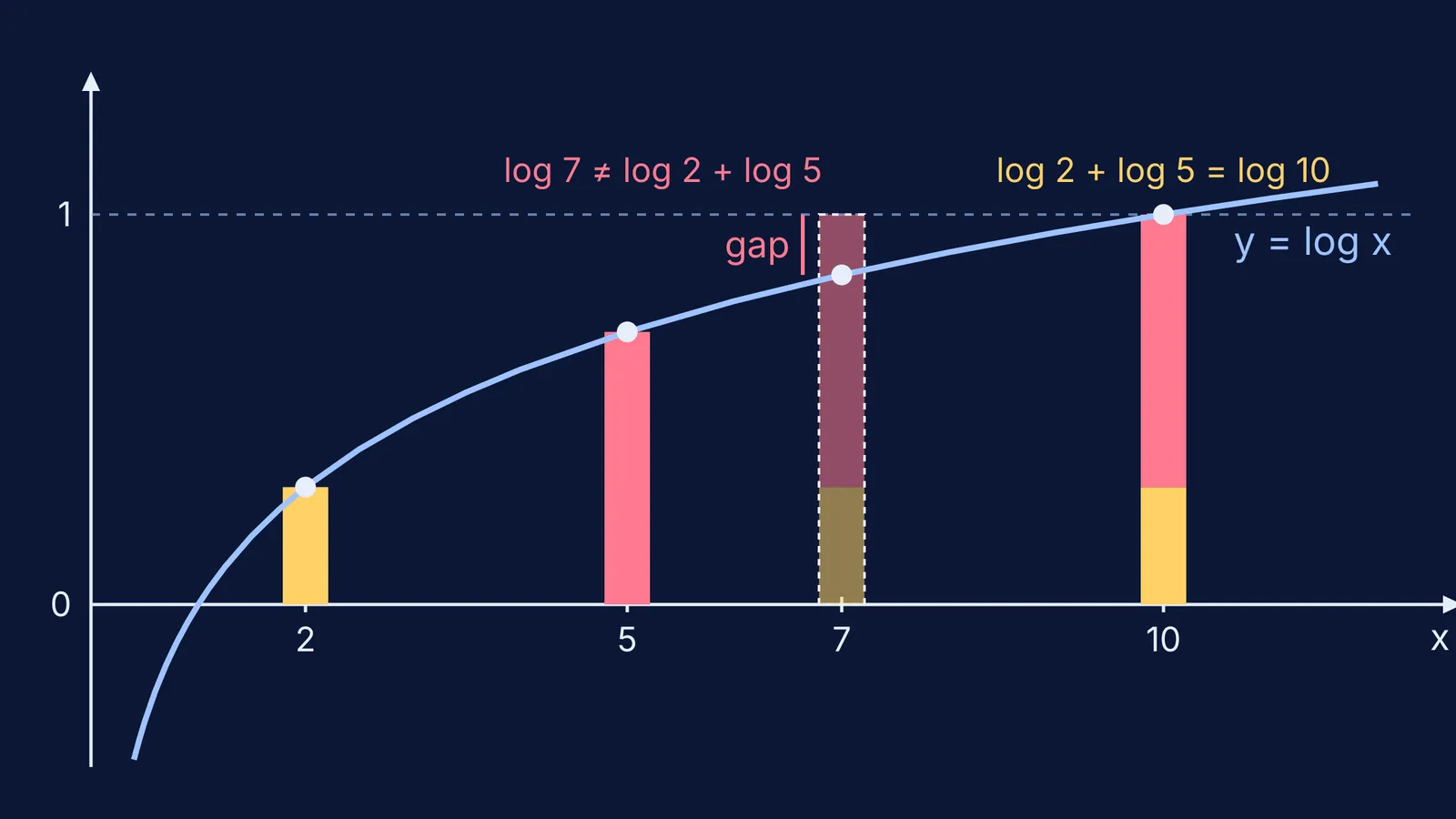
There is no rule for log(M + N) or log(M − N). A log of a sum stays a log of a sum. If log and ln confuse you, read our explainer on log vs ln notation first.
What are the most common mistakes with logarithm rules?
Raman Ganesan and Jaguthsing Dindyal gave a logarithms test to 89 Year 9 students in Singapore and sorted the errors by type in their 2014 MERGA conference paper. In the lowest-scoring third, 31 students (34.8% of all 89) misused a law of logarithms, against 9 students (10.1%) in the top third. The authors suggest some students may just remember slogans such as "add means multiply" and "subtract means divide" and misapply them.
One student turned log 16 ÷ log 4 (same base) into the log of 12, because "divide means minus". The answer is 2.
Invented rules to watch for, each with a quick check in base 10:
log(a + b) = log a + log b. Check a = 2, b = 8: log 10 = 1, but log 2 + log 8 = log 16 ≈ 1.204.
log a ÷ log b = log(a/b) or log(a − b). Check a = 100, b = 10: 2 ÷ 1 = 2, but log 10 = 1 and log 90 ≈ 1.954.
(log x)² = 2 log x. Check x = 1000: 3² = 9, but 2 × 3 = 6. The power rule moves an exponent on x, not on the log.
log(2x) = 2 log x. Check x = 5: log 10 = 1, but 2 log 5 ≈ 1.398. The correct expansion is log 2 + log x.
log(x²) = 2 log x for every x. At x = −3, log 9 exists but log(−3) does not. For any x ≠ 0, log(x²) = 2 log|x|.
How does change of base work, and where does it go wrong?
Change of base says logₐ M = log M / log a, with both logs on the right in the same base (OpenStax). It is a division of two logs, never log(M/a).
Worked example: log₂₅ 5 = log 5 / log 25 = log 5 / (2 log 5) = 1/2. Check: 25^(1/2) = 5. In the Singapore study, at least five students made this error; the one shown rewrote the base 25 as 5², not the 5 as 25^(1/2), and got 2.
It also gives the chain logₐ x × logₓ y = logₐ y, covered in change of base for log chains and products.
How do you simplify a log expression and check the answer?
Order: write the domain, apply the power rule, combine logs into one, evaluate, then check on a calculator.
Worked example 1: simplify 2 log₃ 6 − log₃ 4.
Power rule: 2 log₃ 6 = log₃ 36.
Quotient rule: log₃ 36 − log₃ 4 = log₃ 9 = 2, since 3² = 9.
Check: log₃ 6 = ln 6 / ln 3 ≈ 1.631 and log₃ 4 ≈ 1.262, so 2(1.631) − 1.262 ≈ 2.000.
Worked example 2: solve log₂ x + log₂(x − 2) = 3.
Domain: x > 0 and x − 2 > 0, so x > 2.
Product rule: log₂[x(x − 2)] = 3, so x(x − 2) = 2³ = 8.
Solve: x² − 2x − 8 = 0 gives x = 4 or x = −2.
Check: x = −2 breaks the domain, so reject it. For x = 4, log₂ 4 + log₂ 2 = 2 + 1 = 3. So x = 4.
In the same study, 24 students from the top third (26.9% of the 89 tested) did not check whether their solutions satisfied the original equation, the most common error type in their group. Our guide to logarithmic equations and inequalities has more cases like this.
If your working keeps breaking at the same step, the Fermi Problem Library has worked problems with a step-by-step solver that explains the reasoning rather than printing an answer. If the gap is the idea of a logarithm itself, the Fermi Concept Library gives it its own lesson.
Next time you write a log rule, test it with two numbers first.


