

On this page
When you start solving advanced kinetics in chemistry or integrating functions in mathematics, one of the most common mistakes is pressing the wrong logarithm button on your calculator. The two functions look similar, but mixing them up will throw off your final answer by a factor of more than two.
Here is how to tell them apart, how to convert between them, and the hidden convention that often trips up students in exams.
What is the difference between log and ln?
The difference between log and ln is the number they use as their base. A logarithm asks a simple question: what power must the base be raised to in order to produce a given number?
The common logarithm is the logarithm with base 10 source. It is usually written as log₁₀(*x*) or simply log(*x*). For example, log(100) is 2, because 10 raised to the power of 2 is 100. Similarly, log(1000) is 3. This base is incredibly useful for everyday numbers and scientific notation, which is why it is the default on most calculators.
The natural logarithm is the logarithm to the base of the mathematical constant *e*, an irrational number approximately equal to 2.718 source. It is written as ln(*x*). For example, ln(*e*) is 1, because *e* raised to the power of 1 is *e*. The number *e* appears naturally in systems that grow continuously, such as radioactive decay, compound interest, and population growth.
Why do we multiply by 2.303?
Because the two functions operate on different bases, you cannot use them interchangeably. However, logarithms in different bases differ only by a constant multiplier source.
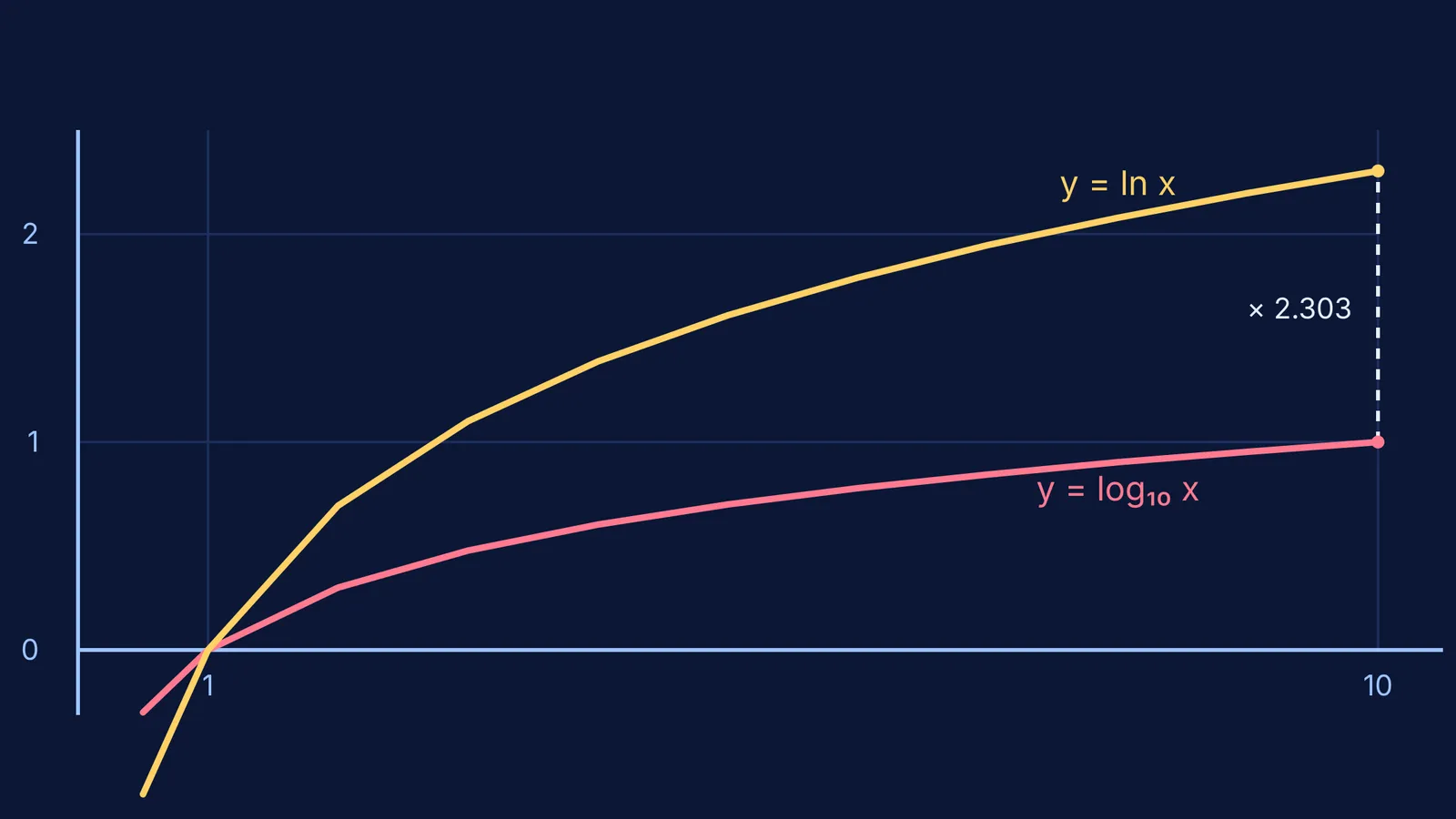
To convert a common logarithm to a natural logarithm, you use the change-of-base formula. The exact conversion factor is the natural logarithm of 10, which is approximately 2.302585. In most high school and entrance exam calculations, this is rounded to 2.303.
This gives us the standard conversion rule: ln(*x*) = 2.303 × log₁₀(*x*)
You will use this constantly in physical chemistry. For instance, the Nernst equation in electrochemistry and the first-order rate law in chemical kinetics are derived using natural logarithms (ln). However, working with base *e* by hand is difficult. To make the arithmetic easier for students, these equations are almost always rewritten in textbooks using log₁₀ by multiplying the variables by 2.303.
Does log mean log₁₀ or ln in JEE?
This is where the notation gets confusing. The meaning of "log" changes depending on whether you are studying chemistry or pure mathematics.
In pure mathematics, mathematicians usually mean the natural logarithm (base *e*) when they write "log" source. This convention is standard in the calculus you need for JEE physics. When you integrate 1/*x*, the answer is universally written as log(*x*), but the base is always assumed to be *e*. The natural logarithm is preferred in calculus because its derivative is simply 1/*x*, whereas the derivative of log₁₀(*x*) involves a messy constant.
In chemistry and experimental physics, "log" strictly means the common logarithm (base 10). If a question about pH, thermodynamics, or first-order kinetics writes log(*x*), you must use base 10. For example, the pH formula is −log[H⁺], which relies entirely on powers of 10.
If you are ever stuck on a math or science topic because of notation, the Fermi Concept Library contains every concept in physics, chemistry, biology, mathematics and computing, each with its own lesson and its place in the map.
A practical checklist for notation
To avoid calculation errors, use this simple framework to decide which base applies to your current problem:
Calculus and pure maths: Treat `log(x)` as `ln(x)`. If a problem asks you to differentiate or integrate, you are working in base *e*.
Chemistry and experimental physics: Treat `log(x)` as base 10. When dealing with pH, sound intensity in decibels, or equations containing 2.303, use the common logarithm.
Scientific calculators: The `log` button is always base 10, and the `ln` button is always base *e*. Do not let mathematical notation trick you into pressing the wrong button.
Programming languages: In Python, C++, Java and JavaScript, the `log()` function calculates the natural logarithm (ln). To get a base-10 logarithm in your code, you must explicitly call the `log10()` function.
Knowing how base-10 logarithms were first computed helps you appreciate why we still use them today to simplify massive numbers. But in a modern exam, understanding the hidden context behind the notation is what will secure your marks.


