

On this page
Put a lot of tiny drops together into one big drop and the liquid gets slightly warmer. It is a standard JEE Main and Class 11 question, and it joins two chapters: surface tension gives you the energy, and calorimetry turns that energy into a temperature rise. Below: the derivation, a worked example with real values for water, and a checklist of mistakes that cost marks.
Why does merging drops release energy?
The total volume stays the same, but the total surface area falls. If n drops of radius r merge into one drop of radius R, equal volumes give n × (4/3)πr³ = (4/3)πR³, so R = n^(1/3) r.
The area before is n × 4πr² and the area after is 4πR². Since n r² = n^(1/3) R², the starting area is n^(1/3) times the final area, so area is always lost when drops merge.
A liquid surface stores energy, and the surface energy per unit area equals the surface tension S. If the difference between those two ideas confuses you, read our explainer on surface energy vs surface tension. The energy released is S times the area lost:
W = 4πR²S (n^(1/3) − 1)
We derive this energy step by step, with more n-drop variations, in energy released when n small drops merge into one big drop.
How do you get the temperature rise from the energy?
Assume all the released energy stays in the new drop as heat. Then W = m c ΔT, where m is the mass of the big drop and c is the specific heat of the liquid. Three steps get you to the formula:
Rewrite the energy using n r² = R³/r: W = 4πR³S (1/r − 1/R).
Write the mass as m = (4/3)πR³ρ, where ρ is the density.
Divide: ΔT = W/(m c) = 3S(1/r − 1/R)/(ρc).
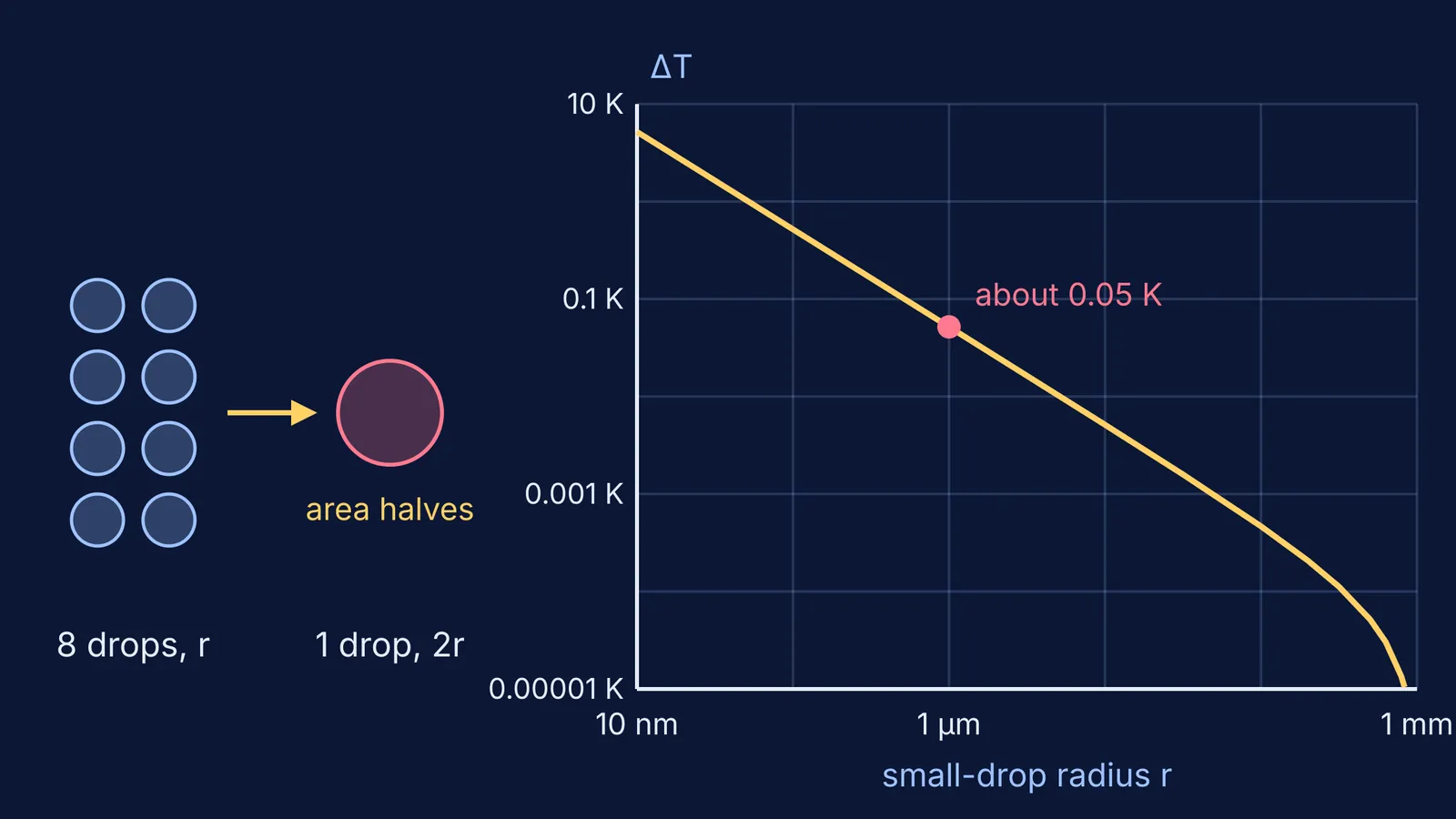
The 4πR³ cancels, which is the useful insight: the temperature rise depends mainly on how small the starting drops were. When R is much bigger than r, the formula shrinks to ΔT ≈ 3S/(ρcr). If you want a refresher on where W = m c ΔT comes from in the lab, see specific heat by the method of mixtures.
How big is the temperature rise for water drops?
The surface tension of water at 25 °C is 71.97 mN/m, according to the IAPWS release on the surface tension of ordinary water. At 25 °C and 1 atm, liquid water has a density of 997.05 kg/m³ and a specific heat of 4.1813 J/g·K, according to the NIST Chemistry WebBook fluid data.
Worked example: fog droplets of radius 1 µm merge into a raindrop of radius 1 mm. Find the temperature rise.
Count the drops: R/r = 1000, so n = 1000³ = 10⁹ droplets.
Areas: the big drop has 4π(1 mm)² ≈ 12.6 mm². The droplets together have n^(1/3) = 1000 times that, about 12,566 mm². The area lost is about 1.255 × 10⁻² m².
Energy: W = 0.07197 N/m × 1.255 × 10⁻² m² ≈ 9.0 × 10⁻⁴ J, a little under 1 millijoule.
Mass: m = (4/3)π(10⁻³ m)³ × 997.05 kg/m³ ≈ 4.18 × 10⁻⁶ kg.
Temperature rise: ΔT = 9.0 × 10⁻⁴ / (4.18 × 10⁻⁶ × 4181.3) ≈ 0.052 K.
Check with the formula: 3 × 0.07197 × (10⁶ − 10³) / (997.05 × 4181.3) ≈ 0.0517 K. Both routes agree.
Now compare a typical textbook case: 1000 drops of radius 1 mm merging into one drop of radius 1 cm. The same formula gives 3 × 0.07197 × (1000 − 100) / (997.05 × 4181.3) ≈ 4.7 × 10⁻⁵ K. Drops a thousand times bigger give roughly a thousand times less warming, because ΔT scales as 1/r.
What do exam questions assume, and where do students slip?
The formula assumes no heat escapes to the air, nothing evaporates, surface tension stays constant, and all the released energy ends up as heat in the drop.
Marks are often lost in the units and arithmetic rather than the physics. Before you submit, check:
Radii are in metres. A 1 mm radius is 10⁻³ m, not 1.
Surface tension is in N/m. Divide mN/m by 1000; one dyne/cm equals one mN/m.
Specific heat is in J/kg·K. Water's 4.18 J/g·K (NIST) is about 4180 J/kg·K.
You used radius, not diameter, everywhere.
You took the mass of the final drop, which equals the total mass of the small drops.
For the reverse question (a drop sprayed into droplets with no outside work), the same formula gives a fall in temperature.
If you keep losing marks at the units or algebra step, the Fermi Problem Library has worked problems with a step-by-step solver that explains the reasoning rather than printing an answer. If the shaky part is the idea of surface energy itself, its lesson sits in the Fermi Concept Library alongside every other physics concept.
Next time you see a drop question, write ΔT = 3S(1/r − 1/R)/(ρc) first, plug in SI units, and run the sense check before you move on.


