

On this page
In coordinate geometry, one of the most common phrases you will encounter is a straight line being "equally inclined to the axes". It appears frequently in JEE and board exam questions, often as a single hidden clue that unlocks the entire problem.
When a question states that a line is equally inclined to the coordinate axes, it means the angle it makes with the x-axis and the y-axis is identical in magnitude. Because the coordinate axes themselves meet at a 90° angle, the only way a straight line can split that difference evenly is by sitting exactly halfway between them.
What does equally inclined to the axes mean?
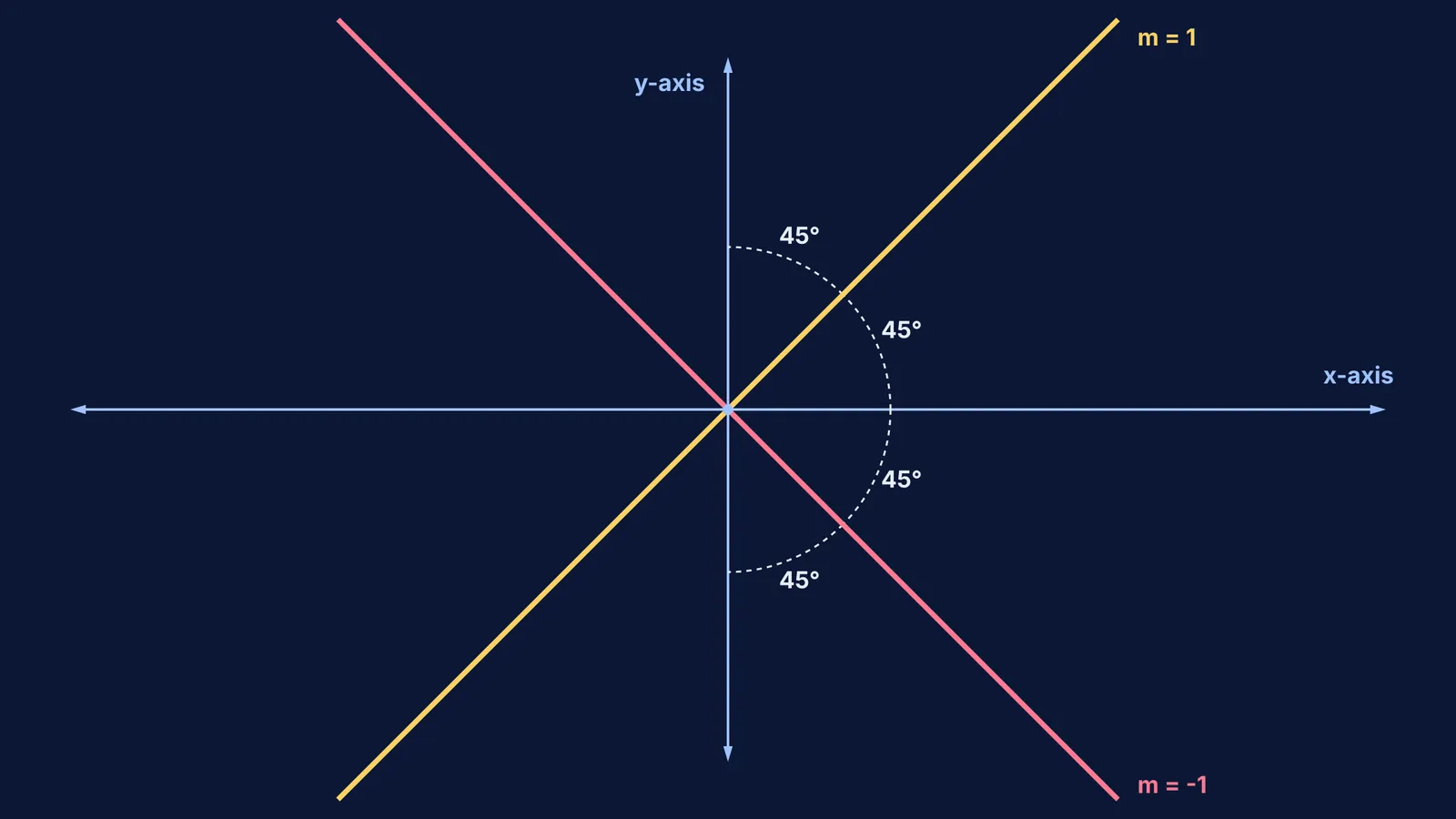
A line that is equally inclined to the axes creates a symmetric path through the Cartesian plane. Because it must form the same angle with both the horizontal x-axis and the vertical y-axis, that inner angle is always 45°.
However, in mathematics, the formal angle of inclination (θ) is defined as the angle measured counter-clockwise from the positive direction of the x-axis. As detailed in the Wikipedia article on Slope, the slope (m) of a line is directly related to its angle of inclination through the tangent function: m = tan(θ).
This creates exactly two possible cases for a line equally inclined to the axes:
The rising line: The line cuts diagonally upward through the first and third quadrants. Its angle of inclination is 45°. The slope is m = tan(45°) = 1.
The falling line: The line cuts diagonally downward through the second and fourth quadrants. While it still forms a 45° angle with the axes visually, its formal angle of inclination from the positive x-axis is 135°. The slope is m = tan(135°) = −1.
Therefore, whenever a problem states a line is equally inclined to the axes, you immediately know that m = ±1.
Why does the slope have to be 1 or -1?
The slope of a line is defined mathematically as the ratio of the vertical change to the horizontal change (often remembered as "rise over run"). When a straight line is equally inclined to the axes, for every single unit it travels to the right, it must travel exactly one unit vertically to maintain its perfect diagonal path.
If it goes up one unit for every unit right, the ratio is 1 / 1, meaning the slope is +1.
If it goes down one unit for every unit right, the ratio is −1 / 1, meaning the slope is −1.
Any other ratio would force the line to tilt closer to one axis than the other. For instance, a slope of 2 means the line rises faster than it runs, bringing it closer to the y-axis and making the angles unequal.
Equally inclined vs equal intercepts: What is the difference?
A classic exam trap is confusing a line that is "equally inclined to the axes" with a line that makes "equal intercepts" on the axes. They sound similar, but they give you completely different mathematical conditions.
Equally inclined to the axes: The line forms equal angles with both axes. The slope can be either 1 or −1.
Equal intercepts: The line cuts the axes at the exact same coordinate value (e.g., crossing the x-axis at +5 and the y-axis at +5). If the intercepts are a and b, this means a = b. The equation of the line is x/a + y/a = 1, which rearranges to x + y = a. The slope of this line is strictly −1.
If a line has equal intercepts, it is a specific type of equally inclined line. But an equally inclined line does not necessarily have equal intercepts (for example, a line with slope 1 passing through the origin has intercepts of 0 and 0).
When practicing coordinate geometry, small variations in the language can change your whole solution path. Fermi's AI tutor can help you spot these wording traps as you practice. Instead of just printing the final answer, the tutor checks your reasoning in the Fermi Problem Library and explains why setting the slope to 1 is only half the solution.
How do you solve problems with equally inclined lines?
If you know the line is equally inclined to the axes, you are essentially given the slope. From there, you only need one other piece of information—usually a point the line passes through—to find the full equation.
Here is a standard worked example: *Find the equations of the lines passing through the point (2, 3) that are equally inclined to the axes.*
Step 1: Identify the slopes Since the lines are equally inclined to the axes, their slopes must be m = 1 and m = −1.
Step 2: Use the point-slope form The point-slope formula is y − y₁ = m(x − x₁). We will apply this twice, once for each possible slope, using the point (2, 3).
Step 3: Solve for Case 1 (m = 1) y − 3 = 1(x − 2) y − 3 = x − 2 x − y + 1 = 0
Step 4: Solve for Case 2 (m = -1) y − 3 = −1(x − 2) y − 3 = −x + 2 x + y − 5 = 0
The two lines that satisfy the condition are x − y + 1 = 0 and x + y − 5 = 0. In an exam, unless the question provides a further constraint (such as "the line makes a negative intercept on the y-axis"), you must provide both equations to get full marks.
How to test your intuition
Coordinate geometry relies heavily on being able to picture the lines before you start writing equations. It helps to practice sketching the graph of any linear equation quickly. If you want to build this habit, you can learn how to draw the graph of a linear equation quickly.
Once you are comfortable with single lines, you can test more complex setups—like finding the angle bisectors of two lines—which uses the exact same geometry logic. And if you want to verify how intersecting and coincident lines behave, check out the parallel and coincident lines ratio test to see how slopes govern the entire Cartesian system.
If you want to see how these slopes connect to the rest of coordinate geometry, read the lesson on straight lines in the Fermi Concept Library to understand exactly why an angle of inclination above 45° breaks the symmetry.


