

On this page
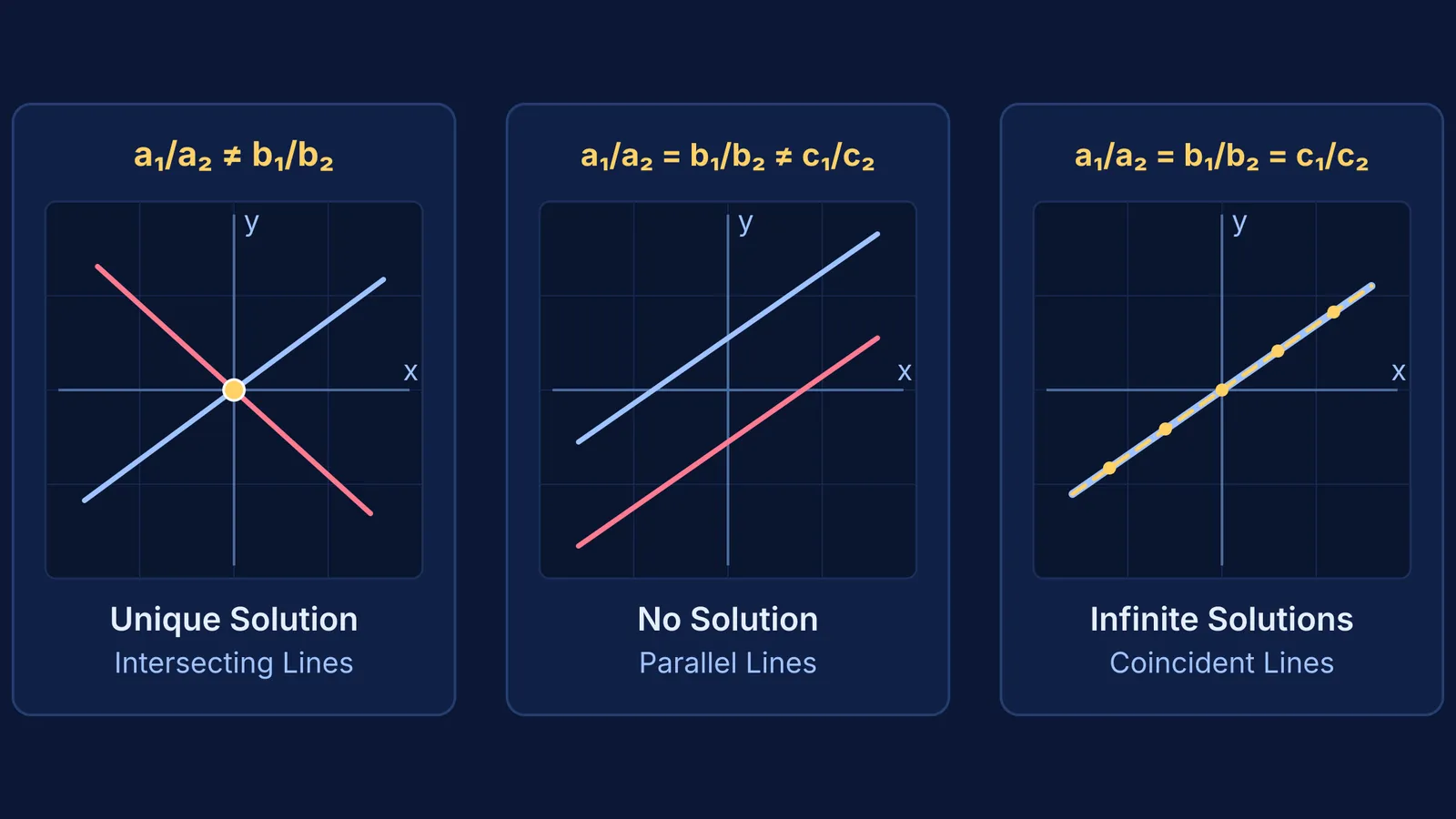
Every linear equation in two variables traces a straight line across the Cartesian plane. When you examine two linear equations together, their geometric relationship determines whether you find a single intersection point, an infinite line of matching coordinates, or no intersection at all. Rather than plotting coordinates on graph paper, you can determine their behavior in seconds by comparing coefficient ratios.
Unit II (Algebra) accounts for 20 marks out of the 80 marks in the CBSE Class 10 mathematics theory examination, allocating 15 periods to linear systems. Mastering the ratio test gives you quick marks on multiple-choice questions while verifying your graphical solutions.
What are the conditions for a1/a2, b1/b2 and c1/c2?
To test any pair of equations, write both in standard form: a₁x + b₁y + c₁ = 0 and a₂x + b₂y + c₂ = 0.
Here, coefficients a₁, b₁, a₂, and b₂ must satisfy a₁² + b₁² ≠ 0 and a₂² + b₂² ≠ 0 according to the CBSE secondary curriculum. Students often search for the a1 by a2 b1 by b2 c1 by c2 conditions to test consistency without graphing. By comparing the three ratios a₁/a₂, b₁/b₂, and c₁/c₂, you encounter three distinct geometric outcomes:
Intersecting lines (unique solution): If a₁/a₂ ≠ b₁/b₂, the lines cross at exactly one point. The system has a unique solution and is consistent.
Coincident lines (infinitely many solutions): If a₁/a₂ = b₁/b₂ = c₁/c₂, the lines lie directly on top of each other. Every coordinate along the line is a solution, making the system consistent and dependent.
Parallel lines (no solution): If a₁/a₂ = b₁/b₂ ≠ c₁/c₂, the lines have identical slopes but different intercepts. They never cross, so the system has no solution and is inconsistent.
Understanding these ratios connects directly with algebraic techniques explained in linear equations in Class 10: substitution, elimination, graphs.
Why does the constant ratio c1/c2 separate parallel from coincident lines?
Students often confuse parallel lines with coincident lines because both share the condition a₁/a₂ = b₁/b₂. The equality of the x and y coefficient ratios means both lines have the identical geometric slope, −a/b.
The constant ratio c₁/c₂ determines where each line cuts the axes. If the constant terms scale by the same proportion (a₁/a₂ = b₁/b₂ = c₁/c₂), the second equation is a scalar multiple of the first, sharing the identical y-intercept, −c/b. When the constant terms scale differently (a₁/a₂ = b₁/b₂ ≠ c₁/c₂), the lines have equal slopes but distinct intercepts, creating parallel tracks.
If you find it difficult to picture how changing constants shifts lines, the Fermi Simulation Lab provides interactive simulations for ideas that are easier to see than to read.
How do you solve find-k questions without sign errors?
Board examiners frequently test these conditions with an unknown parameter k. In the CBSE Class 10 Mathematics Standard sample question paper 2024-25, Question 2 in Section A asks for the value of k that makes 3x − ky = 7 and 6x + 10y = 3 inconsistent.
Here is the worked solution:
Standard form: 3x − ky − 7 = 0 and 6x + 10y − 3 = 0.
Coefficients: a₁ = 3, b₁ = −k, c₁ = −7 and a₂ = 6, b₂ = 10, c₂ = −3.
Inconsistency condition: a₁/a₂ = b₁/b₂ ≠ c₁/c₂, giving 3/6 = −k/10 ≠ (−7)/(−3), or 1/2 = −k/10 ≠ 7/3.
Solve for k: 1/2 = −k/10 yields −2k = 10, so k = −5.
Verify: 5/10 = 1/2 ≠ 7/3 holds true, confirming k = −5.
The official CBSE marking scheme awards 1 mark for k = −5. Omitting the verification of c₁/c₂ is a common mistake discussed in Class 10 CBSE maths: board answer mistakes and how to show working.
A similar trap occurs when solving for infinite solutions in kx + 3y − (k − 3) = 0 and 12x + ky − k = 0. Setting k/12 = 3/k gives k² = 36, so k = 6 or k = −6. Substituting k = −6 into (k − 3)/k yields 3/2, which does not match k/12 = −1/2. Only k = 6 satisfies all three ratios simultaneously. When structuring your exam approach with a CBSE Class 10 maths paper: a section-by-section plan, testing all ratios avoids losing marks.
When working through multi-step algebra problems, the Fermi Problem Library offers worked problems with a step-by-step solver that explains the reasoning rather than printing an answer.
How do you check linear equation problems step by step in an exam?
Use this five-step checklist to solve ratio problems accurately:
Move all terms to the left-hand side so both constants are in standard form.
List a₁, b₁, c₁ and a₂, b₂, c₂ with their exact signs.
Compare a₁/a₂ with b₁/b₂ first; if unequal, conclude a unique solution exists.
If a₁/a₂ = b₁/b₂, evaluate c₁/c₂ to distinguish parallel lines from coincident lines.
If solving for an unknown variable k gives multiple roots, substitute every root back into c₁/c₂ to discard invalid solutions.


