

On this page
In ICSE maths, inequation questions usually come with a tag such as x ∈ W. That tag is the replacement set, and it changes the answer. The ICSE Class 10 syllabus for 2026-27, as reproduced on Oswal Publishers' syllabus page, lists "Linear Inequations in one unknown for x ∈ N, W, Z, R", solved algebraically, written in set notation and shown on the number line. CBSE students meet the same idea in Chapter 5 of the NCERT Class 11 textbook, Linear Inequalities.
What is the replacement set of an inequation?
The replacement set is the set of values the variable is allowed to take, and the solution set is the part of it that makes the inequation true. NCERT calls the values of x that make an inequality a true statement its solutions, and the set of them its solution set (NCERT Class 11, Chapter 5). So the solution set is always a subset of the replacement set.
The four you will see most:
N, natural numbers: 1, 2, 3, ...
W, whole numbers: 0, 1, 2, 3, ...
Z, integers: ..., −2, −1, 0, 1, 2, ...
R, real numbers: every point on the line, fractions included
Some questions give a small finite set instead. Treat it the same way.
How do you find the solution set step by step?
Ignore the replacement set and solve the inequation as you would an equation.
If you multiply or divide both sides by a negative number, reverse the sign.
Write the result as one simple condition, such as x < 4.
Go through the replacement set and keep only the members that satisfy it.
Write the answer in set notation, then draw it.
Step 2 is NCERT's Rule 2 (NCERT Class 11, Chapter 5), but the step that is easiest to skip is 4. In the same chapter, Example 1 solves 30x < 200 to get x < 20/3. For natural numbers the solution set is {1, 2, 3, 4, 5, 6}; for integers it is {..., −2, −1, 0, 1, 2, 3, 4, 5, 6}. Same algebra, different answers.
Worked example: one inequation, four replacement sets
Solve 4 − 3x > −8.
Subtract 4 from both sides: −3x > −12.
Divide by −3 and flip the sign: x < 4.
Now filter:
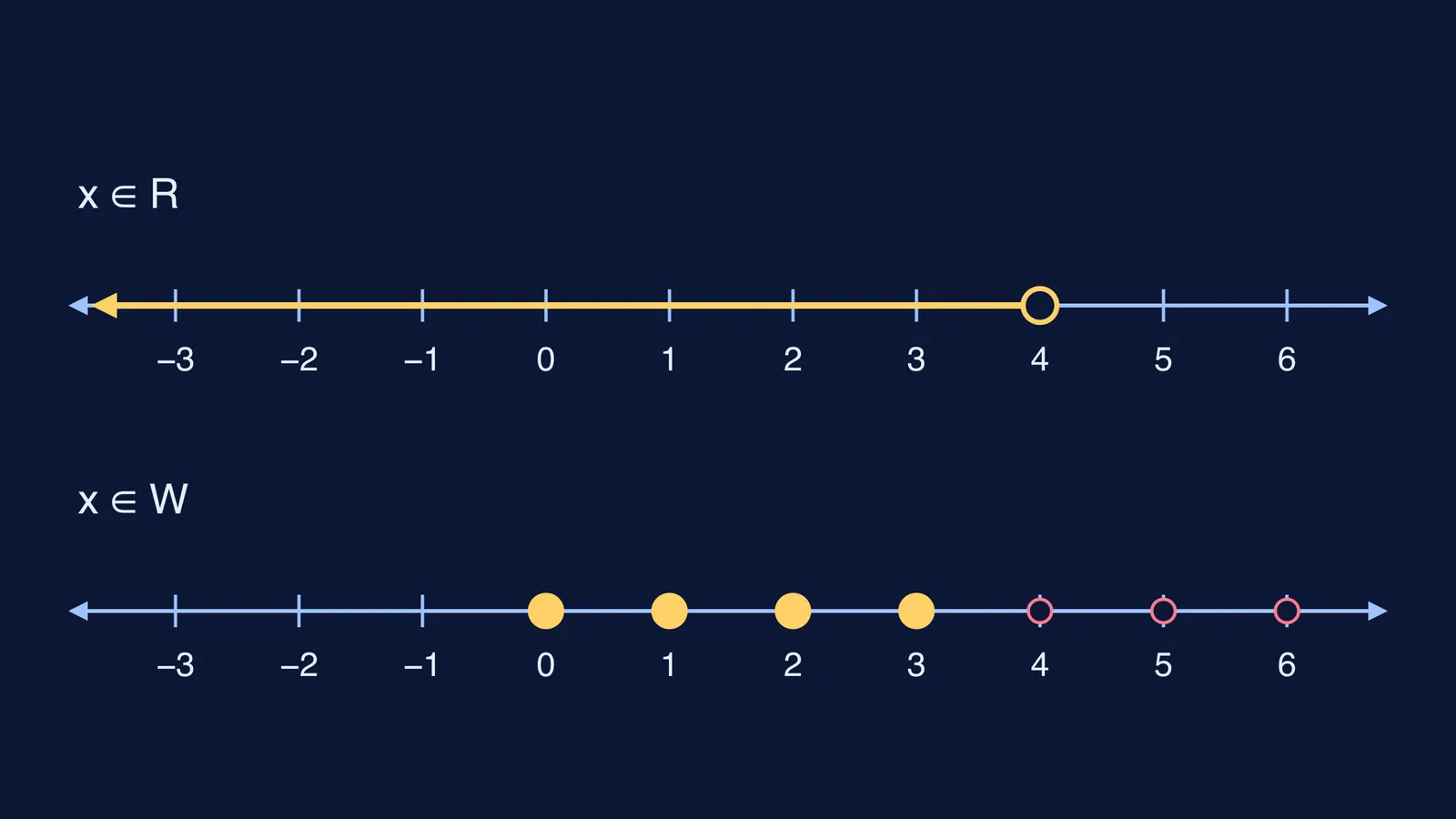
x ∈ W gives {0, 1, 2, 3}. The value 4 fails: 4 − 12 = −8, not greater than −8.
x ∈ N gives {1, 2, 3}, because 0 is not a natural number.
x ∈ Z gives {..., −2, −1, 0, 1, 2, 3}, running on forever to the left.
x ∈ R gives {x : x ∈ R, x < 4}.
A finite replacement set works the same way. Solve 5 − 2x ≥ 1 for x ∈ {−2, −1, 0, 1, 2, 3, 4}. Subtracting 5 gives −2x ≥ −4, and dividing by −2 gives x ≤ 2, so the solution set is {−2, −1, 0, 1, 2}. Check the edges: x = 2 gives 1 ≥ 1, true; x = 3 gives −1 ≥ 1, false.
How do you show the solution set on a number line?
The replacement set decides the picture.
N, W or a finite set: a solid dot on each member and nothing else. Do not join the dots, because no value between them is allowed.
Z, when the set runs on forever: dots on the integers, then "..." on the side where it continues.
R: a thick line, with a hollow circle at the boundary for < or >, a filled circle for ≤ or ≥, and an arrow if it goes on forever.
The diagram at the top shows the first example both ways. For more on the real-number case, see this guide to solving a linear inequality and showing it on a number line.
What are the common mistakes with replacement sets?
Forgetting to flip the sign after dividing by a negative. The four rules for when the inequality sign flips cover every case.
Putting 0 in the answer when x ∈ N.
Joining the dots with a line when the replacement set is N, W or Z.
Stopping at x < 4 when the question asked for the solution set. To switch between listed and rule-based answers, see how to convert roster form to set-builder form.
If your answer doesn't match the book and you can't see why, the Fermi Problem Library has worked problems with a step-by-step solver that explains the reasoning rather than printing an answer, so you can find the line where it went wrong. If the number sets themselves feel shaky, the Fermi Concept Library gives each mathematics concept its own lesson.


