

On this page
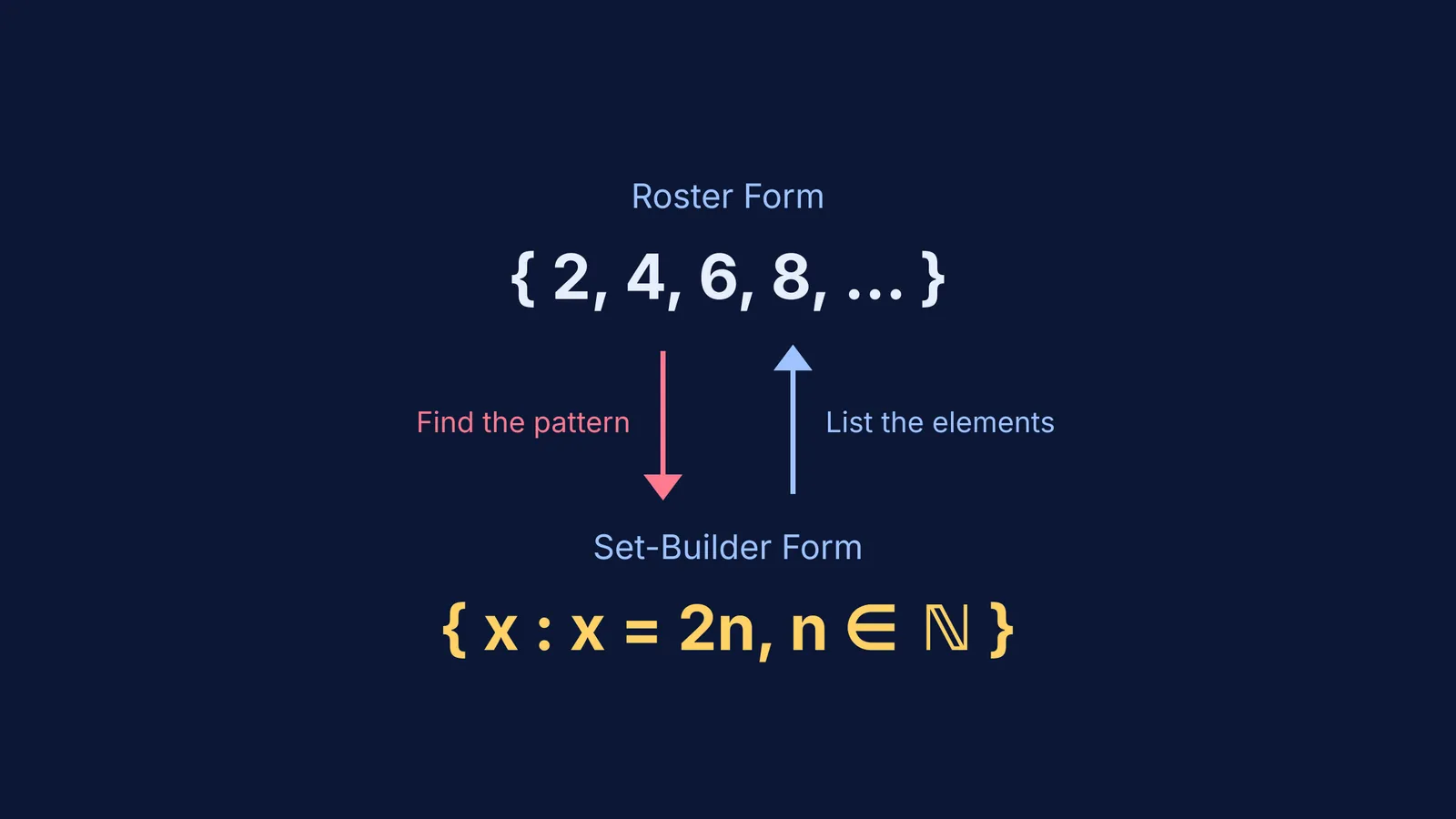
According to the National Council of Educational Research and Training (NCERT), a set is represented in roster form by listing its elements, and in set-builder form by stating a single common property they possess.
What is roster form and set-builder form?
In roster form (also known as tabular form), you write out the members of the set explicitly, separate them by commas, and enclose them in curly braces. For example, the set of the first three natural numbers is simply {1, 2, 3}. When writing in this format, order does not matter, and elements are generally not repeated. If you want to describe the set of letters in the word "SCHOOL," the roster form is {S, C, H, O, L}.
In set-builder form, instead of listing the individual elements, you write a mathematical rule that defines them. The set of the first three natural numbers would be written as { x : x ∈ ℕ and x < 4 }. The colon (:) or vertical bar (|) means "such that." The rule guarantees that only the numbers 1, 2, and 3 belong to the set, and no other number can slip in. When you need to understand counting with 2ⁿ for a power set or exploring combinations, knowing how to interpret these algebraic rules is essential.
How do you convert roster form to set-builder form?
When you look at a set in roster form, your job is to play detective. You need to spot the pattern connecting the numbers and then translate that pattern into an algebraic property.
Here is a step-by-step framework to handle this conversion:
Identify the base set: Are the numbers natural numbers (ℕ), integers (ℤ), or rational numbers (ℚ)?
Spot the mathematical rule: Look at how each number grows. Are they squares, multiples of a certain number, or fractions with a clear top-and-bottom relationship?
Define the limits: Where does the pattern begin and end?
Let's apply this framework to a standard Class 11 example: A = {1, 4, 9, 16, 25}
Base set: We are dealing with natural numbers.
Rule: Notice that 1 = 1², 4 = 2², 9 = 3², and so on. The pattern is simply the square of a natural number, which we can write as n².
Limits: The numbers go from 1² up to 5². Therefore, the limit is n ≤ 5.
Now, put it all together in set-builder form: A = { x : x = n², n ∈ ℕ and 1 ≤ n ≤ 5 }
If you are stuck on harder patterns during a study session, the Fermi Problem Library has worked problems with a step-by-step solver that explains the reasoning rather than printing an answer.
How do you convert set-builder form to roster form?
Converting from set-builder to roster form is usually a much more straightforward task. You simply read the algebraic rule, plug in the allowed values, and list out the final results.
Take the set B = { x : x is an integer and −3 < x < 4 }.
Look at the condition: x must be an integer (ℤ).
Check the boundaries: It must be strictly greater than −3 and strictly less than 4.
List the matching numbers: −2, −1, 0, 1, 2, 3.
So, the roster form is B = {−2, −1, 0, 1, 2, 3}.
Let's try a rational number example where the rule requires a calculation: C = { x : x = n / (n + 1), n ∈ ℕ and 1 ≤ n ≤ 4 }. Substitute the natural numbers n = 1, 2, 3, and 4 into the given formula n / (n + 1):
When n = 1, x = 1 / (1 + 1) = 1/2
When n = 2, x = 2 / (2 + 1) = 2/3
When n = 3, x = 3 / (3 + 1) = 3/4
When n = 4, x = 4 / (4 + 1) = 4/5
The roster form is C = {1/2, 2/3, 3/4, 4/5}. If these mathematical foundations feel shaky, the Fermi Concept Library has every concept in mathematics, each with its own lesson and its place in the map.
Why does the format matter?
For a small, finite set of numbers, roster form is quick, visual, and easy to read. However, when you deal with infinite sets—like the set of all even numbers, or real numbers falling between 0 and 1—listing them out completely is impossible. Set-builder form gives you the mathematical precision to describe massive, infinite collections neatly in a single line.
Both formats show up constantly in Class 11 and 12 mathematics, from finding domain and range to exploring probabilities and solving three-set Venn problems. Being comfortable translating between the two languages helps you move faster through algebra and calculus without stumbling over unfamiliar notation.


