

On this page
Linear inequalities look like regular equations, but instead of an equals sign, they use symbols like <, >, ≤, or ≥. While the steps to solve them are mostly the same, there is one rule that catches many students out.
A 2025 study found that 28% of seventh-grade students hold misconceptions about linear equations and inequalities, struggling with fundamental concepts like variable degree, coefficients and inequality notation. A common mistake students make is forgetting the rules when negative numbers are involved, or when it is time to graph the result.
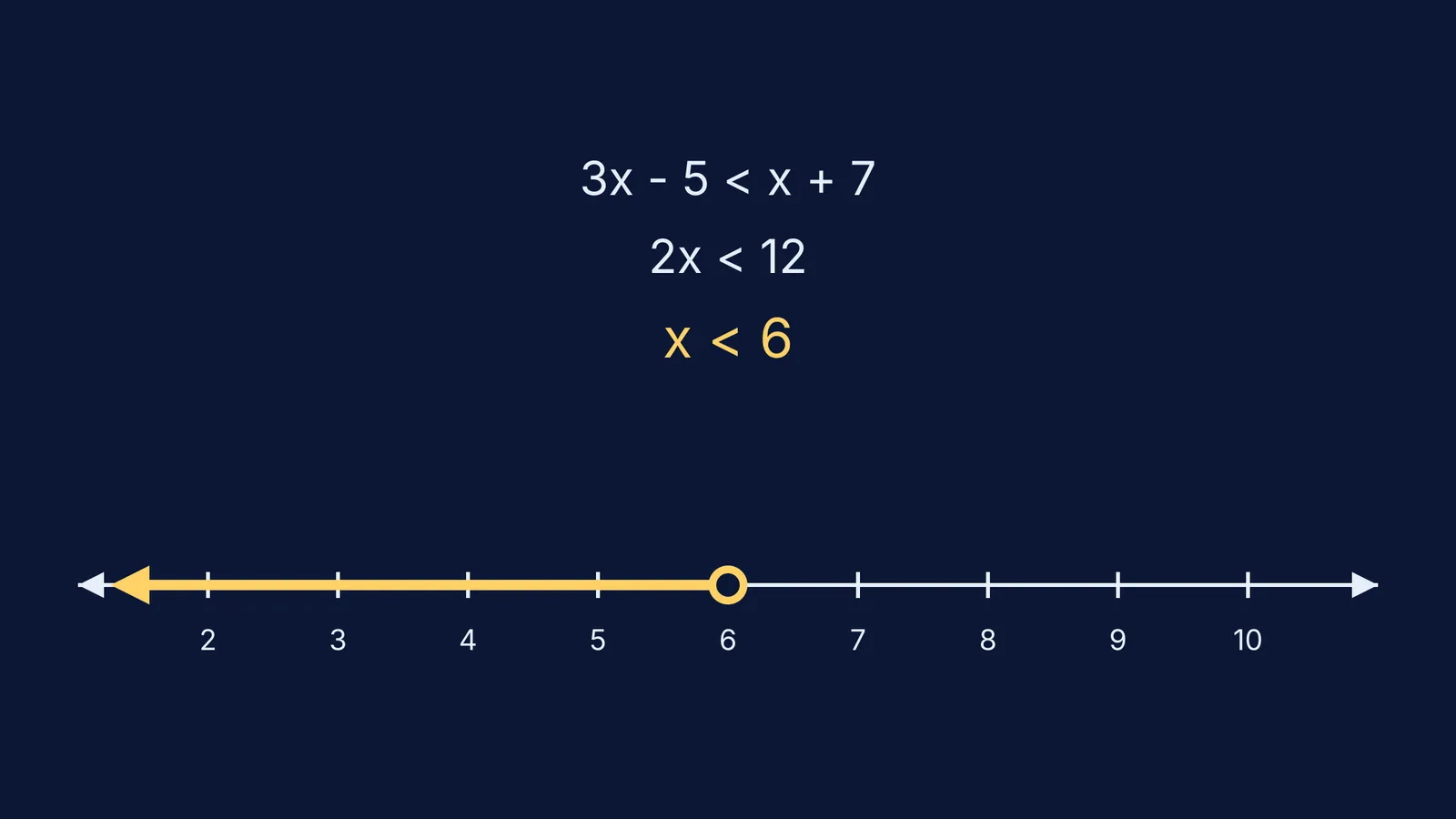
Here is how to solve linear inequalities without making those mistakes, using the example 3x - 5 < x + 7.
How to solve 3x - 5 < x + 7?
You solve a linear inequality by collecting all the variables (the x terms) on one side and all the numbers on the other side.
First, subtract x from both sides to group the variables on the left: 3x - x - 5 < 7 2x - 5 < 7
Next, add 5 to both sides to group the numbers on the right: 2x < 7 + 5 2x < 12
Finally, divide both sides by 2 to find x: x < 6
The solution tells us that x can be any number less than 6.
Why must you flip the sign when dividing by a negative number?
In the example above, we divided by a positive 2, so the inequality sign stayed exactly as it was. However, the most important rule in this topic is that when multiplying or dividing both sides of an inequality by a negative number, the inequality sign must be reversed).
You can see why this is true with a simple example: 4 > 2. If you multiply both sides by -1, you get -4 and -2. Since -4 is smaller than -2, the statement only remains true if you flip the sign: -4 < -2.
To see how this works in algebra, let us solve 3x - 5 < x + 7 again, but this time we will move the variables to the right side:
First, subtract 3x from both sides: -5 < x - 3x + 7 -5 < -2x + 7
Next, subtract 7 from both sides: -5 - 7 < -2x -12 < -2x
Now, you have to divide both sides by -2. Because you are dividing by a negative number, you must flip the < sign to a > sign: 6 > x
Reading this backwards gives you x < 6, which is exactly the same answer we found earlier. Forgetting to flip this sign is the most common reason students lose marks in these questions. This is closely related to understanding evaluating algebraic expressions with negative values and why a negative times a negative is positive.
How to show an inequality on a number line?
Once you have your solution, the next step is to draw it. A number line provides a visual way to show all the possible values that make the inequality true.
When graphing an inequality, you have to make two choices:
Open or closed dot? Use an open dot (○) for strict inequalities (< or >). This shows that the boundary number itself is not included in the solution. Use a closed, solid dot (●) for "less than or equal to" (≤) and "greater than or equal to" (≥) to show the number is included.
Which direction? Draw an arrow pointing to the left for "less than" (< or ≤), because numbers get smaller to the left. Draw an arrow pointing to the right for "greater than" (> or ≥).
For our solution of x < 6, you will draw a number line, place an open dot at 6, and draw a thick line with an arrow pointing to the left.
A step-by-step checklist
Before your next exam, use this checklist to make sure you have not missed anything:
Treat the inequality like an equal sign to collect like terms.
Stop and check: are you multiplying or dividing by a negative number? If yes, flip the sign immediately.
Choose the correct dot for your number line (open for < and >, closed for ≤ and ≥).
Draw the arrow in the correct direction.
If you want to practice applying these rules, the Fermi Concept Library contains interactive examples covering algebra and inequalities. When you work through problems, Fermi's AI tutor can help by checking each step of your working, catching sign errors before they become habits. You can also explore how these ideas apply in other areas, such as finding the first negative term of an arithmetic progression.


