

On this page
The fix for fractions in an equation is one move: multiply every term by the lowest common multiple (LCM) of the denominators, and the fractions disappear. Most lost marks then come from two slips: a minus sign in front of a fraction, and whole numbers left unmultiplied. Below: the method, two worked examples and a 30-second check that catches both.
Why do fractions in equations trip students up?
Fraction skill and algebra skill are linked. Robert Siegler and colleagues, writing in Psychological Science, analysed large, nationally representative longitudinal data sets from the United States and the United Kingdom. They found that primary-school knowledge of fractions and division uniquely predicted algebra knowledge in high school, five or six years later, even after controlling for other mathematical knowledge, general intellectual ability, working memory and family income and education.
The errors also follow patterns. Julie Booth and colleagues, in The Journal of Problem Solving, note that students hold many misconceptions as they move from arithmetic to algebraic thinking, and that these can hold back both performance and learning.
If adding fractions with different denominators still feels shaky, revise how to add unlike fractions using the LCM first.
How do you solve a linear equation with fractions?
Find the LCM of all the denominators in the equation.
Put brackets around every numerator with more than one term, such as (x − 3).
Multiply every term on both sides by the LCM, including whole numbers with no denominator.
Cancel each denominator, then expand, carrying the sign in front of each bracket to every term inside.
Collect the x terms on one side and the numbers on the other, then solve.
Substitute your answer into the original equation, not your simplified one.
Worked example: what happens to the minus sign?
Solve (3x − 1)/4 − (x − 3)/6 = (x + 3)/2.
The denominators are 4, 6 and 2, so the LCM is 12. Multiply each term by 12:
12 × (3x − 1)/4 becomes 3(3x − 1)
12 × (x − 3)/6 becomes 2(x − 3), with the minus sign still in front
12 × (x + 3)/2 becomes 6(x + 3)
So 3(3x − 1) − 2(x − 3) = 6(x + 3).
Expand: 9x − 3 − 2x + 6 = 6x + 18.
Simplify: 7x + 3 = 6x + 18, so x = 15.
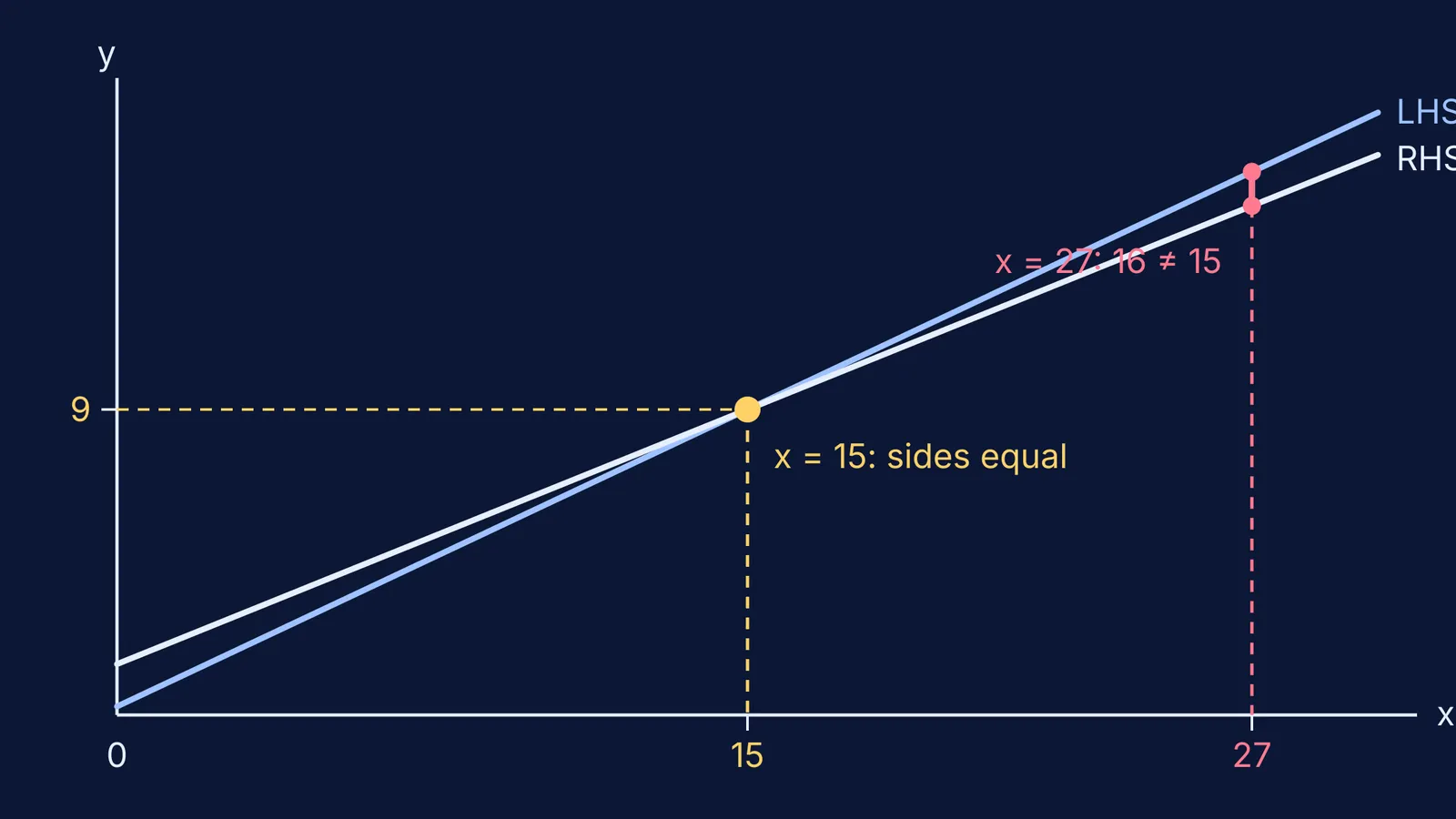
Now check by substitution. Left side: (45 − 1)/4 − (15 − 3)/6 = 11 − 2 = 9. Right side: (15 + 3)/2 = 9. Both sides match, so x = 15 is correct.
A student who writes −2x − 6 instead of −2x + 6 gets 7x − 9 = 6x + 18, so x = 27. Substitute it: the left side is (81 − 1)/4 − (27 − 3)/6 = 20 − 4 = 16, and the right side is (27 + 3)/2 = 15. The sides disagree, so the answer is wrong.
What if there is a whole number with no denominator?
Solve x/2 + 1 = x/3 + 3. The LCM of 2 and 3 is 6, and the 1 and the 3 must be multiplied by 6 too: 3x + 6 = 2x + 18, so x = 12. Check: 12/2 + 1 = 7 and 12/3 + 3 = 7.
If you multiply only the fractions, you get 3x + 1 = 2x + 3, so x = 2. Substituting gives 2/2 + 1 = 2 on the left but 2/3 + 3 = 11/3 on the right, so the check catches this slip as well.
Once the fractions are gone, our guides to linear equations in one variable for Class 8 and transposing terms when x is on both sides cover the rest.
How can you practise so the method sticks?
Solve five equations a day for a week, each ending with a written substitution check.
After each, ask: did I bracket every numerator and multiply every term, including whole numbers?
Practise spotting mistakes: change one sign in a solved example and find the error. A research project funded by the US Institute of Education Sciences describes "a growing body of research showing that students benefit from instruction that includes incorrect examples" (IES project page).
Parents can simply ask: "What did you multiply by, and does your answer work when you put it back?"
When an answer fails the check, the Fermi Problem Library has worked problems with a step-by-step solver that explains the reasoning rather than printing an answer, so you can compare each line with yours. If finding the LCM itself is the gap, the Fermi Concept Library gives each mathematics concept its own lesson.
Try one now: (x + 4)/5 − (x − 2)/3 = 2. The answer is x = −4; substitute it to see why it works.


