

On this page
When equations have variables on both sides, doing the same operation to both sides can quickly overload a student's working memory. A 2016 study by Bing Ngu and Huy Phan in *Educational Psychology Review* found that the "transposing" method—moving a term across the equals sign and changing its operation—reduces cognitive load by letting the student focus on one side at a time. This makes transposing much faster and less prone to arithmetic slips when collecting like terms.
Most of us learn linear equations in one variable using the "balance method". If you have x + 5 = 12, you subtract 5 from both sides to keep the scales level. It builds a beautiful foundation for understanding equality. But when equations grow, the balance method can become a mental trap.
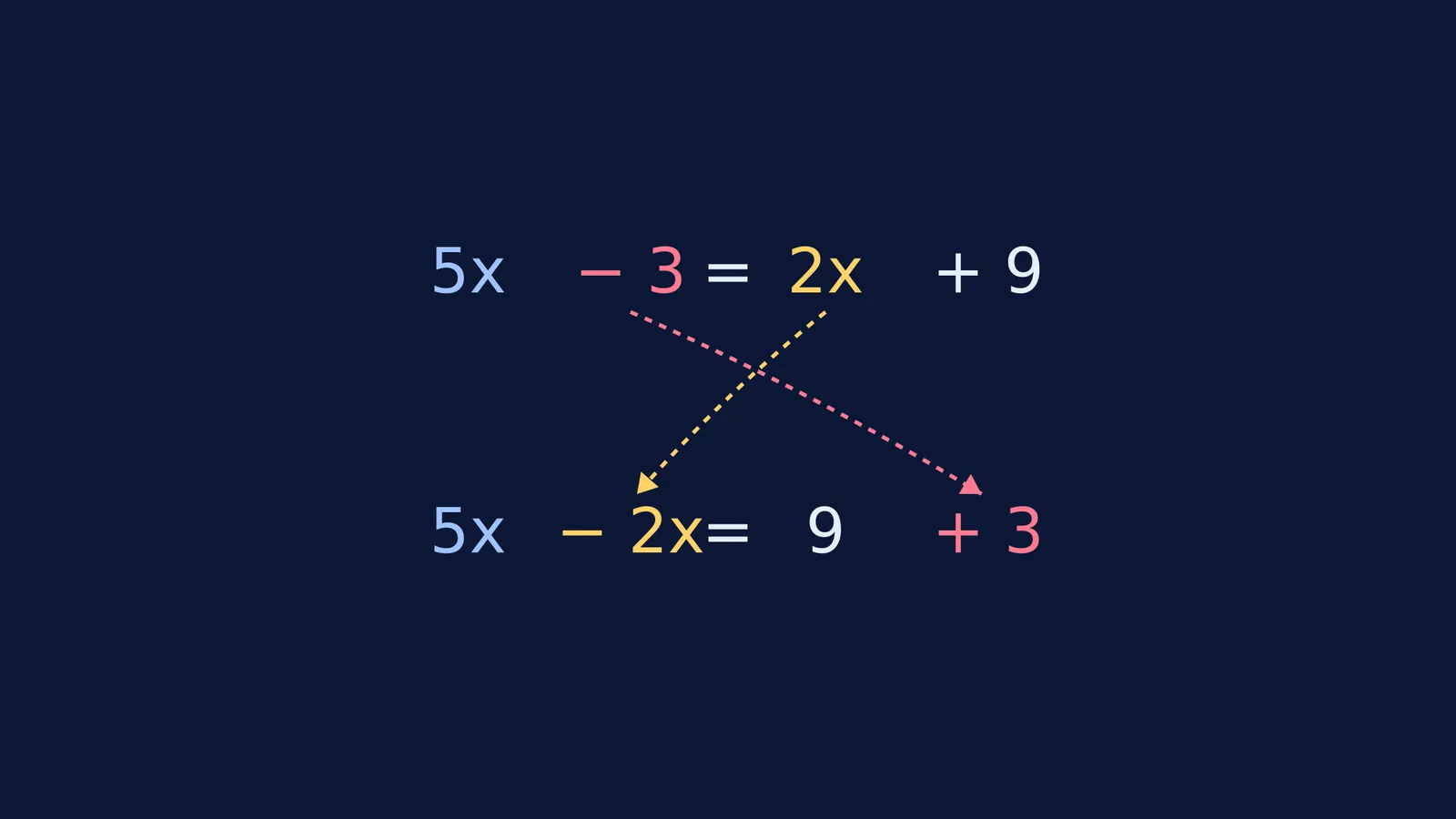
Take a classic algebra problem: 5x − 3 = 2x + 9.
If you use the balance method, you have to write −2x on both sides, then +3 on both sides. Because of its high "element interactivity", students have to hold multiple operations and signs in their working memory all at once. By performing the operation twice—once on the left and once on the right—students double the number of steps they must track in their heads. This extraneous load leaves less mental space to process the underlying algebra. The solution? Transposing.
How to transpose terms when x is on both sides?
Transposing means picking up a term, moving it across the equals sign, and flipping its operation. Addition becomes subtraction, and subtraction becomes addition. The golden rule is simple: change side, change sign.
Here is how to solve 5x − 3 = 2x + 9 by transposing terms.
Step 1: Move variables to one side Look at the 2x on the right. We want all our variables on the left so that we can combine them. Pick up the 2x and move it to the left side of the equals sign. Because it was positive, it becomes negative: 5x − 2x − 3 = 9
Step 2: Move constants to the other side Now look at the −3 on the left. We need the numbers on the opposite side of the variables. Pick it up and move it to the right. Because it was negative, it becomes a positive +3: 5x − 2x = 9 + 3
Step 3: Collect like terms Now that the x terms are grouped on the left and the numbers are grouped on the right, you can do the arithmetic on each side independently: 3x = 12
Step 4: Solve for x Finally, divide both sides by 3 to leave the x by itself. Here we are using the balance method for the final multiplication or division: x = 4
Why do you change the sign when transposing?
Transposing is not magic; it is just a shortcut for the balance method. When we move +3 and turn it into −3, we are actually subtracting 3 from both sides. We just skip writing the step that cancels it out on the original side. By removing that visual and mental clutter, we free up our working memory to focus entirely on the next step.
This efficiency is crucial as you move into higher mathematics. Whether you are dealing with quadratic word problems in Class 10 or plotting complex graphs, you need to be able to rearrange terms swiftly without burning mental energy on the intermediate arithmetic.
What if there are brackets or fractions?
Before you can transpose terms freely, they must be separate and unbound. If your equation contains brackets, expand them first. For example, if you have 3(x + 2) = 5x − 4, you must distribute the 3 to get 3x + 6 = 5x − 4. Once the brackets are gone, you can begin moving variables to one side and constants to the other.
If you have fractions, it is usually easiest to multiply the entire equation by the lowest common multiple of the denominators. This clears the fractions and leaves you with an equation that is much simpler to rearrange.
How do you check the root?
In algebra, the solution is called the root of the equation. You should never have to guess whether your root is correct. You can always check it by substituting it back into the very first line of the problem.
Let's check our root, x = 4: 5(4) − 3 = 2(4) + 9 20 − 3 = 8 + 9 17 = 17
Because the left side equals the right side, the root is correct. If the numbers did not match, it would mean a mistake was made during the transposition steps.
Where do things go wrong?
The two big traps when variables are on both sides are:
Forgetting to flip the sign. If you write 5x + 2x = 9 − 3, you will end up with the wrong root. Always scan the previous line to ensure a flipped sign accompanies every move.
Combining unlike terms. You cannot subtract 3 from 5x because they are different entities. Only combine variables with variables and constants with constants.
If you are practising and your root does not balance the equation, it can be hard to spot which term you failed to flip. This is where the Fermi Problem Library comes in handy: it features a step-by-step solver that explains the reasoning rather than printing an answer, so you can see exactly where a sign was dropped or an operation went wrong. If you want to review the underlying rules of equality, you can look them up in Fermi's Concept Library.
By treating the equals sign as a boundary where operations flip, you can tame even the messiest equations and keep your algebra error-free.


