On this page
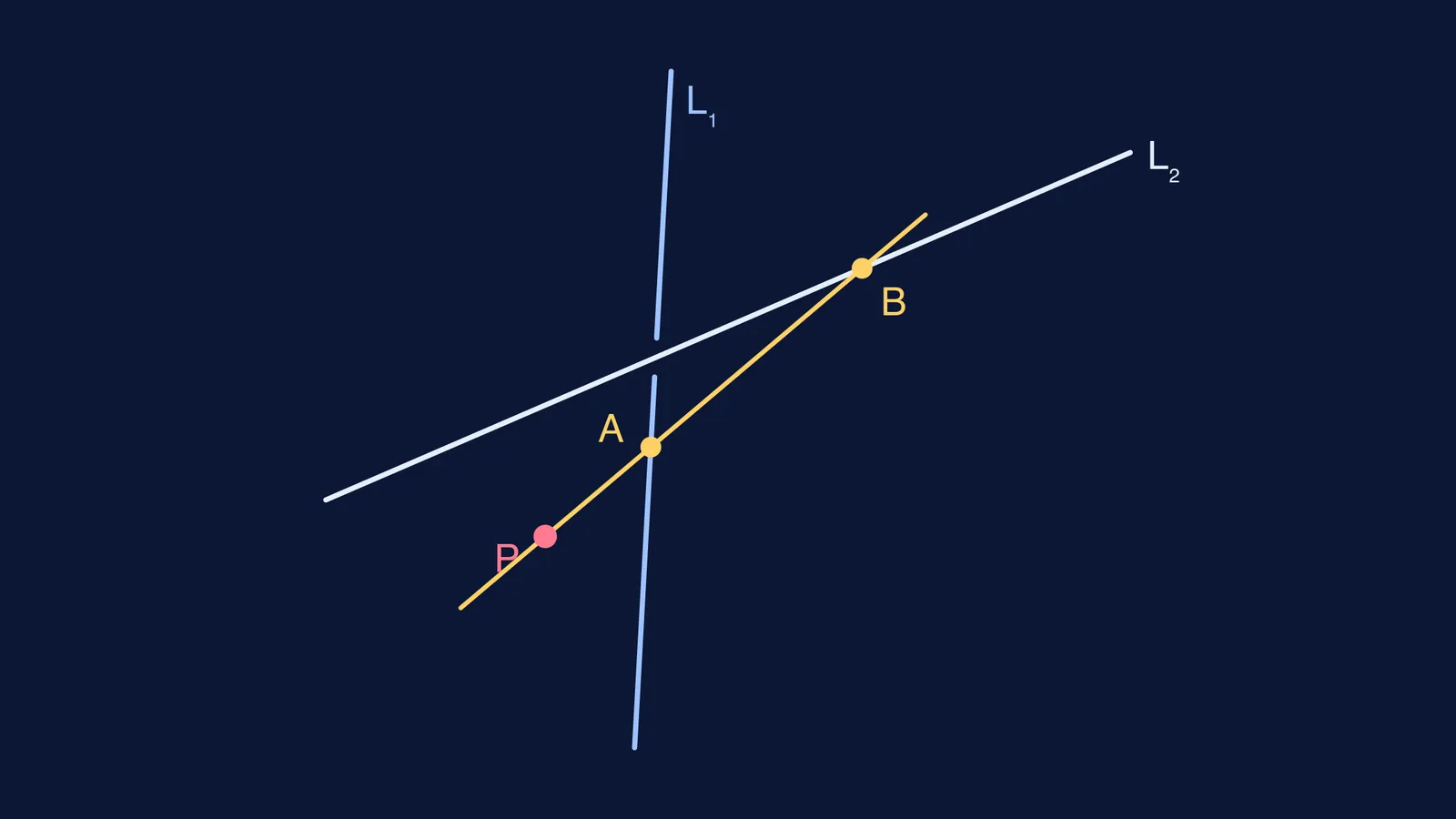
You are given a point P and two lines in space that never meet, and asked for the line through P that cuts both. This Class 12 and JEE favourite is easier than it looks: put a general point on each line, then make P and those points collinear.
What are skew lines, and why does such a line exist?
Skew lines are two lines in space that are not parallel and do not intersect, as OpenStax Calculus Volume 3 defines them. Two lines are skew exactly when they are not coplanar, as the Wikipedia article on skew lines explains.
A line meeting both is called a transversal. It must lie in the plane through P containing the first line and in the plane through P containing the second, so it is where those planes cross.
How do you find the line through a point that meets two lines in 3D?
Write each line in parametric form. The line through (x₀, y₀, z₀) parallel to ⟨a, b, c⟩ is x = x₀ + ta, y = y₀ + tb, z = z₀ + tc (OpenStax Calculus Volume 3). If that form is rusty, see our guide to the line through two points, r = a + λ(b − a). Then:
Write a general point A on the first line with parameter s, and B on the second with a different parameter t.
Form the vectors PA and PB.
Impose collinearity: PA = λPB, three equations in s, t and λ.
Divide two equations to remove λ and solve for both parameters.
Write the line through P with direction PA, and check that A and B satisfy it.
Worked example: the line through P(0, −2, −1)
Find the line through P(0, −2, −1) that meets L₁: (x + 1)/2 = (y + 1)/1 = (z − 2)/(−1) and L₂: (x − 1)/1 = (y + 2)/3 = (z − 1)/2.
Step 0: confirm the lines are skew. The directions d₁ = (2, 1, −1) and d₂ = (1, 3, 2) are not proportional, and d₁ × d₂ = (5, −5, 5). The vector from (−1, −1, 2) on L₁ to (1, −2, 1) on L₂ is (2, −1, −1); its dot product with (5, −5, 5) is 10, not zero, so the lines are skew.
Step 1: general points. A = (−1 + 2s, −1 + s, 2 − s) and B = (1 + t, −2 + 3t, 1 + 2t).
Step 2: vectors from P. PA = (2s − 1, s + 1, 3 − s) and PB = (1 + t, 3t, 2 + 2t).
Step 3: collinearity. PA = λPB gives:
2s − 1 = λ(1 + t)
s + 1 = 3λt
3 − s = 2λ(1 + t)
Step 4: solve. Divide the first equation by the third: (2s − 1)/(3 − s) = 1/2, so 4s − 2 = 3 − s and s = 1. The division is safe: t = −1 would need 2s − 1 = 0 and 3 − s = 0 at once. With s = 1, the first two equations read 1 = λ(1 + t) and 2 = 3λt. Dividing, 2 = 3t/(1 + t), so t = 2 and λ = 1/3.
Step 5: write and check the line. A = (1, 0, 1), B = (3, 4, 5) and PA = (1, 2, 2). The required line is x/1 = (y + 2)/2 = (z + 1)/2. A gives 1 = 1 = 1 and B gives 3 = 3 = 3. Since λ = 1/3, the order along the line is P, then A, then B.
How can you check the answer with planes?
The plane through P containing L₁ has normal PQ₁ × d₁, where Q₁ = (−1, −1, 2): (−1, 1, 3) × (2, 1, −1) = (−4, 5, −3). The plane through P containing L₂ has normal PQ₂ × d₂, where Q₂ = (1, −2, 1): (1, 0, 2) × (1, 3, 2) = (−6, 0, 3). Their line of intersection runs along n₁ × n₂ = (15, 30, 30) = 15(1, 2, 2), the same direction. For a refresher, see the plane containing a line and a point.
When does no such line exist?
If P lies on the plane through L₁ that is parallel to L₂, the two planes above meet in a line parallel to L₂, which never reaches it. If P lies on L₁ itself, every line joining P to a point of L₂ works, so there are infinitely many answers.
If you stall at step 4, the Fermi Problem Library has a step-by-step solver that explains the reasoning. For direction ratios and cross products, try the Fermi Concept Library.
Try it yourself: redo the example with P(2, 2, 3). You should get the same line, with λ = −1, because this P sits exactly between A and B.