

On this page
You are asked for the limit of (x² − 5x + 6)/(x² − 9) as x tends to 3. Plug in first, every time. What you get back tells you whether you are done or what to do next.
When does direct substitution work for a limit?
NCERT's Class 11 Mathematics chapter "Limits and Derivatives" shows, in section 12.3.2, that for any polynomial f, the limit of f(x) as x tends to a equals f(a) (NCERT Class 11 Mathematics, Chapter 12). So the limit of x³ − x² + 1 as x tends to 1 is just 1 − 1 + 1 = 1, one of the chapter's own examples.
The same section extends this to rational functions, which are one polynomial divided by another: the limit of g(x)/h(x) as x tends to a equals g(a)/h(a), provided h(a) is not zero. OpenStax states the same result as Theorem 2.6, "Limits of Polynomial and Rational Functions", and its examples call the method direct substitution (OpenStax Calculus Volume 1, section 2.3).
Why does plugging in work?
Substitution is not a trick someone made up. It follows from the algebra of limits. NCERT's Theorem 1 says that if the limits of f(x) and g(x) both exist as x tends to a, then the limit of a sum, difference or product is the sum, difference or product of the limits, and the limit of a quotient is the quotient of the limits whenever the denominator's limit is not zero (NCERT, section 12.3.1). A constant multiplier can also be taken outside the limit.
Start from the limit of x being a. The product rule gives xⁿ tending to aⁿ, and the sum and constant-multiple rules build any polynomial term by term. The quotient rule covers rational functions, but only while the bottom does not tend to 0.
What do you do when you get 0/0?
0/0 is not an answer, and it does not mean the limit fails to exist. It means the quotient rule cannot be used yet. NCERT treats the two cases separately: if h(a) = 0 but g(a) is not zero, the limit does not exist; if both g(a) = 0 and h(a) = 0, then (x − a) is a factor of both polynomials, and you can cancel it (NCERT, section 12.3.2).
How do you find the limit of (x² − 5x + 6)/(x² − 9) as x tends to 3?
Substitute x = 3. Top: 9 − 15 + 6 = 0. Bottom: 9 − 9 = 0. The form is 0/0.
Because 3 is a root of both, (x − 3) is a factor of both: x² − 5x + 6 = (x − 2)(x − 3) and x² − 9 = (x − 3)(x + 3).
Cancel (x − 3), which is allowed because x is never equal to 3 in the limit.
Substitute again into (x − 2)/(x + 3): (3 − 2)/(3 + 3) = 1/6.
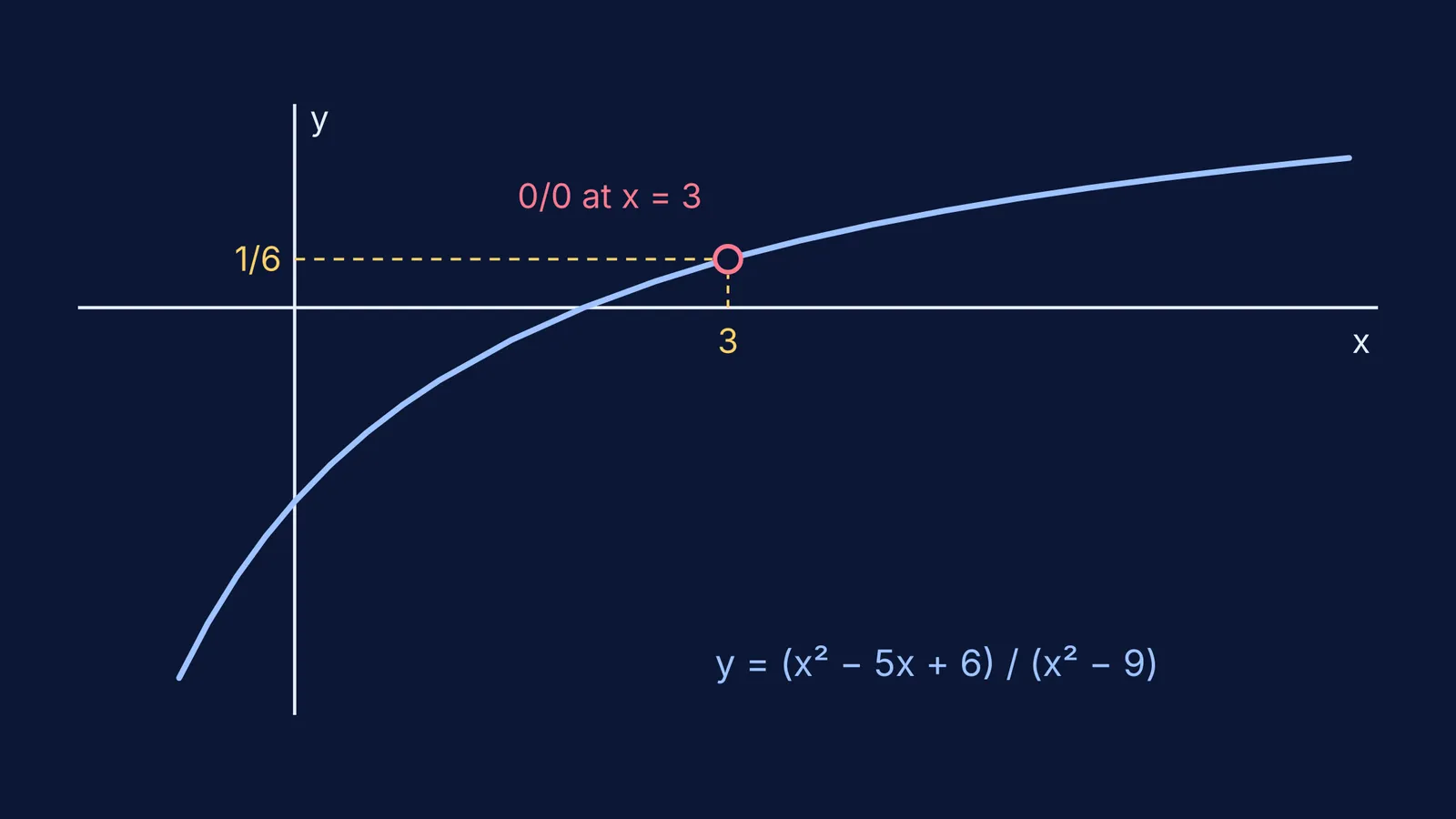
The graph at the top of this post is this function. It is the curve y = (x − 2)/(x + 3) with one point missing at x = 3. The limit is the height of that hole, 1/6, even though the function has no value there.
Always substitute again after cancelling. In NCERT's Example 2(ii), (x³ − 4x² + 4x)/(x² − 4) as x tends to 2 becomes x(x − 2)/(x + 2) after one cancellation, giving 0/4 = 0. The flipped fraction in Example 2(iii) ends in 4/0, which NCERT marks as not defined (NCERT, Example 2).
If the factoring itself is where you get stuck, our guide to solving 0/0 limits by factorisation has more practice, and the Fermi Problem Library has worked problems with a step-by-step solver that explains the reasoning rather than printing an answer, so you can see why each factor cancels.
What is a quick routine for any rational limit?
Use this before you write a single line of factoring:
Substitute x = a into the top and the bottom separately.
Number over a non-zero number: that number is the limit. Stop.
Non-zero number over 0: the limit does not exist. If the question asks, check the left-hand and right-hand behaviour.
0 over 0: factor (x − a) out of both, using synthetic division for cubics, cancel it, and go back to step 1.
Three slips to watch for:
Striking out x² from x² − 9 and x² − 5x + 6. See why you cancel factors, not terms.
Writing 0/0 as the final answer. It is the start of the work.
Dropping "lim" from the middle lines. Until you substitute, every line is about the limit.
For that case, see our explainer on limits of rational functions at infinity. If the factor theorem itself feels shaky, the Fermi Concept Library has a lesson for every concept in mathematics, so you can go back one step first.


