

On this page
Put a small lamp at the bottom of a pool at night and look down from above. The surface does not glow everywhere. You see a bright circle right above the lamp and dark water around it. Physics textbooks and exams often turn this into a short numerical, and the same geometry tells you what a fish sees and how big a disc hides the lamp.
Why does a source under water light only a circle?
Light going from water into air bends away from the normal, following Snell's law, n1 sin θ1 = n2 sin θ2 (OpenStax College Physics 2e, the law of refraction). The refractive index of fresh water is 1.333 and that of air is 1.000293, according to the same OpenStax table, so taking air as 1 is fine.
The critical angle is the angle of incidence that gives an angle of refraction of 90°, and for a ray going from water to air it is 48.6° (OpenStax, total internal reflection). Any ray that meets the surface at a larger angle is totally internally reflected back into the water.
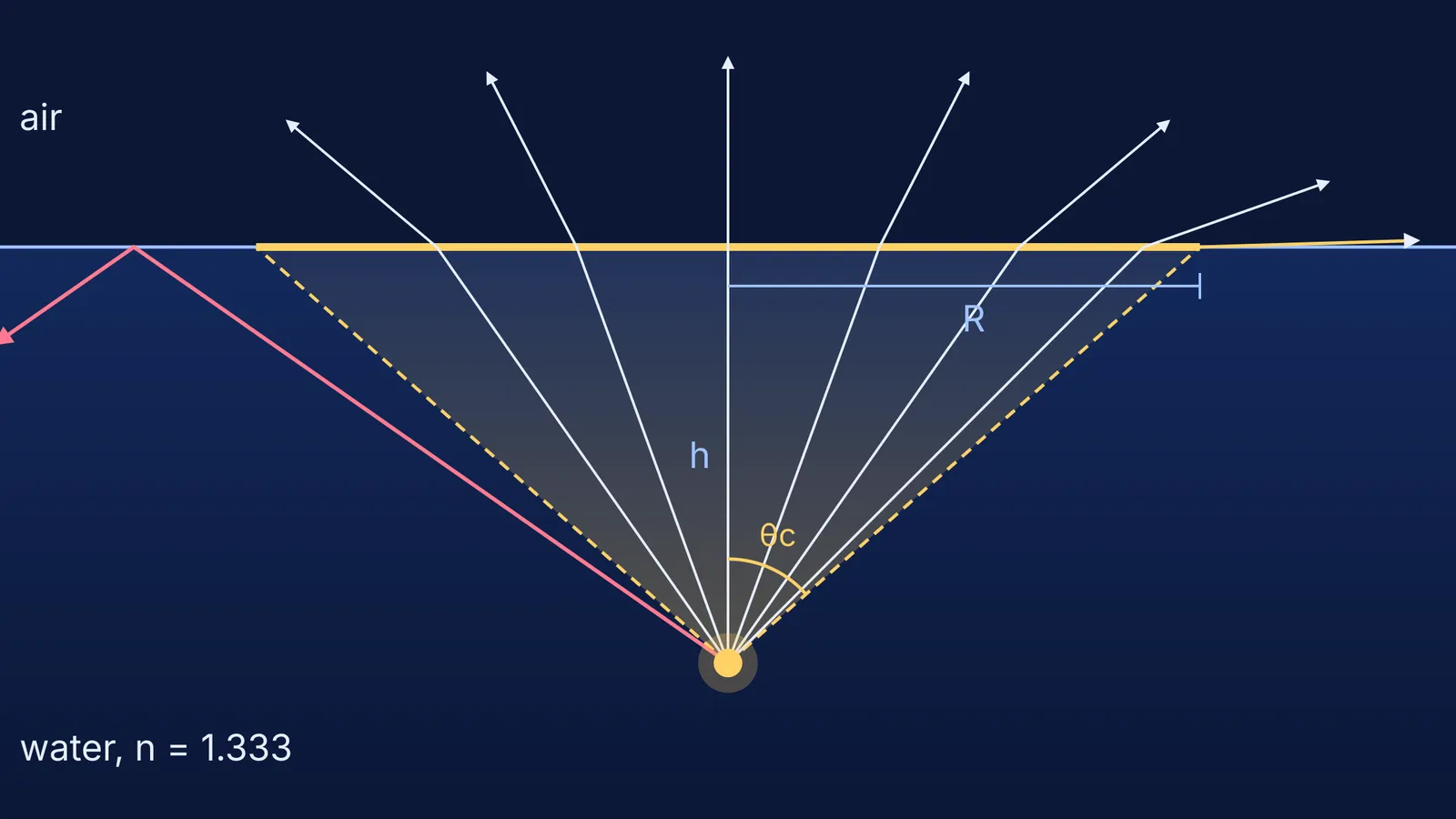
So the only light that escapes travels inside a cone with a half-angle of 48.6° around the vertical through the lamp. Where that cone meets the surface, you get the bright circle.
What is the formula for the radius of the circle of light?
Call the depth of the source h and the radius of the circle R. The edge ray leaves the source at the critical angle θc, measured from the vertical, so the right triangle gives tan θc = R/h.
Since sin θc = 1/n (OpenStax), cos θc = √(n² − 1)/n, and the radius is:
R = h tan θc = h/√(n² − 1)
Examiners usually take n = 4/3 for water. Then n² − 1 = 7/9 and R = 3h/√7, which is about 1.13h. With n = 1.333 you get the same 1.13h.
Worked example. A bulb sits 2.0 m below the surface of a pool. Find the radius and the area of the bright circle. Take n = 4/3.
sin θc = 1/n = 3/4, so θc is about 48.6°.
R = h/√(n² − 1) = 2.0 × 3/√7, which is about 2.27 m.
R² = 4 × 9/7 = 36/7, about 5.14 m², so the area πR² is about 16.2 m².
At 4.0 m down, R doubles to about 4.54 m and the area grows four times: radius scales with depth, area with depth squared.
What does a fish see when it looks up?
Run the rays backwards. Light from the whole sky, from straight overhead down to the horizon, reaches the fish only through that same cone. The optics outreach team at the University of Arizona describes this Snell's window as underwater vision being reduced to a 97 degree cone of visibility (Wyant College of Optical Sciences), which is about twice the 48.6° critical angle.
Refraction squeezes a 180° view above the water into about 97° below it, much like a fisheye lens, and outside the window the surface looks dark or shows a reflection of things under the water (Snell's window, Wikipedia). So a fish at depth d sees the entire outside world through a circle of radius d/√(n² − 1) directly above it.
What is the smallest disc that hides the source?
To stop any light escaping, you must cover the whole bright patch. The smallest opaque disc floating on the surface, centred above a point source at depth h, has radius h/√(n² − 1). Any smaller, and rays near the critical angle slip out past its rim.
Two variations show up in tests:
A source of finite size. If the source is a flat glowing disc of radius r at depth h, each point on it has its own circle, so the covering disc needs radius r + h/√(n² − 1).
A rising source. If the source moves up at speed v, the radius changes at dR/dt = v/√(n² − 1), so for water the circle shrinks at about 1.13v.
These are short questions, and a common slip is measuring the angle from the surface instead of from the normal. If you want to see exactly where your own working goes wrong, the Fermi Problem Library has worked problems with a step-by-step solver that explains the reasoning rather than printing an answer.
Where else does the critical angle show up?
The same idea keeps light trapped inside a glass strand, which you can test in our optical fibre simulation on when light stays trapped. It also explains how a total reflecting prism turns light by 90° and 180°. Refraction at the same air-water surface is why a swimming pool looks shallower than it really is.
If total internal reflection itself still feels shaky, start with its lesson in the Fermi Concept Library, which covers every concept in physics, chemistry, biology, mathematics and computing.


