

On this page
Life in the Deserts is Chapter 7 of Our Environment, NCERT's Class 7 geography book. It compares two places: the Sahara, a hot desert, and Ladakh, a cold desert (NCERT, Chapter 7 PDF). NCERT has also brought out a new Class 7 social science book, Exploring Society: India and Beyond (NCERT CIET), so check which book your school uses.
What is a desert, according to NCERT?
NCERT defines a desert as an arid region with extremely high or low temperatures and scarce vegetation (NCERT, Chapter 7). Its three features are low rainfall, scanty vegetation and extreme temperatures. Sand is not one of them. Temperature divides deserts into hot and cold.
How do the Sahara and Ladakh compare?
Learn the chapter as five rows: location, climate, plants, animals, people. Every fact below is from the NCERT chapter.
Location:
Sahara: a large part of North Africa, touching eleven countries, with an area of around 8.54 million sq km.
Ladakh: in the Great Himalayas, enclosed by the Karakoram Range and the Zanskar mountains, from about 3,000 m at Kargil to more than 8,000 m in the Karakoram.
Climate:
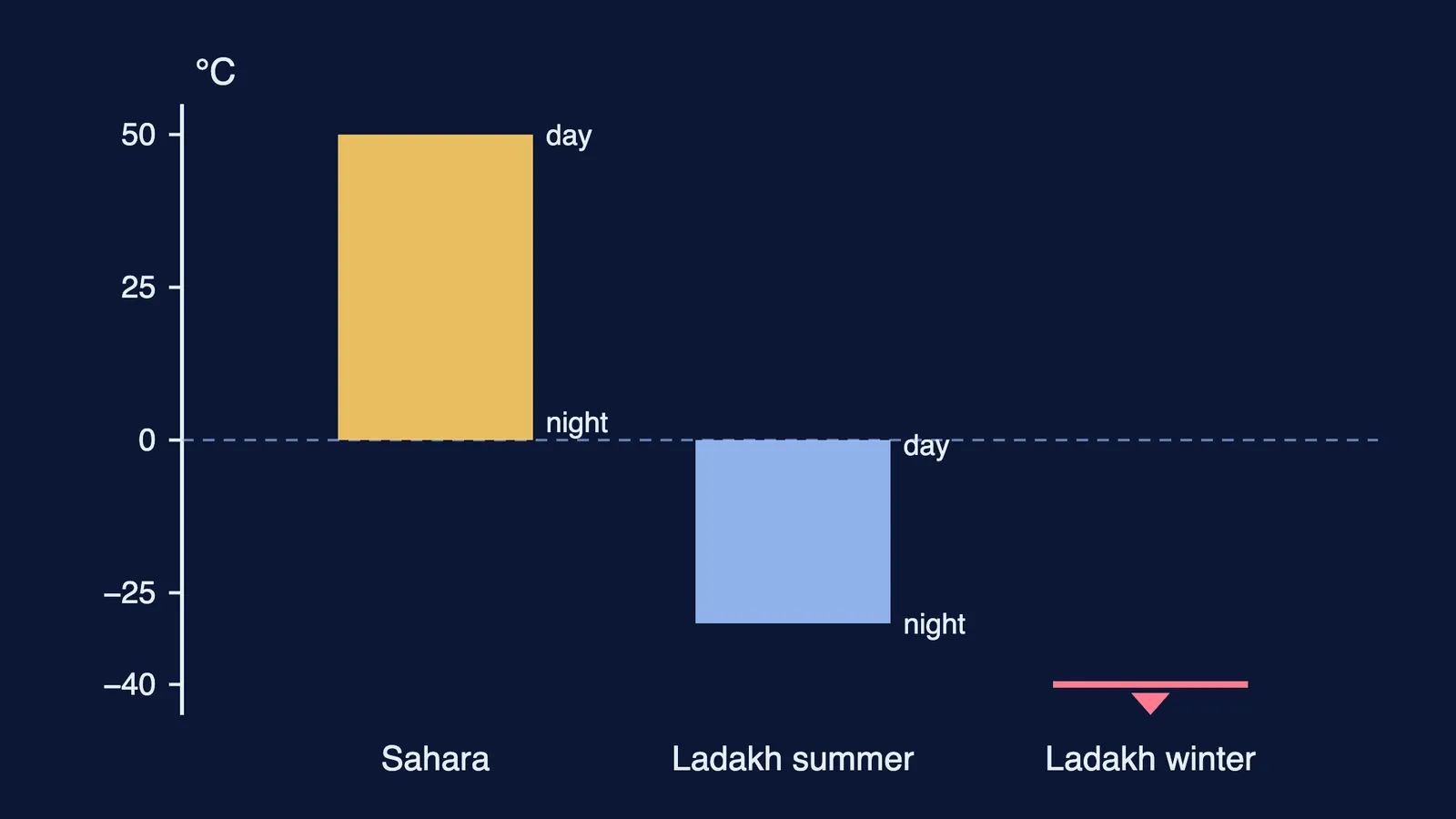
Sahara: days can reach 50°C and nights can fall close to 0°C, under a cloudless sky with a short rainy season.
Ladakh: summer days just above 0°C, nights well below −30°C, and winters that can stay below −40°C for most of the time.
Plants:
Sahara: cactus, date palms and acacia, with oases where date palms grow around water.
Ladakh: scanty patches of grass and shrubs, willows and poplars in the valleys, and apple, apricot and walnut trees that bloom in summer.
Animals:
Sahara: camels, hyenas, jackals, foxes, scorpions, snakes and lizards.
Ladakh: wild goats, wild sheep, yaks and special kinds of dogs, plus birds such as the Tibetan snowcock, redstarts and hoopoes.
People:
Sahara: Bedouin and Tuareg nomads herd goats, sheep, camels and horses and wear heavy robes against dust storms and hot winds. Oasis and Nile valley farmers grow date palms, rice, wheat, barley and beans. Oil has been found in Algeria, Libya and Egypt.
Ladakh: people are either Buddhists or Muslims, with gompas (monasteries) such as Hemis and Thiksey. They grow barley, potatoes, peas, beans and turnips in summer, and tourism is a major activity.
For how these plants and animals survive, read our guides to xerophytic adaptations in desert plants and how camels, snakes and desert rats survive heat.
Why is Ladakh a desert if it is so cold?
A desert is defined by dryness, not heat. Ladakh lies in the rain shadow of the Himalayas, so it gets as little as 10 cm of rain a year (NCERT, Chapter 7). The air is so thin that the sun feels intense; NCERT says sitting in the sun with your feet in the shade can cause sunstroke and frostbite at once.
The Sahara's cold nights come from clear skies: with no clouds, the day's heat escapes after sunset. Our explainer on why deserts are hot by day and cold at night walks through the physics. If heat and radiation still feel fuzzy, the Fermi Concept Library has a lesson for every concept in physics, each with its place in the map.
Is the 57.7°C Sahara record in the textbook still correct?
A "Do you know?" box in the chapter says Al Azizia in Libya recorded 57.7°C in 1922 (NCERT, Chapter 7). That reading is no longer the world record. In 2012 an international team of meteorologists, investigating for the World Meteorological Organization, concluded it was probably inaccurate; the most likely cause was a new, inexperienced observer misreading an unsuitable replacement instrument (Arizona State University). The official record is now 56.7°C, measured on 10 July 1913 at Greenland Ranch in Death Valley, USA.
How do you write a 3-mark answer on this chapter?
Take NCERT's own exercise question: "What are the climatic conditions of the Ladakh desert?" Make three separate points, each with a fact from the NCERT chapter:
Ladakh is a cold, dry desert at high altitude, from about 3,000 m to over 8,000 m.
Summer days are just above 0°C and nights fall well below −30°C; in winter temperatures may stay below −40°C.
It lies in the rain shadow of the Himalayas, so rainfall can be as low as 10 cm a year.
The chapter also reminds you that India covers about 3.28 million sq km, against the Sahara's 8.54 million sq km. Since 8.54 ÷ 3.28 ≈ 2.6, the Sahara is roughly two and a half times the size of India.
A 20-minute revision plan:
From memory, write the five rows for both deserts in 5 minutes.
Check them against the book and mark gaps in another colour.
On outline maps, mark the Sahara and four nearby countries, then the Karakoram, Zanskar, Ladakh and Zoji La.
Answer the exercise questions out loud, then write two.
If you are not sure where to start in a wider science revision, Fermi's AI tutor can work out what you already know and build a plan for the session.


